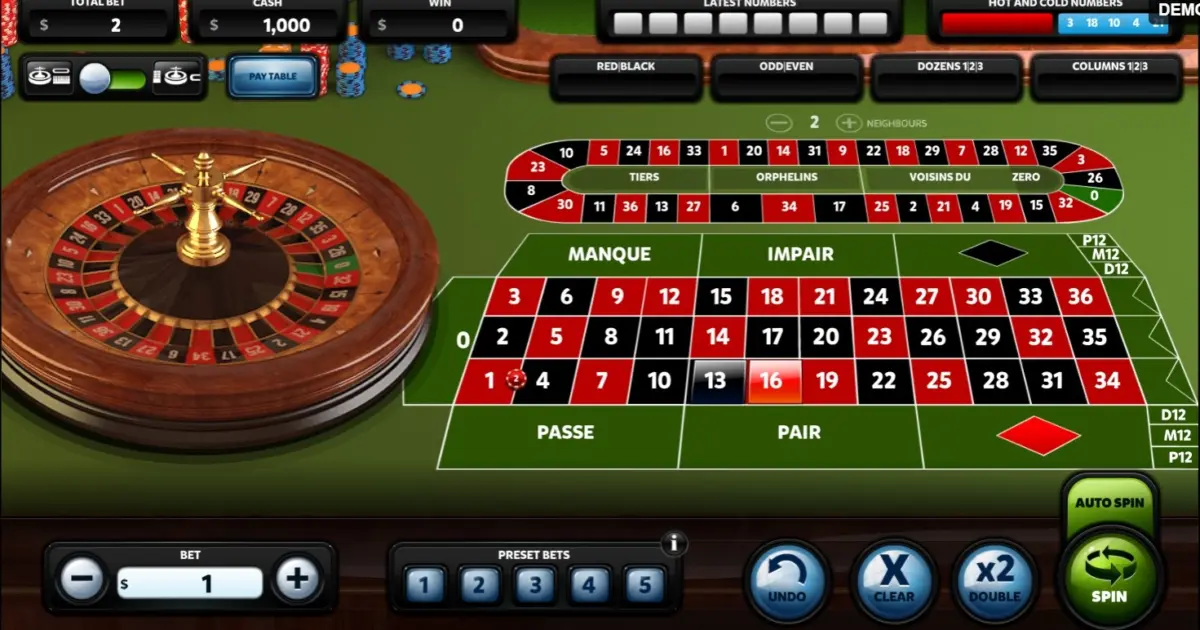
If you want the lowest house edge available in standard roulette, a French wheel is where you look, and french roulette (red rake) carries a published RTP of 97.3%. That figure lines up with a single-zero wheel, and the name points to French rules — meaning La Partage or En Prison on even-money bets. What FACTS does not confirm is which of those two rules this table actually applies, or whether it applies at all, so read the in-game rules screen before you stake money.
Is French Roulette (Red Rake) worth your spins?
The 97.3% RTP is the number that matters, and it sits just above the 96.97% average across the tables in our database. It is also slightly below Red Rake Gaming’s own average of 97.41% across its roulette titles, which tells you this is a solid mid-pack figure rather than a standout one.
Here is the important nuance. A 97.3% RTP on a single-zero wheel is exactly what you would expect from the standard 2.70% house edge applied to every bet. If this table also runs La Partage, your even-money bets — red/black, odd/even, high/low — face a materially better edge of around 1.35%, while inside bets stay at 2.70%. That means the headline RTP may understate what you actually face on the outside bets and describe precisely what you face on the inside ones.
The table’s popularity is low: it sits at rank 218 in our list, in the bottom 3% by traffic. That is a signal about visibility, not quality. A French wheel with a genuine La Partage rule is mathematically better for even-money betting than the European tables that get far more clicks. If you are here for the maths rather than the crowd, low traffic is irrelevant.
Red Rake Gaming and this wheel
Red Rake Gaming has four roulette tables in our database, which makes this a small, focused range rather than a sprawling one. Their average RTP across those four is 97.41%, so the studio is broadly competitive on the numbers.
The direct comparison is European Roulette (Red Rake), which lists the same 97.3% RTP. On paper they are identical. The difference, if the French table applies La Partage, is in how the zero is handled on even-money bets — and that difference is worth more to a red/black bettor than any cosmetic feature. Compare the two rules screens side by side before you pick one.
The studio’s highest listed figure belongs to American Roulette (Red Rake) at 97.74%, which is unusual, because a double-zero wheel normally means a 5.26% house edge and an RTP nearer 94.74%. FACTS gives the number but not the paytable behind it, so treat that table as one to inspect carefully rather than assume. There is also VIP Roulette (Red Rake) at 97.3%, likely aimed at higher stakes, though FACTS does not list its table limits.
FACTS does not tell us whether this table includes a racetrack for call bets like Voisins du Zéro or Tiers du Cylindre. French wheels usually do, and their absence would be a genuine omission for anyone who bets by wheel sector, so check the interface in demo mode.
House edge: 2.70%, 5.26% or 1.35%?
Three numbers cover almost all of roulette, and knowing which one applies to you is the single most valuable thing on this page.
2.70% is the single-zero (European) figure. The wheel has 37 pockets. A straight-up number pays 35:1 when the true odds are 36:1, and that one-pocket gap is the entire house edge. It applies uniformly to every standard bet on the layout.
5.26% is the double-zero (American) figure. Adding a 38th pocket nearly doubles the cost of play, and the five-number basket bet on that layout is worse still at 7.89%. There is no situation in which a double-zero wheel is the better choice when a single-zero wheel is available.
1.35% is the French figure, and it only applies to even-money bets. Under La Partage, when zero lands you get half your even-money stake back. Under En Prison, the bet is held for one more spin instead. Either mechanism halves the effective cost of red/black, odd/even and high/low. It does nothing for straight-ups, splits, corners or dozens — those remain at 2.70%.
The name of this table points to that third case, and the 97.3% RTP is consistent with a single-zero wheel. But a name is a hint, not a rule. Some tables labelled French run standard European rules with a French-styled layout. Open the rules screen and look for the words La Partage, En Prison, or a stated half-back on zero before you assume you have the 1.35% bet available.
Bet types, payouts and true odds
These figures assume a 37-pocket single-zero wheel, which is what the title and the 97.3% RTP indicate. Confirm the pocket count in-game.
| Bet | Pays | True odds | Win chance | House edge |
|---|---|---|---|---|
| Straight up (1 number) | 35:1 | 36:1 | 2.70% | 2.70% |
| Split (2 numbers) | 17:1 | 17.5:1 | 5.41% | 2.70% |
| Street (3 numbers) | 11:1 | 11.33:1 | 8.11% | 2.70% |
| Corner (4 numbers) | 8:1 | 8.25:1 | 10.81% | 2.70% |
| Line (6 numbers) | 5:1 | 5.17:1 | 16.22% | 2.70% |
| Column / Dozen | 2:1 | 2.08:1 | 32.43% | 2.70% |
| Red/Black, Odd/Even, High/Low | 1:1 | 1.06:1 | 48.65% | 2.70%, or 1.35% with La Partage |
Read down the house edge column and the point becomes obvious: inside and outside bets cost the same per unit staked. What changes is variance. A straight-up number wins once in 37 spins and pays 36 units; red/black wins nearly half the time and pays two. Same expected cost, wildly different session shape. The only row where the number actually improves is the last one, and only if French rules are live.
What experienced players actually do
They pick the lowest-edge bet available and stake it flat. On a French table with La Partage that means even-money bets at a fixed unit size. It is not exciting, and it is the only choice that is mathematically defensible.
They do not run progressions. Martingale, Fibonacci, D’Alembert, waiting for five reds before backing black — none of these change expected value by a single unit. Spins are independent and the wheel has no memory. What progressions do is reshape variance: they trade a high chance of small wins for a small chance of a very large loss, and they run into the table maximum precisely when you are furthest behind. A doubling sequence from one unit needs 128 units on the eighth loss, and eight consecutive losses on red/black happen roughly once every 260 sequences. FACTS does not list this table’s limits, which is another reason to check them in demo mode.
They also ignore the results board. Numbers that have not appeared are not due, and numbers that have appeared repeatedly are not hot. On an RNG wheel each spin is drawn fresh, and tracking history gives you nothing predictive — it only gives you the feeling of a pattern.
The practical habits worth copying are dull: a fixed unit, a session length decided before you start, and a walk-away point that does not move because you are up or down.
Free play before real money
A French Roulette (Red Rake) free demo is available, and it is the right place to answer the questions FACTS cannot. Check three things: does the rules screen state La Partage or En Prison, is there a racetrack for call bets, and what are the minimum and maximum stakes on even-money bets. Ten minutes in demo mode settles all three.
What the demo will not tell you is anything about outcomes. Demo results have no bearing on real-money sessions — the RNG is the same, but a short run of spins tells you nothing about the next run, in either mode. Use free play to learn the interface and verify the rules, not to test a theory.
Roulette is entertainment, not income. Play only if you are 18 or over, decide your budget before you open the game, and treat that amount as the cost of the session rather than a stake you expect back. If tracking losses or chasing them starts to shape your decisions, stop and use the deposit limits, cooling-off and self-exclusion tools your operator provides.
Final take
The listed 97.3% RTP is fair, marginally above the 96.97% corpus average, and consistent with a 37-pocket single-zero wheel. The name points to French rules, which would make the even-money bets the best standard wager in roulette at roughly 1.35% — but FACTS does not confirm La Partage is active here, and that unconfirmed detail is the whole reason to consider this table over its European sibling.
So the sequence is simple. Open the demo, read the rules screen, and look for the half-back-on-zero clause. If it is there, flat-stake even money and you are playing about as efficiently as roulette allows. If it is not, you have a standard European wheel at 2.70% and no particular reason to pick this one over any other.
Frequently Asked Questions
Can I play French Roulette (Red Rake) for free?
Yes, a free demo is available for this table. It runs in your browser with no download required, which makes it the practical way to check whether the rules screen confirms La Partage, whether a racetrack for call bets is included, and what the minimum and maximum stakes are before you commit real money.
What is the RTP of French Roulette (Red Rake)?
Red Rake Gaming lists 97.3% for this table. That is 0.33 percentage points above the 96.97% average across the roulette tables in our database, and slightly below Red Rake's own 97.41% average. The figure is consistent with a single-zero wheel carrying the standard 2.70% house edge.
What is the house edge and which wheel is this?
The title and the 97.3% RTP both point to a 37-pocket single-zero wheel, which normally means a 2.70% house edge on every standard bet. If French rules are active, even-money bets drop to roughly 1.35%. FACTS does not confirm La Partage on this specific table, so verify it on the rules screen.
Does any betting system work on this table?
No. Martingale, Fibonacci, D'Alembert and waiting for a run of one colour all leave expected value unchanged. Spins are independent and the wheel has no memory, so past results carry no predictive information. Progressions only redistribute variance and push you toward the table maximum at the worst possible moment.
How does it compare to European Roulette (Red Rake)?
Both list the same 97.3% RTP, so on the headline number they are identical. The potential difference is the zero rule: if this French table applies La Partage, even-money bets cost about half as much as on the European version. Compare both rules screens directly, since FACTS does not confirm it.




