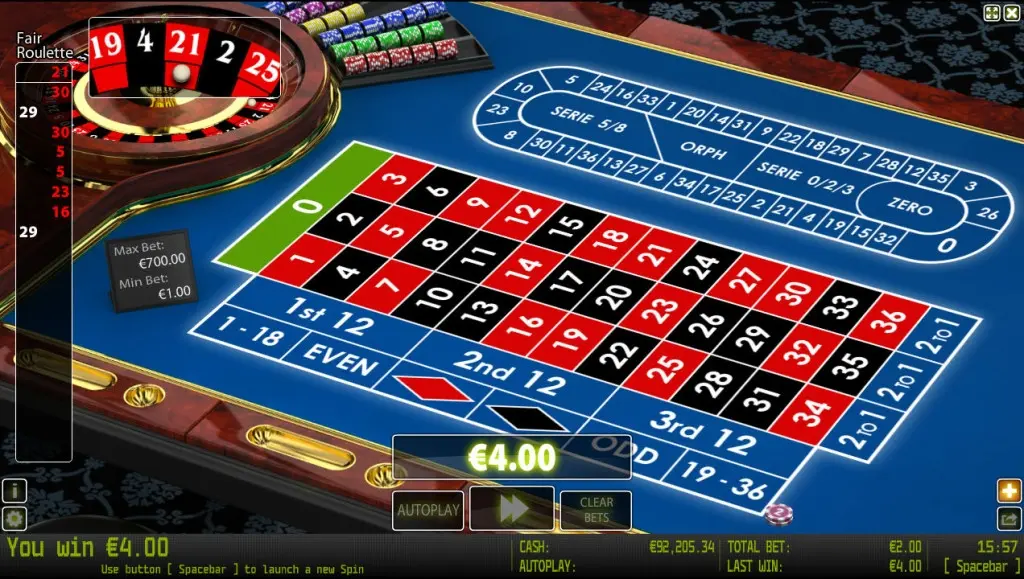
Fair Roulette Pro is a Worldmatch roulette table with a published RTP of 97.3%, playable as a free demo with no deposit. That RTP figure sits slightly above the 96.97% average across the tables reviewed here and well above Worldmatch’s own 96.51% average across its 13 games. What the supplied data does not tell you is the pocket count or whether any French rule applies, and those two details matter more than the headline percentage.
What kind of roulette is Fair Roulette Pro?
The available information lists this as a roulette table from Worldmatch, and nothing more specific than that. There is no confirmed pocket count, no confirmation of whether the wheel carries a single zero or a double zero, and no note on whether La Partage or En Prison applies to even-money bets. The title itself offers no hint either — “Pro” describes the presentation, not the layout.
That absence is worth taking seriously rather than glossing over, because the wheel type is the single biggest lever on your expected cost. A single-zero wheel has 37 pockets and a house edge of 2.70% on every standard bet. A double-zero wheel has 38 pockets and a house edge of 5.26% on standard bets, rising to 7.89% on the five-number basket bet that only exists on that layout. Same game, same table, nearly double the long-run cost per unit staked.
So the first thing to do when the game loads is open the rules or info screen and count the zeros on the wheel graphic. If there is one, you are looking at European rules. If there are two, the cost of play roughly doubles. If the even-money bets return half your stake when zero lands, that is La Partage, and it cuts the even-money edge to around 1.35% — the best standard bet available anywhere in roulette.
Return to player and house edge
The listed RTP for this table is 97.3%. Read literally, that means the game is modelled to return 97.30 units for every 100 staked over a very long run, leaving a 2.70% house edge — which is exactly the figure a standard single-zero wheel produces on every bet type. That correspondence is suggestive, but it is not proof, and you should confirm it against the game’s own rules screen rather than reasoning backwards from a number on a review page.
It is also worth understanding what RTP does and does not promise. It is a long-run average across an enormous number of spins, not a description of your session. A 97.3% figure does not mean you will finish 2.7% down; it means the shortfall converges towards that rate as the spin count grows very large. Over a hundred spins, variance dominates completely and any outcome from a large win to a full loss of your stake sits comfortably within normal.
For comparison, the two other Worldmatch tables in this group split sharply. Fair Roulette and Instant 3D Roulette both list the same 97.3%, while Ecuruleta lists 94.73% — a difference of more than two and a half points, which is the sort of gap that usually signals a different wheel layout or a different bet structure entirely.
Reading the Worldmatch paytable before you bet
Before your first spin, the info screen is the only authoritative source for this table. Check four things in order.
- Zero count. One zero or two. This sets your baseline house edge and nothing else on the screen matters as much.
- Zero handling on even-money bets. Full loss, half back, or held for the next spin. Half back cuts the even-money edge to roughly 1.35%.
- Straight-up payout. Classic roulette pays 35:1. If a table pays less than that, the shortfall is usually funding a multiplier or bonus feature, and the effective return on straight bets shifts accordingly.
- Table limits. Minimum and maximum per bet type. Inside and outside bets often carry different ceilings, and the outside maximum is what caps any progression you might be tempted to run.
The supplied data confirms none of these for this table, which is precisely why the in-game rules screen is not optional. Two minutes there tells you more than any review can.
Bet coverage, variance and session length
Assuming a standard single-zero layout, every bet below carries the same 2.70% house edge. What changes is the shape of the ride, not the expected value.
| Bet type | Numbers covered | Payout | True odds (37 pockets) |
|---|---|---|---|
| Straight up | 1 | 35:1 | 36:1 |
| Split | 2 | 17:1 | 17.5:1 |
| Street | 3 | 11:1 | 11.33:1 |
| Corner | 4 | 8:1 | 8.25:1 |
| Line | 6 | 5:1 | 5.17:1 |
| Dozen / Column | 12 | 2:1 | 2.08:1 |
| Red / Black, Odd / Even, High / Low | 18 | 1:1 | 1.06:1 |
The straight-up row is the whole story in one line: paid at 35:1 against true odds of 36:1, a single pocket of difference, and that gap is the entire house edge. Every other row is the same gap expressed differently.
For session length, coverage is what you control. Even-money bets win a little under half the time on a single-zero wheel, so a fixed stake on red or high stretches a bankroll across the most spins per unit risked. Straight-up bets win roughly once in 37 attempts and pay 36 units back, which produces long dry runs punctuated by sharp spikes. Neither is the smarter bet in expectation. Pick the one that matches how long you want to sit there.
Patterns, hot numbers and the gambler’s fallacy
An RNG wheel has no memory. Each spin is independent, so the previous results panel is a record, not a signal. A number that has not appeared in 200 spins is exactly as likely on the next spin as one that just landed twice. No number, colour or sector is ever due.
The same applies to betting systems, and here the honest answer is the useful one. Martingale, Fibonacci, D’Alembert, Labouchere, waiting for five reds before backing black — none of them changes expected value by a single unit. They cannot, because the house edge is baked into each individual payout, and adding up a sequence of negative-expectation bets in any order still gives a negative expectation.
What progressions actually do is reshape variance. Martingale converts many small wins into one rare catastrophic loss, and it collides with the table maximum quickly: doubling from one unit puts you at 1,024 units on the eleventh step, which almost every outside-bet ceiling will block before the sequence completes. When it stops, the loss is already locked in. Flat staking is not a winning strategy either, but it is at least honest about what it is doing.
Trying the demo
A free demo of Fair Roulette Pro is available, and it is the right place to answer the questions this review cannot. Load it, open the rules screen, count the zeros, read the straight-up payout, and check the outside-bet maximum. Then place a few small bets to see how the layout, racetrack (if there is one) and repeat-bet controls behave under your own hands. Practising the interface costs nothing and removes the mis-click risk that costs real money later.
What the demo cannot do is forecast results. Demo play uses the same maths but a different sample, and a hot demo run predicts nothing about a real-money session. Play is for adults 18 or over. Set a budget before you open the game, treat it as the price of entertainment rather than a source of income, and stop when it is gone rather than chasing it. If it stops being fun, close the tab.
Verdict on Fair Roulette Pro
The listed 97.3% RTP is a genuinely respectable figure — above the 96.97% corpus average and matched only by two other tables in this Worldmatch group. If the wheel proves to be single-zero with standard payouts, that number is exactly what you would expect, and there is nothing here to complain about on the maths.
The caveat is that the pocket count, zero handling, table limits and any call-bet options are all unconfirmed in the information available. That is not a mark against the game, but it does mean the review cannot do your due diligence for you. Popularity is low, at roughly the 4.5th percentile of tables covered here, so it is an obscure table rather than a broken one.
Load the demo, spend two minutes on the rules screen, and you will know more than any summary can tell you. If you want a like-for-like alternative from the same studio at the same listed return, Fair Roulette is the obvious first stop.
Frequently Asked Questions
Can you play Fair Roulette Pro free with no download?
Yes. A free demo of Fair Roulette Pro is available, so you can open the table in a browser without depositing. Use it to check the rules screen, the zero count and the straight-up payout, and to practise the bet controls before committing real money to any spin.
What is the Fair Roulette Pro RTP?
The listed RTP is 97.3%, which implies a 2.70% house edge over the long run. That is above the 96.97% average across the roulette tables reviewed here and above Worldmatch's own 96.51% average. RTP describes long-run behaviour, not what any single session will return.
Is Fair Roulette Pro a European or American wheel?
The available information does not confirm it, so check the in-game rules screen. A single-zero wheel has 37 pockets and a 2.70% edge; a double-zero wheel has 38 pockets and a 5.26% edge, or 7.89% on the basket bet. That difference roughly doubles your long-run cost.
Does the Martingale system work on this table?
No. Martingale does not change expected value, because the house edge sits inside every individual payout regardless of staking order. It converts frequent small wins into one rare large loss and hits the table maximum fast — the eleventh doubling step from one unit already requires 1,024 units.
Who makes Fair Roulette Pro and how does it compare to Fair Roulette?
Worldmatch develops it, one of 13 games from the studio covered here. Fair Roulette lists the identical 97.3% RTP, so the expected return matches; the difference is presentation and interface rather than maths. Ecuruleta, by contrast, lists 94.73%, which is a materially worse return.




