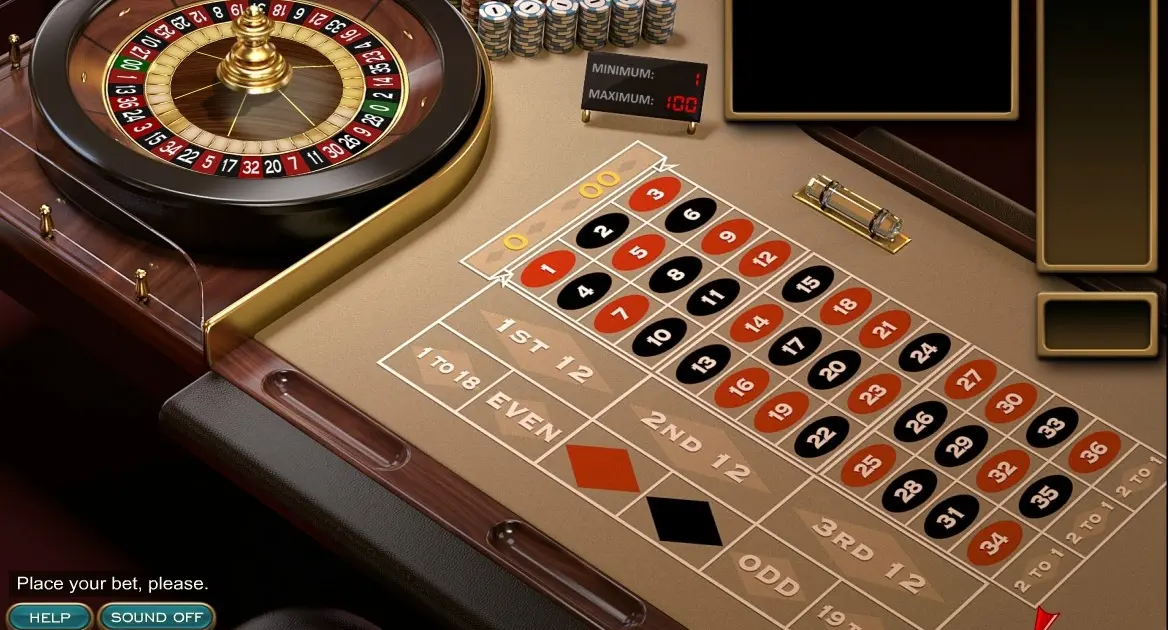
American Roulette (Nucleus) is a no-frills double-zero table from Nucleus Gaming that sticks to the classic format: 38 pockets, standard payouts, and no multiplier gimmicks. If you already know the difference between a European and an American wheel, the decision here is straightforward — you are paying a 5.26% house edge for the familiar 00 layout. The free demo lets you confirm the paytable and get comfortable with the interface before any real money is at stake.
American Roulette (Nucleus) and the Nucleus Gaming roulette range
Nucleus Gaming’s roulette portfolio is small. Alongside this American table, the provider offers European Roulette (Nucleus), which uses a single-zero wheel and carries a 97.3% RTP — a full 2.57 percentage points higher than this game. If you are comparing within the same provider, the choice between the two is purely mathematical: same developer, same interface, different wheel. There is also Zoom Roulette from a different studio if you want a European wheel with a different visual style. The point is that Nucleus Gaming gives you both wheel types; this review covers the American version specifically.
The wheel, the pockets and the edge
The American wheel has 38 pockets numbered 1 through 36, plus 0 and 00. That extra pocket is the entire reason the house edge sits at 5.26% rather than the 2.70% you would see on a European wheel. Every standard bet on this table — red/black, odd/even, straight-up, split, corner, column, dozen — carries that same 5.26% edge. There is no La Partage or En Prison rule on even-money bets here, which means zero and double-zero take the full stake on those wagers. On a European wheel with La Partage, the even-money house edge drops to roughly 1.35%. That gap is not a matter of opinion; it is arithmetic. Over 1,000 spins at $1 per spin, the expected loss on this American table is about $52.60, compared to roughly $13.50 on a French-rule European table. The wheel layout itself places the 0 and 00 opposite each other, which changes the visual sequence of red and black pockets but does not alter the maths.
94.73% in practice
The stated RTP of 94.73% aligns with the standard 5.26% house edge on a double-zero wheel. RTP in roulette is not like slots — there is no hidden volatility model. It is simply 1 minus the house edge, calculated across all bet types. In practice, that number means that for every $100 wagered over a very large sample, the game returns approximately $94.73 on average. In the short term, variance dominates: you can be ahead or behind by any amount. Over 100 spins at $5 per spin ($500 total wagered), an expected loss is about $26.30, but the actual result could easily be a $200 profit or a $300 loss. The RTP tells you the direction the maths pushes over time, not what happens in any single session. Compared to the provider’s own European Roulette (Nucleus) at 97.3%, this table returns less per dollar wagered. That is the price of the 00 pocket.
Building a bet you understand
The bet types and payouts on American Roulette (Nucleus) follow the standard double-zero format. Understanding the relationship between payout and true odds is the key to making informed decisions at this table.
| Bet Type | Payout | True Odds (American) | House Edge |
|---|---|---|---|
| Straight-up (single number) | 35:1 | 37:1 | 5.26% |
| Split (two numbers) | 17:1 | 18:1 | 5.26% |
| Street (three numbers) | 11:1 | 11⅔:1 | 5.26% |
| Corner (four numbers) | 8:1 | 8½:1 | 5.26% |
| Five-number basket (0, 00, 1, 2, 3) | 6:1 | 6½:1 | 7.89% |
| Six-line (six numbers) | 5:1 | 5⅓:1 | 5.26% |
| Column / Dozen (12 numbers) | 2:1 | 2:1 | 5.26% |
| Even-money (red/black, odd/even, high/low) | 1:1 | 1:1 | 5.26% |
Notice that every bet except the five-number basket carries the same house edge. The basket bet — covering 0, 00, 1, 2, and 3 — has a 7.89% edge, making it the worst bet on the table. High-variance bets like straight-ups and low-variance bets like even-money wagers cost you the same percentage over time; they just deliver very different session experiences. Pick the volatility profile that matches your bankroll and session goals, not a number you think is “due.”
Systems, streaks and independent spins
No betting system changes the expected value on this table. The Martingale — doubling your stake after every loss on an even-money bet — is the most popular system and the most dangerous. On a table with a typical $500 maximum, a Martingale sequence on even-money bets hits the limit after roughly seven consecutive losses, which happens about once every 128 sequences. When it hits, you lose the entire accumulated progression. Fibonacci, D’Alembert, and flat-betting systems all produce different variance curves but the same long-run result: a 5.26% loss rate on total money wagered. Spins are independent events. The wheel has no memory. A run of ten reds does not make black more likely on the next spin — the probability remains 18/38, or about 47.37%. If tracking previous results gives you comfort, use it for entertainment, but understand it provides zero predictive value on an RNG wheel.
Free demo and staying in control
A free demo of American Roulette (Nucleus) is available, and it is the right place to start. Use it to confirm the paytable matches what this review describes, test the interface, and get a feel for the pace of play without risking anything. Demo results do not predict real-money outcomes — the RNG produces independent results regardless of whether you are playing for fun or for cash. Set a budget before you switch to real money and treat it as the cost of entertainment. Never chase losses, never bet money you cannot afford to lose, and stop when the fun stops. If gambling stops being enjoyable, step away. This game is for players 18 and older only.
Who should play American Roulette (Nucleus)
This table makes sense if you specifically prefer the American wheel layout or if you are playing at a casino that only offers Nucleus Gaming tables. The maths are identical to any other standard double-zero roulette — there is nothing unique about the RTP or the bet structure beyond the provider’s implementation. If your priority is the lowest possible house edge, European Roulette (Red Tiger) at 97.3% RTP is a better mathematical choice. If you want the same provider’s European option, European Roulette (Nucleus) also sits at 97.3%. American Roulette (Nucleus) is a clean, functional version of a game that has been around for over a century. Know the edge, set your limits, and play it for what it is.
Frequently Asked Questions
Can I play American Roulette (Nucleus) for free?
Yes. A free demo is available, letting you test the interface and confirm the paytable without risking real money. Demo results do not predict real-money outcomes, but they are useful for learning the layout and bet mechanics.
What is the RTP of American Roulette (Nucleus)?
The RTP is 94.73%, which corresponds to the standard 5.26% house edge on a double-zero American wheel. This figure applies to all standard bets except the five-number basket bet, which carries a 7.89% edge.
Why is the house edge higher than European roulette?
The American wheel has 38 pockets including both 0 and 00, compared to 37 pockets on a European wheel. That single extra pocket roughly doubles the house edge from 2.70% to 5.26% on every standard bet.
Does any betting system work on this table?
No. Systems like Martingale or Fibonacci change how your bets are sized across sessions but do not alter the 5.26% house edge. Spins are independent, and no progression can overcome the built-in mathematical disadvantage.
How does American Roulette (Nucleus) compare to European Roulette (Nucleus)?
Both are from Nucleus Gaming with identical interfaces, but the European version uses a single-zero wheel with a 97.3% RTP versus 94.73% here. The European table returns about 2.57 cents more per dollar wagered over time.




