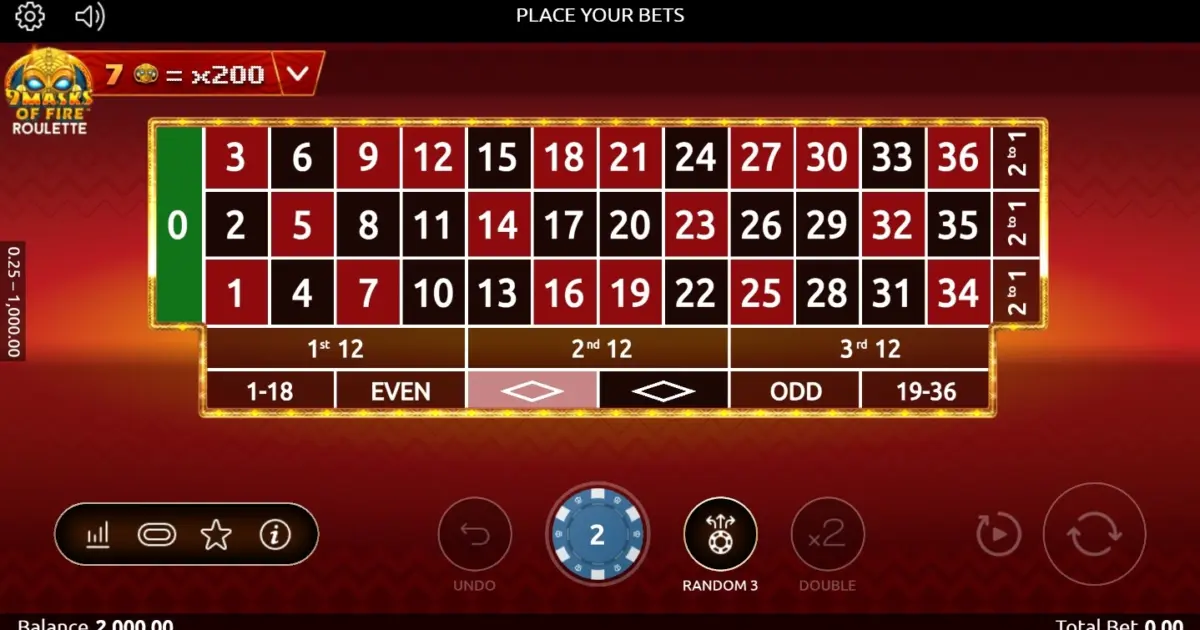
If you want a straightforward answer: the 9 masks of fire roulette table carries a published RTP of 97.3%, which is marginally better than the 96.97% average across the roulette titles we list and level with the best of Real Dealer Studios’ own tables. A free demo is available, so you can look at the layout and the rules screen without spending anything.
The one thing you cannot learn from the data we hold is which wheel it uses. That single detail matters more than everything else on this page, and the game’s own rules screen will tell you in seconds.
9 Masks of Fire Roulette at a glance
Here is the complete set of confirmed figures for this table.
| Field | Value |
|---|---|
| Provider | Real Dealer Studios |
| Published RTP | 97.3% |
| Category | Roulette |
| Free demo | Available |
| Provider titles listed | 30 |
| Provider average RTP | 97.25% |
| Corpus average RTP | 96.97% |
| Popularity percentile | 43.9 |
Not confirmed anywhere in our data: pocket count, whether La Partage or En Prison apply, table minimums and maximums, whether a racetrack and call bets are offered, and whether any side bet or multiplier feature sits on top of the base game. Those gaps are not trivia. Table limits decide whether your bankroll suits the game at all, and the zero rules decide what an even-money bet actually costs you. Read the paytable and rules panel in the demo before you form an opinion, and treat anything you read elsewhere about this specific table with suspicion unless it matches what the game itself says.
Which wheel is this, and what it costs you
Our data holds no variant hint for this title, so the wheel family is genuinely unknown here. That leaves three possibilities, and the difference between them is large.
- Single-zero (European), 37 pockets: house edge of 2.70% on every standard bet.
- Double-zero (American), 38 pockets: house edge of 5.26% on standard bets, and 7.89% on the five-number basket bet.
- Single-zero with French rules: La Partage or En Prison return half your stake on even-money bets when zero lands, cutting the even-money edge to roughly 1.35% — the best standard bet in roulette.
The published 97.3% RTP is a clue but not proof, because an RTP figure can be quoted for a specific bet type rather than the table as a whole. Count the pockets on the wheel graphic, then check whether the rules mention half-stake returns on red/black, odd/even and high/low. If the game runs a multiplier or feature round, the straight-up payout will usually be trimmed to fund it, which changes the effective return on inside bets. That information lives in the paytable, not in the title.
What a 97.3% RTP means per spin
RTP is the long-run average return, and 97.3% implies a 2.7% average loss on money staked. Stake 1 unit per spin for 100 spins and you have put through 100 units; the modelled average loss is 2.7 units. That is an average over an enormous number of spins, not a schedule. Across 100 real spins you might be up 40 units or down 60, and both are ordinary.
What matters practically is money wagered per hour, not money in your pocket. At roughly 40 spins an hour at 1 unit a spin, expected cost is about 1.1 units per hour. Double the stake and you double the cost. Triple the spin rate and you triple it. The RTP figure never moves.
For context, 97.3% sits 0.33 points above the corpus average and matches Real Auto Roulette, another Real Dealer Studios table at the same figure. Compared with Fortune Finder with Holly at 96.6%, you keep about 0.7 units more per 100 staked over the long run.
Inside versus outside bets
Inside and outside bets change how results are distributed, not what they cost. Every standard bet on a single-zero wheel carries the same 2.70% edge. The table below shows why, using a 37-pocket layout.
| Bet | Pockets | Pays | True odds |
|---|---|---|---|
| Straight up | 1 | 35:1 | 36:1 |
| Split | 2 | 17:1 | 17.5:1 |
| Street | 3 | 11:1 | 11.33:1 |
| Corner | 4 | 8:1 | 8.25:1 |
| Line | 6 | 5:1 | 5.17:1 |
| Dozen / column | 12 | 2:1 | 2.08:1 |
| Red/black, odd/even, high/low | 18 | 1:1 | 1.06:1 |
That one-pocket gap on a straight-up bet is the entire house edge. Even-money bets land just under half the time and produce long flat stretches; straight-up bets hit about once in 37 spins and pay 36 units back on the hit. Same cost, very different ride. If the table turns out to be double-zero, add a pocket to every “true odds” figure and the edge rises to 5.26%.
Why no betting system changes the maths
No progression alters expected value. Martingale, Fibonacci, D’Alembert, Labouchere, waiting for five reds before backing black — none of them touch the house edge, because each spin is independent and the wheel has no memory. Twelve reds in a row tells you nothing about spin thirteen.
What progressions do is reshape variance. Martingale converts many small wins into rare very large losses, and it collides with the table maximum: eight consecutive losses at a 1-unit base needs a 256-unit bet to continue, and if the ceiling or your balance stops you there, the whole sequence is realised as a loss. Flat betting spreads the same expected cost more evenly.
Ignore anyone selling “due” numbers, hot sectors or cold colours on an RNG wheel. Result histories are display features, not information. If a system is what brought you here, the useful takeaway is that the only levers you actually control are stake size, spin count and, if the rules allow it, choosing even-money bets under La Partage.
Playing the 9 Masks of Fire Roulette demo
A free demo is available, and it is the right place to confirm what our data cannot: pocket count, zero rules, table limits, racetrack availability and the full paytable. Play 9 Masks of Fire Roulette free for a hundred spins and you will also learn whether the pacing suits you, which is a genuine reason to pick one table over another when the maths is identical. Real Dealer Studios lists 30 titles with us at a 97.25% average, so if the interface does not click, Roulette with Rachael offers the same 97.3% figure in a different presentation.
Demo results predict nothing about real-money sessions. A hot demo run is variance, not a signal.
Roulette is entertainment, not income. Play only if you are 18 or over, set a budget before you open the game and treat it as spent, and never stake money you need for anything else. If it stops feeling like a game, stop and use the deposit limits, time-outs and self-exclusion tools your operator provides.
Verdict
A 97.3% published RTP is a fair starting point: better than the 96.97% corpus average, level with the best Real Dealer Studios tables we list, and enough to make this worth a look. But the figure alone does not tell you what you are betting into. Until you have confirmed the pocket count and the zero rules on the rules screen, you cannot say whether an even-money bet here costs 1.35%, 2.70% or 5.26%, and that spread is wider than any difference an RTP decimal point makes. Open the demo, read the paytable, then decide.
Frequently Asked Questions
Can I play 9 Masks of Fire Roulette for free?
Yes, a free demo is available, and it runs on the same rules as the paid table. Use it to confirm the details our data does not cover: pocket count, zero rules, table limits and the full paytable. Demo outcomes carry no predictive value for real-money play, so treat them as practice with the interface only.
What is the 9 Masks of Fire Roulette RTP?
The published RTP is 97.3%, meaning an average long-run loss of 2.7% of everything staked. Stake 100 units and the modelled average loss is 2.7 units. That sits 0.33 points above the 96.97% average across the roulette titles we list, and matches Real Dealer Studios' strongest tables.
Is this a European or American wheel?
Our data does not confirm it, and the title gives no hint either way. A 37-pocket single-zero wheel carries a 2.70% house edge; a 38-pocket double-zero wheel carries 5.26%, rising to 7.89% on the five-number bet. French rules on a single-zero wheel cut even-money bets to about 1.35%. Check the rules screen.
Does any betting system work on this table?
No. Martingale, Fibonacci, D'Alembert and pattern-spotting all leave the house edge unchanged, because spins are independent and the wheel has no memory. Progressions only redistribute variance, trading frequent small wins for rare large losses, and they run into table maximums fast. Stake size and spin count are the only real levers.
How does it compare to other Real Dealer Studios roulettes?
It matches Real Auto Roulette and Roulette with Rachael at 97.3%, the top of the range across the 30 Real Dealer Studios titles we list, which average 97.25%. Fortune Finder with Holly trails at 96.6%. Since the RTP figures tie, presentation and confirmed table rules should decide which one you open.




