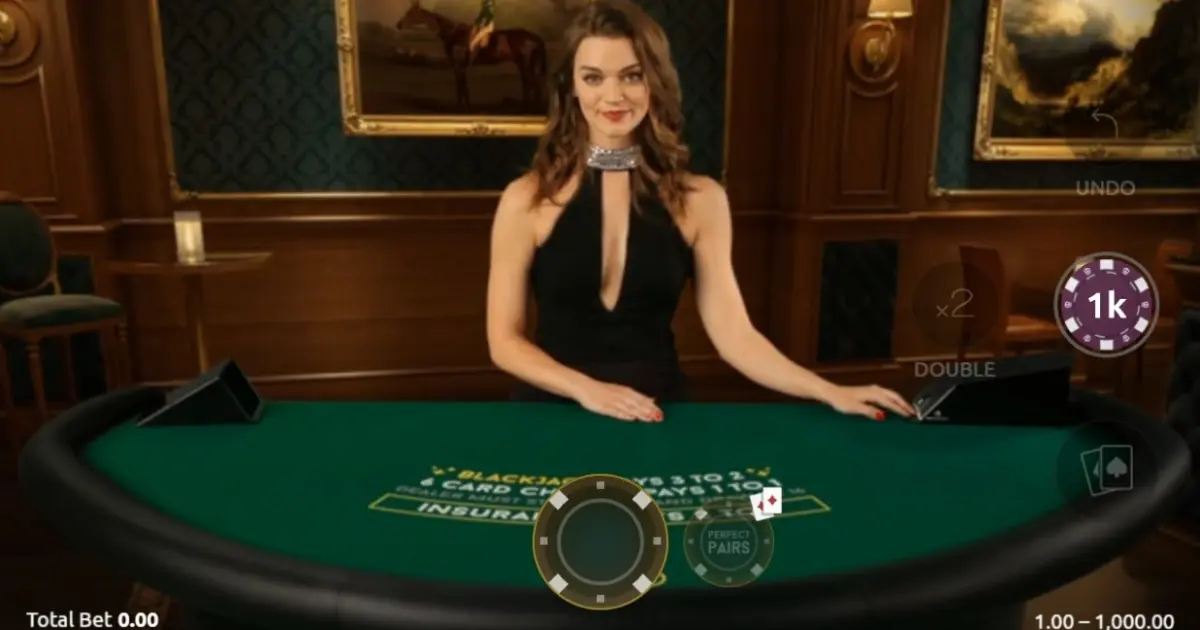
Ultimate Blackjack with Rachael sits at the high end of the blackjack market on paper, with a published RTP of 99.5% that puts it above both its provider average and the broader corpus of reviewed tables. The question for a strategic player is whether the underlying rules support that number for someone who actually plays imperfectly, and what the missing rule disclosures mean for your expected return at the felt.
How Ultimate Blackjack with Rachael plays
This is a single-player blackjack table produced by Real Dealer Studios, a provider that films real dealers dealing physical cards while the outcome is determined by a certified random-number generator. You place your wager, receive your two cards, and the dealer on screen completes their hand according to fixed house rules.
The “Rachael” in the title identifies the specific dealer host filming this variant, a naming convention the studio uses across its catalogue. Rapid Multihand Blackjack with Rachael, for instance, shares the same presenter but offers a different table structure that lets you play multiple hands simultaneously.
What the game does not advertise publicly in structured data form: the number of decks in the shoe, the blackjack payout ratio, the dealer’s soft-17 behaviour, whether late surrender is available, and which double or split restrictions apply. These are the rules that determine whether 99.5% is achievable or aspirational.
Rules the name and provider tell you
Real Dealer Studios positions its games as RNG blackjack tables rather than live casino games. This distinction matters because it means the card sequence is generated digitally even though you watch a human dealer handle physical cards on video. The reshuffle timing is determined by the software, not by shoe penetration, which has direct consequences for anyone considering card counting.
The word “Ultimate” in the title does not map to a recognised rule-set variant the way “European” signals no-hole-card or “Switch” signals paired hands. Treat it as branding. The only way to confirm whether this table pays 3:2 or 6:5 on a natural, whether the dealer hits soft 17, and whether you can re-split aces is to open the rules screen inside the game itself before depositing a single unit.
Reading the 99.5% return figure
RTP on a blackjack table is expressed as (100% − house edge), so 99.5% implies a house edge of 0.5% under perfect basic strategy. That places this table among the tighter offerings in the review set, roughly level with the provider’s other Ultimate Blackjack variants and slightly above the corpus average of 99.41%.
The critical caveat: published RTP assumes optimal play on every single decision. No human sustains perfect basic strategy across hundreds of hands without occasional slips. A player making roughly one strategy error per 100 hands might see a realised return closer to 98.5–99.0%. Two errors per 100 hands pushes the figure lower still. The gap between published and realised is your skill premium, and it is never zero.
Where the house edge actually comes from
Even without confirmed rule details, the general drivers of blackjack house edge are well established. A 3:2 blackjack payout versus 6:5 costs the player approximately 1.4 percentage points, which would shift the published figure from 0.5% to roughly 1.9%. Dealer hitting soft 17 versus standing adds about 0.2%. Each additional deck adds a marginal cost. Absence of double-after-split adds approximately 0.14%. Late surrender, where available, reduces the edge by roughly 0.07%.
Side bets such as Perfect Pairs or 21+3 typically carry house edges of 3–7% depending on paytables, far exceeding the base game. Insurance is mathematically a losing proposition at standard 2:1 odds unless you are counting cards with a true count exceeding +3, which as discussed below is impossible here.
Until you confirm the specific rules, the 99.5% figure represents a best-case ceiling for this table, not a guaranteed floor.
Does card counting work here?
No. Card counting requires shoe penetration: a period during which the composition of undealt cards becomes skewed enough that a trained counter can identify a positive-expectation situation. RNG-driven blackjack reshuffles the virtual shoe after every hand, meaning each deal is statistically independent of the last. The Hi-Lo count, the Omega II system, and every other counting method you have read about will produce no measurable advantage at this table.
What does work is playing correct basic strategy consistently. That single habit is worth several tenths of a percentage point relative to casual play and is the only proven method for reducing the house edge toward its published minimum. No system, progression, or pattern-spotting technique changes the expected value of your bets.
Bankroll and unit sizing
Blackjack variance is moderate compared to slots but still swings meaningfully over short sessions. A losing run of eight to ten hands is common enough that you should size your bet as a small fraction of your total session bankroll. A unit of 1–2% of your budget gives you enough hands to play basic strategy without emotional pressure and absorbs normal downswings without forcing a bail-out.
Betting progressions like Martingale or D’Alembert change the shape of your variance — they produce frequent small wins punctuated by occasional large losses — but they do not alter expected value. No progression overcomes a negative expectation game.
Set your budget before you open the table, treat the entire session as entertainment spending rather than income, and stop when that budget is exhausted. If gambling stops being enjoyable, stop. 18+ only.
Verdict
| Metric | Value |
|---|---|
| RTP | 99.5% |
| Provider | Real Dealer Studios |
| Category | Black Jack |
| Popularity percentile | 86.5% |
| Free demo | Available |
The headline number is competitive and the production model is transparent about what it is: a RNG table dressed as a live experience, which is honest branding. The weakness is disclosure. A maths-literate blackjack player cannot fully evaluate a table without knowing the payout on a natural and the soft-17 rule. If those turn out favourable when you open the rules screen, 99.5% is real and this is one of the better online blackjack tables available. If a 6:5 payout or aggressive dealer hitting hides in the fine print, your actual edge is worse than the headline suggests.
The demo is free to play, so there is no reason to skip the rules check. Compare the experience directly against Ultimate Blackjack with Olivia, which shares the same RTP and provider framework with a different host and possibly different rule parameters. If you prefer multi-hand action, Rapid Multihand Blackjack with Rachael trades a slightly lower 99.44% return for the ability to run more decisions per hour. For a character-driven alternative, Vinnie Jones Blackjack matches this table at 99.5% from the same provider.
Frequently Asked Questions
Can I play Ultimate Blackjack with Rachael for free?
Yes, a free demo version is available on this review site. Demo play lets you test the interface and confirm the in-game rule disclosures without financial risk, but it does not predict how the same rules translate into real-money results over a long session.
What does the 99.5% RTP on Ultimate Blackjack with Rachael actually assume?
The 99.5% figure assumes you play perfect basic strategy on every single hand, with no deviations, no insurance, and no side bets. A casual player making one or two strategy errors per hundred hands will realise a return closer to 98.5–99.0%, meaning the published RTP is a ceiling rather than a typical outcome.
What rules determine whether the 0.5% house edge is achievable at this table?
The critical unknowns are the blackjack payout ratio (3:2 versus 6:5), the dealer's soft-17 behaviour, the number of decks, and whether late surrender or double-after-split is permitted. Real Dealer Studios does not publish these in structured form, so you must check the rules screen inside the game. Each of these factors can shift the edge by tenths or whole percentage points.
Does card counting help at Ultimate Blackjack with Rachael?
No. The game uses an RNG to determine card order despite showing a real dealer on video, and the virtual shoe reshuffles after each hand. Card counting depends on tracking composition through shoe penetration, which does not exist here. The only proven approach is consistent basic strategy play.
How does Ultimate Blackjack with Rachael compare to other Real Dealer Studios blackjack tables?
At 99.5% RTP it matches the provider's other top titles, including Vinnie Jones Blackjack and Ultimate Blackjack with Olivia, while sitting slightly above Rapid Multihand Blackjack with Rachael at 99.44%. The provider average across its four blackjack games is 99.48%, so this table performs at or above that benchmark.




