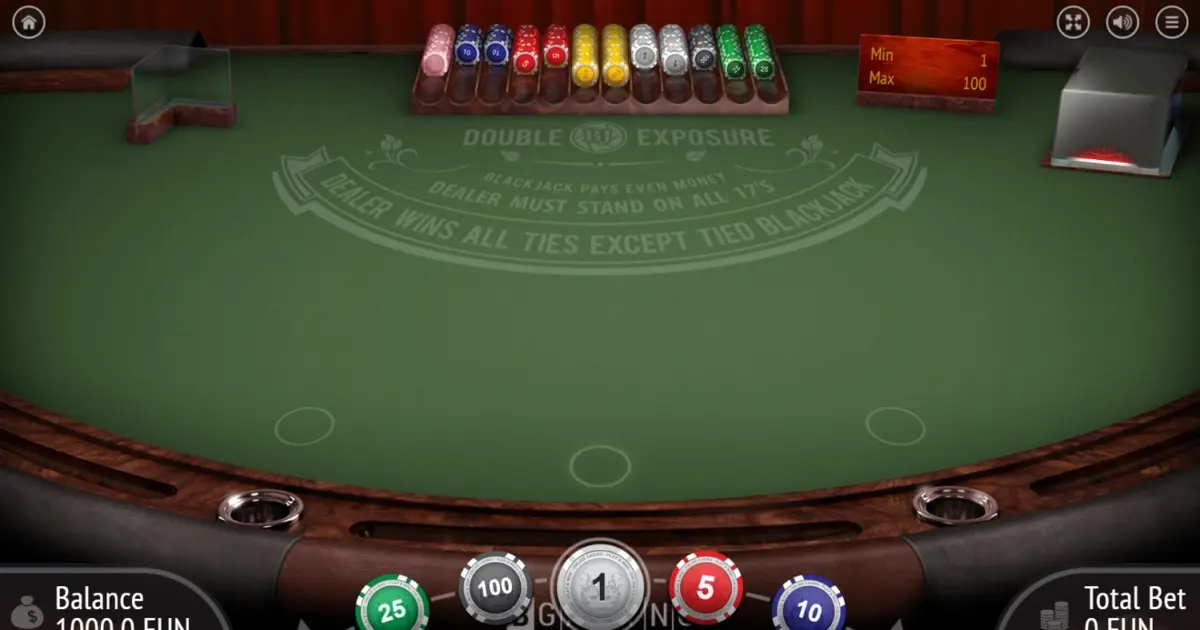
If you have ever wished you could see the dealer’s hole card before deciding whether to hit, Double Exposure Blackjack by BGaming does exactly that. Both dealer cards are dealt face-up on every hand, which removes the usual guesswork and lets you make fully informed decisions. The trade-off for that advantage comes in adjusted rules and payouts that shift the maths back toward the house — so understanding the details matters before you sit down, even in free demo mode.
What kind of blackjack is Double Exposure Blackjack?
Double Exposure Blackjack (sometimes called Face-Up 21) is a variant where the dealer’s two initial cards are both dealt face-up, visible to the player before any action is taken. This is not a cosmetic change — it fundamentally alters the game’s strategy, because you always know exactly what you are playing against. The obvious benefit to the player is enormous, so casinos compensate with rule adjustments that restore a house edge.
In most Double Exposure implementations, including versions by BGaming, blackjack pays even money rather than 3:2, and ties (except a player blackjack) go to the dealer. These two rule changes alone recapture most of the edge that seeing both cards would otherwise hand to the player. The result is a game that feels more transparent and strategic but still carries a built-in house advantage. BGaming’s Blackjack MH, a more conventional variant, offers a comparable RTP of 99.33% if you prefer standard rules.
The game is part of BGaming’s blackjack lineup, which includes a small but focused collection of six tables. BGaming’s average RTP across those titles sits at 99.38%, so Double Exposure Blackjack is very close to the provider’s own baseline — the slight difference is simply the cost of the face-up rule set.
| Provider | BGaming |
|---|---|
| RTP | 99.3% |
| Free demo | Yes |
Return to player: 99.3%
The published RTP for this table is 99.3%, which means that over a theoretically infinite number of hands, the game returns 99.3 cents for every dollar wagered. That figure places it in the upper tier of online blackjack RTPs, though it sits marginally below the corpus average of 99.41% across all blackjack titles tracked on this site.
Two critical caveats apply to every RTP number on this page. First, that 99.3% assumes you play perfect basic strategy on every single hand — no deviations, no hunches, no “I feel like standing here.” Second, RTP is a long-run statistical average. In any real session of 50 or 100 hands, actual returns will vary widely due to normal variance. A session can easily finish well above or below that number. What RTP does tell you is how generous the rule set is relative to other tables: at 99.3%, the house edge on Double Exposure Blackjack is 0.7%, which is solid for a variant that gives you this much information up front.
For comparison, Surrender Multihand Blackjack from a different provider posts a 99.48% RTP — the difference reflects its inclusion of late surrender and standard blackjack payouts, illustrating how much individual rules matter to the bottom line.
Deck count, dealer rules and the payout that matters most
BGaming does not publish the exact deck count for Double Exposure Blackjack in its standard game information. Deck count matters — the difference between single-deck and eight-deck blackjack is typically a few hundredths of a percent in house edge — but it is not the deciding factor here. Check the in-game rules screen or paytable before committing real money, because the number of decks is displayed once you open the game.
The rule that dominates this variant’s maths is the blackjack payout. In standard blackjack, a natural pays 3:2. In Double Exposure, most versions including BGaming’s pay even money (1:1) on blackjack. That single change costs the player roughly 2.4% of expected value compared to a 3:2 game, making it the most damaging rule adjustment in any blackjack variant. It is the primary reason you should never assume a “face-up” game is automatically easier on your bankroll.
Other rule changes to look for in the paytable include whether the dealer hits or stands on soft 17, whether you can double after a split, how many times you can re-split, and whether ties push or are won by the dealer. Each of these moves the house edge by a few tenths of a percent. Basic strategy for Double Exposure differs substantially from standard blackjack strategy precisely because both dealer cards are known — many hands that would be hits in standard blackjack become stands, and vice versa.
Playing your first ten hands
If you open the free demo of Double Exposure Blackjack, you will immediately see the key difference: both dealer cards sit face-up before you act. Start by familiarising yourself with the strategy adjustments that follow. Because you can see the dealer’s total, you often know whether a hit is likely to bust you or whether the dealer already has a hand you cannot beat. This removes much of the uncertainty that drives basic-strategy decisions in standard blackjack.
The core basic-strategy moves — always split aces and eights, never split tens, hit hard 16 against a dealer 17 or higher — are modified here. With both cards visible, you will stand on totals that would normally require a hit, and you will double more aggressively when the dealer’s exposed total is weak. A strategy chart specific to Double Exposure rules exists and is worth studying before you play seriously; it is available in most blackjack strategy guides and is not the same chart used for conventional tables.
Use your first session in demo mode to confirm the specific rules in play — particularly the tie rule and whether blackjack pays even money or 3:2. These details vary between providers, and they change the correct strategy. If you want a more familiar starting point before tackling the face-up strategy, BGaming’s Multihand Blackjack Pro 2 at 99.38% RTP uses conventional rules and lets you play multiple hands simultaneously.
Side bets: the maths behind the temptation
Double Exposure Blackjack by BGaming does not advertise specific side bets in its published game data. That does not mean the game is side-bet-free — the in-game interface may offer options such as Perfect Pairs or 21+3 that are simply not listed in the provider’s external documentation. Check the table layout when you open the game to see what is available.
If side bets are present, the general maths applies regardless of which ones appear. Side bets carry a significantly higher house edge than the base game. Perfect Pairs typically carries a house edge between 2% and 11% depending on the paytable, and 21+3 often exceeds 3%. Insurance — offered in some form at most blackjack tables — is a side bet on the dealer having a blackjack, and at standard 2:1 odds it carries a house edge of roughly 7.7%. Basic strategy says never take insurance, and that advice holds here too.
The temptation with side bets is that they offer large payouts relative to the stake. A Perfect Pairs bonus might pay 25:1 for a suited pair. But the probability of landing that hand is low enough that the expected loss per bet is far higher than on the base game. If you are playing Double Exposure for its 99.3% RTP, adding a side bet with a 4%+ house edge is counterproductive — you are voluntarily playing a much worse game on the same table.
Session limits and bankroll
Set a session budget before you start and do not exceed it. A game with a 0.7% house edge still means you will lose money on average over time — the edge is small, but it is real and it compounds with volume. A sensible approach is to set a fixed amount you can afford to lose, treat it as the cost of entertainment, and stop when it is gone. If you set a win target as well, consider stopping there too — session variance can swing both ways.
Unit sizing matters. A common guideline is to ensure your session bankroll covers at least 50 to 100 base-unit bets, which gives you enough runway to absorb normal losing streaks without busting out early. At a $5 minimum table, that means bringing at least $250 to $500 for a session. With a 99.3% RTP, the expected loss per 100 hands at $5 per hand is only about $3.50 — but actual results will deviate significantly from that average, and some sessions will be substantially worse.
Remember that this is entertainment, not income. Play only with money you can afford to lose, set firm time and spend limits before each session, and stop if gambling stops being fun. If you are in the UK and need support, contact BeGambleAware.org. You must be 18 or older to play.
Verdict on Double Exposure Blackjack
Double Exposure Blackjack by BGaming is a solid variant that does what it promises: it shows you both dealer cards and lets you make decisions with full information. The 99.3% RTP is competitive, though the even-money blackjack payout and tie-against-player rule mean it does not quite match the best standard blackjack tables on raw expected value. For players who enjoy strategic depth and prefer knowing exactly where they stand before acting, it is an interesting and honest game.
If you are looking for a slightly higher RTP with more conventional rules, Surrender Multihand Blackjack at 99.48% or Multihand Blackjack Pro 2 at 99.38% may be worth exploring. But for a face-up experience with transparent mechanics, Double Exposure Blackjack delivers — just make sure you study the Double Exposure-specific basic-strategy chart before you switch from demo to real money. The strategy is genuinely different from standard blackjack, and playing standard strategy on this table will cost you more than you expect.
Frequently Asked Questions
Can I play Double Exposure Blackjack for free without downloading anything?
Yes. BGaming's Double Exposure Blackjack is available as a free demo directly in your browser with no download required. The free demo uses the same rules and RTP as the real-money version, making it useful for practising the face-up strategy before wagering real cash.
What is the RTP of Double Exposure Blackjack by BGaming?
The published RTP is 99.3%, which assumes perfect basic strategy on every hand. In practice, casual play will produce a lower return because even small deviations from optimal decisions increase the effective house edge. The RTP is a long-run average, not a guarantee for any individual session.
Does seeing both dealer cards make Double Exposure Blackjack easier to beat?
Seeing both cards removes uncertainty, but casinos compensate with rule changes — most importantly, blackjack pays even money instead of 3:2, and ties typically go to the dealer. These adjustments restore a house edge of roughly 0.7%, so the game is not easier in terms of expected loss, just different strategically.
Does card counting work on Double Exposure Blackjack?
No. Card counting relies on the ratio of high to low cards remaining in the shoe, which requires an imperfect shuffle and a fixed shoe composition. BGaming's online blackjack uses a random number generator that reshuffles every hand, so counting provides no edge whatsoever.
How does Double Exposure Blackjack compare to BGaming's other blackjack tables?
BGaming's Blackjack MH offers a 99.33% RTP with standard rules, while Multihand Blackjack Pro 2 posts 99.38%. Double Exposure Blackjack's 99.3% RTP is slightly lower due to its face-up rule compensation, but it offers a unique strategic experience that conventional tables do not.




