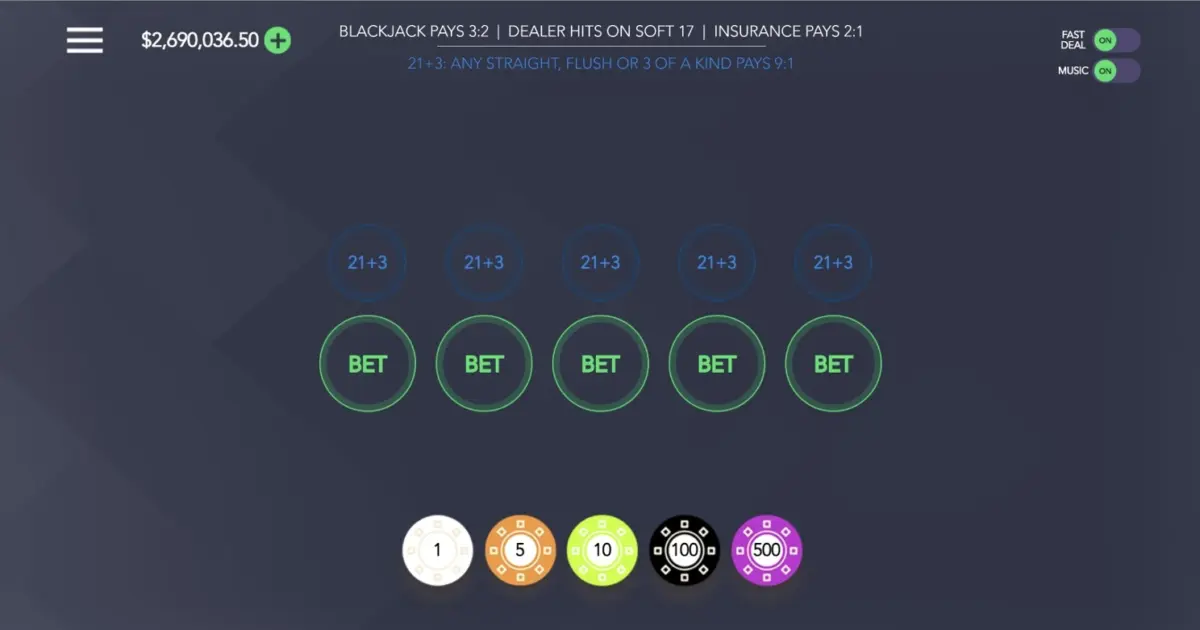
If you want a multi-hand blackjack table with a published return figure you can actually check your play against, this one earns a look. FlipLuck Games lists the RTP at 99.1%, which sits in the normal range for a well-ruled blackjack game, and a free demo is available so you can learn the five-hand layout without staking anything. The catch is the one that applies to every blackjack table ever built: that figure describes flawless play, not casual play.
How 5 Handed Vegas Blackjack plays
The name tells you the shape of the game: you play up to five hands at once against a single dealer hand. FlipLuck Games does not publish the finer mechanics of this table beyond that, so treat the details below as how five-hand blackjack normally works rather than as confirmed rules here.
In a multi-hand format you place a bet on each box you want in play, the dealer deals across all of them, and then you resolve each hand in turn against the same dealer upcard. That matters more than it sounds. Five hands means five decisions per round, five chances to misplay, and roughly five times the money exposed per round compared with a single-box game. Your hourly turnover climbs sharply even if your per-hand bet stays small.
It also changes nothing about the maths of any individual hand. Each box is played on its own merits against the dealer’s card. Hands do not help each other, and a bad card on box one does not improve box four. If you are used to single-hand play, the honest adjustment is downward: cut your per-box stake so that five boxes cost you about what one box used to.
Because the table limits, the exact number of boxes you must fill, and the available actions are not published in the material available here, open the in-game rules screen before you commit real money. That screen is authoritative; a review is not.
| Provider | FlipLuck Games |
|---|---|
| RTP | 99.1% |
| Free demo | Yes |
Vegas Strip rules and what the name tells you
The title points at the Vegas Strip rule family. Vegas Strip normally means four decks, the dealer standing on soft 17, and doubling permitted after a split. Those are player-friendly settings on balance, and if they hold here they help explain a return figure as high as 99.1%.
Read that as a strong indication, not a confirmed ruleset. FlipLuck Games has not published the deck count, the soft 17 rule, the blackjack payout, surrender availability, re-split rules or the dealer peek behaviour for this specific table, and any of them can be tuned by the operator. The single most important one to verify is the blackjack payout. A natural paying 3:2 is standard; a table paying 6:5 costs the player roughly 1.4% of return, which is more damage than every other common rule change combined. No amount of good play recovers it.
The practical step is short. Open the paytable, confirm that blackjack pays 3:2, then check the deck count and the soft 17 line. If the paytable disagrees with the Vegas Strip assumption, the strategy chart you are using is the wrong chart, and the published RTP is not the number you are playing against.
Reading the 99.1% return figure
99.1% is the theoretical return of this table under one very specific condition: perfect basic strategy on every single hand. It is the arithmetic complement of the house edge, so 99.1% RTP means a 0.9% edge to the house. Over enough hands, that is what the game keeps.
Almost nobody realises 99.1%. Every deviation from the chart — standing on a hard 16 against a ten because it feels safer, skipping a double on 11, splitting tens — hands back a slice of return. A player working from instinct rather than a chart typically gives up somewhere between half a point and two points of return, which can quietly double the effective house edge. Across five simultaneous hands the error rate compounds, because you are making five times as many decisions under the same time pressure.
For context, the average across the blackjack tables tracked on this site is 99.41%, so 99.1% sits fractionally below the field. It is still well ahead of the FlipLuck Games catalogue average of 97.0%, which is dragged down by tables like Blackjack 11 at 94.91%. If you want a slightly better published figure in a single-hand format, American Blackjack lists 99.5%.
Where the house edge actually comes from
The house edge in blackjack comes from one structural fact: you act first. Bust before the dealer does and you lose immediately, even if the dealer would have busted on the same shoe. Everything else in the rulebook is a partial refund on that disadvantage.
As general rules of thumb, a dealer who stands on soft 17 is worth about 0.2% to you versus one who hits. Fewer decks help — a single deck is worth a few tenths over eight — though single-deck tables often claw it back with a 6:5 payout. Doubling after a split is worth roughly 0.15%, re-splitting aces a little under 0.1%, and late surrender about 0.1%. European no-hole-card rules cost you around 0.1% because you can lose a doubled or split bet to a dealer blackjack.
Side bets sit outside all of this. Perfect Pairs and 21+3 style wagers typically run house edges of 2% to 6% or worse, several times the base game. Insurance is the clearest case: at 2:1 it is a losing bet on every hand a non-counter will ever face. Whether this table offers any of them is not published, so check before you play.
Does card counting work here?
No. This is an RNG table, and an RNG table reshuffles the virtual deck before every hand. Counting works by tracking cards that have left a shoe so you can bet more when the remaining cards favour you. If the shoe is restored each round, there is nothing left to track — every hand starts from the same fresh distribution regardless of what came before.
The same logic kills every other pattern-based approach. No hand is ever due, a run of dealer twenties says nothing about the next round, and betting progressions such as Martingale or D’Alembert do not change expected value. They redistribute your variance: more small wins, occasional catastrophic losses, identical long-run return. What does help is basic strategy, which is a solved chart rather than a system. It shrinks the house edge to its published minimum and then stops. It never turns the edge positive.
Bankroll and unit sizing
Five hands per round is the whole bankroll story here. If you back all five boxes at your usual single-hand unit, you have quintupled your exposure per round without noticing. A sane approach is to divide your normal unit by the number of boxes you intend to play, so total round risk stays roughly constant.
Beyond that, size your session bankroll in units rather than currency and expect swings. Even at a 0.9% edge, a hundred-round session can finish comfortably up or badly down; that is ordinary variance, not a hot or cold table.
Play only if you are 18 or over, decide your budget before you open the game, and treat it as entertainment spending rather than income. If a session stops being fun, close it.
The free demo is the right place to build the habit. Run the chart across all five boxes until the decisions are automatic, and note that demo results tell you nothing about how real-money sessions will go — they exist to teach the buttons and the chart, not to forecast outcomes.
Verdict
A 99.1% published return is a genuinely competitive figure, and the five-hand layout gets you through more hands per session if that is what you want. Two caveats decide whether it suits you. First, the Vegas Strip ruleset implied by the title is unconfirmed for this table, so verify the blackjack payout and soft 17 line in the paytable before staking anything. Second, five hands multiply both your turnover and your chances to deviate from the chart, so the gap between the published RTP and your realised return is wider here than at a single-box table. Try the demo, get the chart clean across all five boxes, and if you prefer fewer decisions per round then VIP American Blackjack from the same studio is the alternative to look at.
Frequently Asked Questions
Can I play 5 Handed Vegas Blackjack for free?
Yes, a free demo is available, so you can play 5 Handed Vegas Blackjack free with no deposit and no real money at risk. The demo is the sensible place to get comfortable with running basic strategy across five boxes at once. Bear in mind that demo results tell you nothing about how real-money sessions will turn out.
What is the RTP of 5 Handed Vegas Blackjack?
FlipLuck Games publishes an RTP of 99.1%, which corresponds to a 0.9% house edge. That figure assumes perfect basic strategy on every hand, including all five hands in a round. Play from instinct instead of a chart and your realised return drops materially, often by half a point to two full points.
Does it really use Vegas Strip rules?
The title indicates Vegas Strip rules, which normally means four decks, dealer standing on soft 17, and doubling after a split. FlipLuck Games has not confirmed those settings for this table, so treat it as a strong hint. Check the in-game paytable, especially the blackjack payout, before playing for money.
Can I count cards on this table?
No. It is an RNG table that reshuffles before every hand, so there is no shoe composition to track and nothing carries over between rounds. Betting progressions like Martingale do not help either; they reshape variance without changing expected value. Basic strategy is the only tool that genuinely lowers the edge.
Who makes 5 Handed Vegas Blackjack?
FlipLuck Games, a small studio with three tables in this catalogue and an average published RTP of 97.0%. This table's 99.1% is comfortably their strongest figure, well ahead of their Blackjack 11 at 94.91%. For comparison, the wider blackjack corpus tracked here averages 99.41%.




