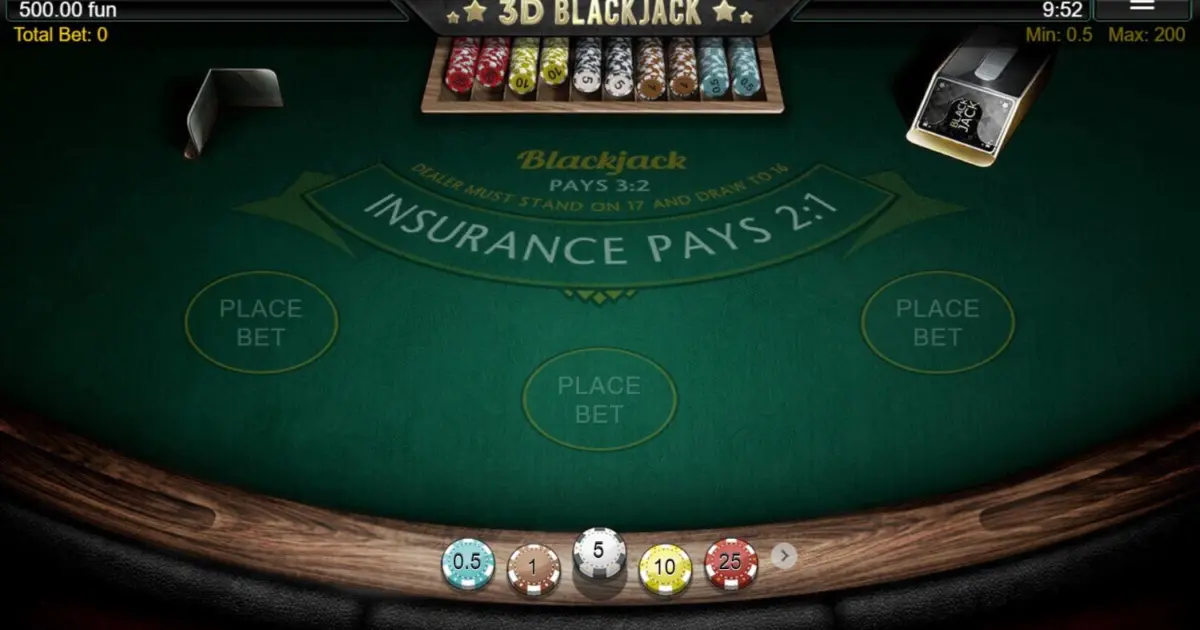
3D Blackjack from Iron Dog Studio reports a published RTP of 99.54%, which translates to a house edge of 0.46% — assuming you play perfect basic strategy on every single hand. That figure places it slightly above the corpus average, but Iron Dog Studio has not published the deck count, the blackjack payout, or the soft-17 rule, so you cannot independently verify the number until you open the game’s own paytable. If you want a table where every rule is transparent before you stake money, this one asks you to take its headline figure on trust.
3D Blackjack in one minute
Iron Dog Studio released this table as a 3D-rendered blackjack game — the visual presentation is the selling point rather than a novel rule set. The provider carries a total game count of one on this site, meaning 3D Blackjack is both its first and only blackjack title, and its provider average RTP matches the table RTP at 99.54%. No side bets, deck count, surrender rules, or table limits are published in the available data. That absence is the single most important thing to understand before you sit down, because the house edge is not a number the provider chooses arbitrarily — it is the arithmetic consequence of specific rules, and without those rules you cannot confirm whether 0.46% is achievable or merely aspirational.
House edge versus RTP: the numbers explained
RTP and house edge are two halves of the same figure: 100% minus the house edge equals RTP, so a published 99.54% RTP implies a 0.46% house edge. The critical caveat that experienced players already know is that this figure assumes perfect basic strategy on every hand. Deviate from the chart even occasionally — standing on 16 against a dealer 10, or hitting when you should double — and your realised return drops by several tenths of a percent. The gap between advertised and realised RTP is where casual players lose value.
Without published rule details for this table, here is what general blackjack maths tells you about the range within which 0.46% likely falls. A typical multi-deck game with dealer stands on soft 17, late surrender allowed, and double after split permitted sits around 0.30–0.40% with perfect play. If the blackjack pays 6:5 instead of 3:2, add roughly 1.4% to the edge — which would push the total well above 1% and make the published 99.54% figure inaccurate. The fact that Iron Dog Studio publishes 99.54% suggests the table pays at least 3:2 on a natural, but the only way to confirm is to read the in-game rules screen.
| Figure | Value | Source |
|---|---|---|
| Published RTP | 99.54% | Provider disclosure |
| Implied house edge | 0.46% | Arithmetic from RTP |
| Corpus average RTP | 99.41% | Site-wide benchmark |
| Difference versus corpus | +0.13% | RTP minus corpus |
| Deck count | Not published | — |
| Blackjack payout | Not published | — |
| Soft-17 rule | Not published | — |
| Side bets | Not published | — |
How this table compares to other online blackjack
The corpus average RTP for blackjack tables on this site is 99.41%. Iron Dog Studio’s 3D Blackjack sits 0.13 percentage points above that benchmark — a small margin in absolute terms, but meaningful when you consider that even a tenth of a percent compounds over thousands of hands into a materially different expected loss per session. For context, American Blackjack reports an RTP of 99.50%, placing it marginally below 3D Blackjack but above the corpus average. If you are comparing tables by headline number alone, the gap between those two is negligible; the difference will come down to rule transparency and presentation.
Classic Blackjack on this site publishes an RTP of 99.28%, a full 26 hundredths below the corpus average and 26 hundredths below 3D Blackjack. That is a more noticeable gap: a player staking $10 per hand over 500 hands would expect to retain roughly $1.30 more per thousand hands on 3D Blackjack than on Classic Blackjack, all else being equal. The name “Blackjack (Mascot Gaming)” also reports 99.50%, the same figure as American Blackjack, making it another closely matched alternative worth a look if you want more rule disclosure.
Basic strategy in practice
Basic strategy is a solved chart — a finite set of decisions for every possible player total against every dealer upcard — derived from computer simulations running millions of hands. It does not guarantee wins. It minimises the house edge to the lowest figure the rules permit, and that minimum is still a positive number for the house. Against 3D Blackjack, the published 0.46% edge is achievable only if you execute every decision correctly, including the non-obvious ones: doubling A-7 versus dealer 2 through 6, surrendering 15 versus dealer 10 when late surrender is available, never splitting 10-value pairs.
Because Iron Dog Studio has not published whether this table allows late surrender or double after split, the basic strategy chart you use may be suboptimal. A chart designed for a game with DAS and surrender will tell you to play more aggressively than a no-DAS, no-surrender table rewards. Until you confirm the rules in the paytable, treat any strategy recommendation as provisional. The safest approach is to play the chart for the rule set you can see on screen.
Betting systems and why they do not change the odds
No betting progression — Martingale, D’Alembert, Fibonacci, Paroli, or any variant — alters the expected value of a blackjack hand. Each hand carries the house edge dictated by the rules, and your stake size on any given hand is independent of the mathematical probability that hand will win. Progressions redistribute when you experience variance; they do not remove the edge. A Martingale sequence that doubles after every loss eventually produces a session win, but it does so by accepting an occasional catastrophic loss that cancels the accumulated small wins. The expected value remains negative throughout.
Flat betting with a strict session budget is the only approach that keeps your realised return close to the theoretical RTP. Unit sizing matters: if the minimum bet is a large fraction of your total bankroll, you will bust before the law of large numbers has time to bring your result near the mean. Experienced players typically risk no more than 1–2% per unit, giving the long run room to operate.
The free demo
A free demo version of 3D Blackjack is available, letting you play without staking money. This is useful for learning the interface, checking the in-game paytable, and practising basic strategy decisions without financial consequence. One important limitation: demo play uses the same RNG as the real-money version, but no sequence of demo results predicts what will happen when you switch to real money. Short sessions swing wildly around the expected value in either direction.
Card counting — tracking high and low card ratios to identify favourable decks — does not work against an RNG blackjack table. The shuffle resets composition every hand, so no information from previous deals carries forward. If you see a “card counting works online” video, it is describing either live-dealer games with a finite shoe or a fundamentally incorrect premise.
Play for entertainment, not income. Set a budget before your first hand and treat the session as a fixed cost. If you are 18 or older and want to play responsibly, this approach protects your bankroll from the variance that blackjack’s structure guarantees.
Verdict
3D Blackjack delivers a headline RTP that sits above the site average, and Iron Dog Studio’s visual presentation gives it a distinct feel among the many blackjack tables on this platform. The honest limitation is transparency: a provider with one game and no published rule breakdown asks players to take a number on faith. Compare it with American Blackjack or Classic Blackjack to see how different tables handle the same maths, and always confirm the deck count, payout ratio, and surrender rules in the game’s own paytable before deciding whether the 0.46% edge is within reach for your style of play.
Frequently Asked Questions
Can I play 3D Blackjack for free?
Yes, a free demo version is available with no registration or deposit required. The demo uses the same RNG as the real-money game and is suitable for practising basic strategy decisions and checking the in-game paytable without financial risk. Demo results do not predict real-money outcomes in either direction.
What does 99.54% RTP mean for my expected loss?
A 99.54% RTP implies a house edge of 0.46%, meaning the table retains 46 cents per hundred dollars wagered over very many hands. That figure assumes perfect basic strategy on every decision — any deviation increases the real edge, sometimes substantially, so casual play will produce a lower return than the headline number suggests.
How does 3D Blackjack's house edge compare to American Blackjack?
3D Blackjack publishes an RTP of 99.54% versus American Blackjack's 99.50%, a difference of four hundredths of a percentage point in the player's favour. Over thousands of hands this margin is measurable, but it is small enough that rule transparency and table limits will matter more to your session outcome than that single basis point difference.
Does card counting work on 3D Blackjack?
No. This is an RNG table that reshuffles every hand, so card composition resets completely between deals. No running count or true count carries forward to the next hand. Card counting requires a finite shoe with a known penetration percentage, which no online RNG blackjack provides regardless of its published RTP figure.
Who developed 3D Blackjack and how many games does the studio make?
Iron Dog Studio developed 3D Blackjack, and it is the provider's only game listed on this review site. The studio's average RTP equals the table's RTP at 99.54% because there is only one product. This single-game portfolio means no track record of rule disclosure practices exists to judge the published figure against.




