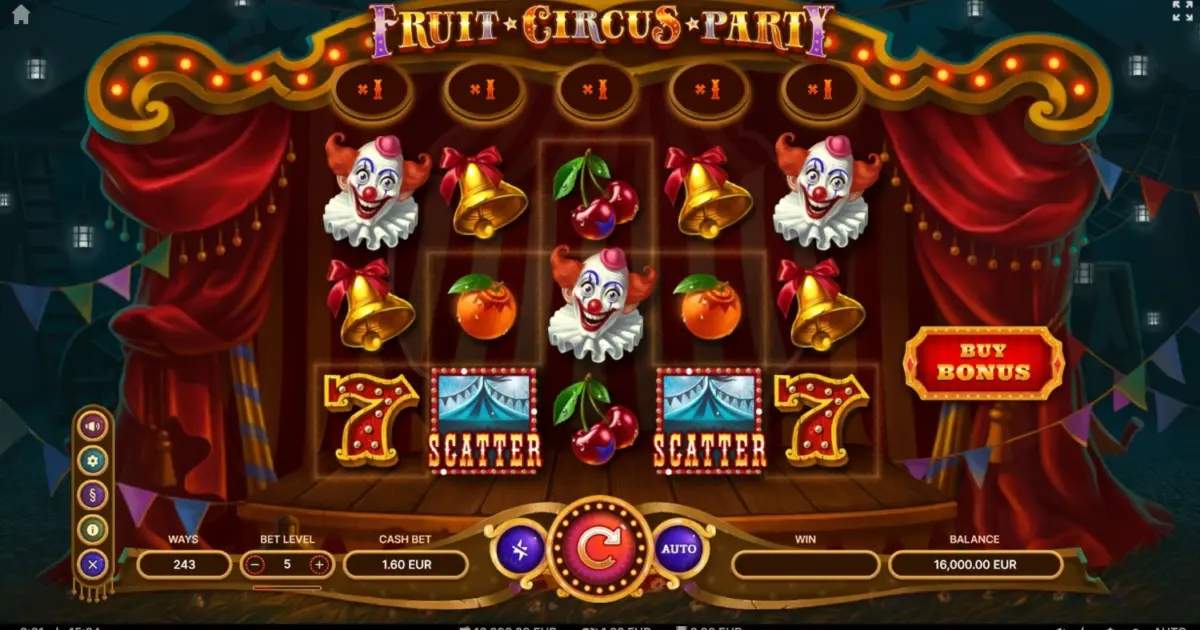
The single number that decides whether the fruit circus party slot deserves your time is 89.04%. That is its published return to player, and it sits 6.67 percentage points below the 95.71% average across the slots covered here. TrueLab Games built it on 5 reels around a fruit theme, and a free demo is available, which is the cheapest possible way to look at it. The maths, though, is the whole story.
Fruit Circus Party Slot versus the average slot
An RTP gap of 6.67 percentage points sounds abstract until you convert it into money wagered. Take 1,000 spins at £1 a spin. That is £1,000 put through the machine. At the 95.71% corpus average, the long-run expected return on that turnover is £957.10. At 89.04%, it is £890.40. The difference is £66.70 of extra expected cost for the same number of spins and the same stake.
Scale it up and the gap widens in proportion. At £2,000 of turnover the expected shortfall against an average slot is roughly £133. At £5,000 it is around £334. None of these figures predict what happens in any individual session — short runs are dominated by variance, not by the theoretical rate — but over enough spins the published percentage is what the game converges toward.
This title also carries a popularity rank of 2378, putting it in the 88.1st percentile for attention among the games listed here. Popularity and payback percentage are unrelated measures. A widely played game is not a better-paying game, and this one illustrates the point clearly.
RTP breakdown: 89.04% in context
An 89.04% RTP means a theoretical house edge of 10.96% — roughly £10.96 retained per £100 wagered across a very large sample of spins. For comparison, most modern video slots publish figures between 94% and 97%, which puts the house edge in the 3% to 6% band. This game roughly doubles to triples that.
Two things are worth being precise about. First, RTP is a long-run statistical average measured over millions of simulated spins, not a promise about your next hundred. Second, every spin is independent. The reels have no memory of what came before, so a run of dead spins does not make a paying combination more likely on the next one, and a good run does not borrow against the future.
| Figure | Value |
|---|---|
| Provider | TrueLab Games |
| RTP | 89.04% |
| Reels | 5 |
| Theme | Fruits, 5-Reels |
| Type | Slot Machine |
| Provider average RTP | 95.88% |
| Corpus average RTP | 95.71% |
| Difference vs corpus | -6.67 points |
| Popularity rank | 2378 |
| Free demo | Available |
Paylines, ways-to-win count, hit frequency and maximum win are not published for this release, so any figure you see quoted for them elsewhere is unverified. Treat it that way.
Volatility profile
No volatility rating has been published for this game, so it cannot be classified here as low, medium or high. That absence matters, because volatility is the figure that tells you what a session is likely to feel like, and without it you are choosing partly blind.
As a general principle: low-volatility slots tend to return small amounts frequently, which stretches a given bankroll over more spins and keeps swings shallow. High-volatility slots pay less often but in larger amounts when they do, which means longer barren stretches and a need for a deeper bankroll to ride them out. Medium sits between the two. Crucially, volatility says nothing about payback rate — a high-volatility game can have a 97% RTP and a low-volatility game an 89% one, or the reverse.
What you can infer is limited to the RTP itself. Whatever the distribution of outcomes here, the average rate at which stakes come back is 89.04%, and a wider distribution around a lower average simply means the downside stretches further. If session predictability matters to you, a game that publishes both figures is an easier decision.
TrueLab Games as a studio
TrueLab Games has 55 titles in this database, with an average RTP across them of 95.88%. That average is slightly above the 95.71% corpus figure, which makes this release an outlier within its own catalogue rather than a reflection of how the studio usually sets its numbers. The gap is about 6.84 points below the studio’s own mean.
That matters practically. If you like what TrueLab produces, you do not have to accept an 89.04% return to get it. Hot Devil Slot from the same studio publishes 96.30%, which is 7.26 points higher and cuts the theoretical house edge from 10.96% to 3.70% — roughly a third of the cost per £100 wagered.
The broader point is that RTP is a configurable setting, sometimes offered to operators in multiple versions of the same game. Always check the figure displayed in the game’s own information panel wherever you are playing, because it is the authoritative number for that specific deployment and it can differ from third-party listings, including this one.
Three Fruits alternatives worth comparing
Fruit slots are one of the deepest categories in the business — 2,560 titles carry the theme here — so there is no shortage of substitutes at better rates. Three are worth a direct comparison.
- Hot Hot Fruit publishes 96.84%, the highest of this group and 7.80 points above this game. On £1,000 of turnover that is about £78 less in expected cost.
- Trickstar Spins sits at 94.00%. That is still below the corpus average, but it is nearly five points clear of 89.04% and shows how wide the spread within a single theme can be.
- Sevens High has no published RTP in this listing. Where a figure is unavailable, check the in-game information screen before committing real money rather than assuming it is in the normal range.
Comparing published percentages before you pick a game is the only lever available to you that actually changes long-run expected cost. Nothing about how or when you spin does.
Getting the most out of the free demo
A free demo is available, and for a game with these numbers it is the sensible first stop. Demo mode is a Fruit Circus Party free demo in the literal sense: virtual credits, no stake, typically no download and no account. Use it to see the interface, the paytable, the bet control and the information screen — and in particular to read the RTP that the specific version in front of you reports.
One limit is worth stating plainly. Demo results do not predict real-money results. A demo session with a run of good outcomes tells you nothing about the next real session, because outcomes are independent and short samples say little about a long-run average.
If you do move to real stakes: this is 18+ only, set a budget before you start and treat the money as the price of entertainment you have already agreed to spend rather than as something you expect back. Decide the number in advance, and stop at it.
Should you play Fruit Circus Party?
For a curiosity look in demo mode, there is no cost and no reason not to. For real money, the case is weak. The published 89.04% return is 6.67 points under the corpus average and 6.84 under TrueLab’s own catalogue average, with no volatility rating, payline count or maximum win figure published to weigh against it.
If the fruit theme is what you want, better-documented options at higher published rates sit in the same category and in the same studio’s range. Choosing on published RTP is the one decision that measurably changes your expected cost per £100 wagered. On that measure, this one is hard to recommend over the alternatives above.
Frequently Asked Questions
Can I play Fruit Circus Party for free?
Free demo play is available for this TrueLab Games title, which runs on virtual credits with no stake at risk and usually no download or account needed. It is the practical way to inspect the paytable, bet controls and the in-game information screen — including the RTP that specific version reports — before deciding whether to stake anything.
What is the RTP of Fruit Circus Party and is it good?
The published RTP is 89.04%, which is low. It implies a theoretical house edge of 10.96%, or about £10.96 retained per £100 wagered across a very large sample. The corpus average here is 95.71%, so the gap is 6.67 percentage points — roughly £67 more expected cost per £1,000 of turnover.
How volatile is Fruit Circus Party?
No volatility rating has been published for this game, so it cannot be classified as low, medium or high. That is a genuine information gap, because volatility determines how long a bankroll tends to last and how deep the swings run. The only confirmed figure for the game's payback behaviour is the 89.04% RTP.
Who are TrueLab Games?
TrueLab Games is the studio behind this release, with 55 titles listed here and an average RTP across them of 95.88% — slightly above the corpus average of 95.71%. That makes this particular game an outlier in their catalogue. Hot Devil Slot, from the same studio, publishes 96.30% by comparison.
How does Fruit Circus Party compare to Hot Hot Fruit?
Hot Hot Fruit publishes a 96.84% RTP against 89.04% here, a difference of 7.80 percentage points in its favour. On £1,000 of turnover that is around £78 less in long-run expected cost. Both sit in the fruit category, which spans 2,560 titles, so substitutes at better published rates are easy to find.