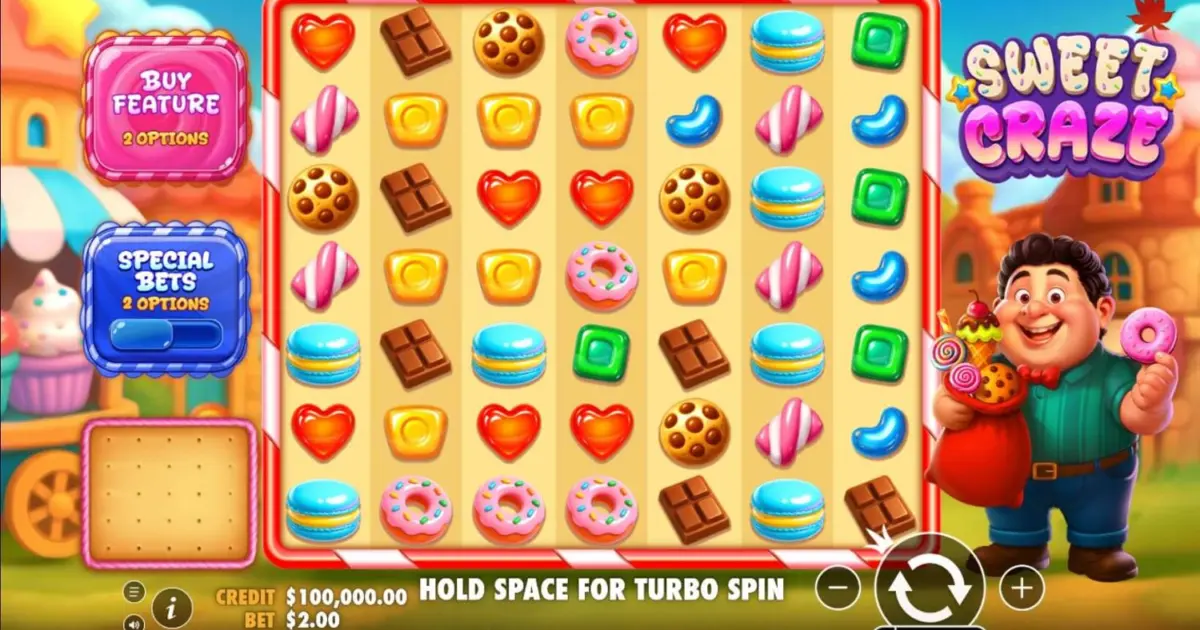
If you only read one line: the published return on this game is 97.54%, which is higher than almost anything else in our database, and the free demo is available so you can look before committing money. That is the case for trying the sweet craze slot. The case against it is thinner data — Pragmatic Play has not published a volatility rating, a max win figure or a hit frequency for this title, so a large part of the session experience is unknown going in.
Below, the numbers that do exist, what they imply mathematically, and where this game sits against its provider’s catalogue and its theme peers.
| Figure | Value |
|---|---|
| Provider | Pragmatic Play |
| RTP | 97.54% |
| Reels | 7 |
| Type | Slot Machine |
| Themes | Sweets, Christmas, 7-Reels |
| Popularity rank | 2,348 (88.2nd percentile) |
| Free demo | Available |
| Volatility | Not published |
| Max win | Not published |
Sweet Craze versus the average slot
The headline comparison is 1.83 percentage points. The average return across the slots we hold data on is 95.71%. This game is listed at 97.54%. In practical terms, wager £1,000 on an average-RTP game and the long-run expected return is £957.10; wager the same £1,000 here and the long-run expected return is £975.40. The difference is £18.30 per £1,000 staked.
That sounds small, and over a single session it is invisible — swing dominates edge at low spin counts. It compounds, though. Someone who plays the same amount every week for a year at 97.54% rather than 95.71% keeps a meaningful slice of turnover that would otherwise have gone to the house edge. Nothing about that is a promise of profit: the expected value is still negative at both figures. A 2.46% house edge is smaller than a 4.29% house edge, and that is the entire claim.
Where it sits on popularity is worth a glance too. Rank 2,348 puts it in the 88.2nd percentile — played more than most titles, but not a headline release. Popularity carries no mathematical information about outcomes.
RTP breakdown: 97.54% in context
Return to player is a long-run statistical average calculated over millions of simulated spins, not a session target. At 97.54%, the design returns £97.54 for every £100 wagered across a very large sample. Your own results will scatter widely around that line, and the scatter is larger than most players expect.
Put numbers on it. At £0.20 a spin, 1,000 spins is £200 of turnover. The expected loss is £4.92. Actual outcomes at that sample size routinely land anywhere from a substantial profit to losing most of the £200, because the distribution of slot results is skewed: many small losses offset by rare large hits. RTP describes the mean of that distribution, nothing about its shape.
Two more things follow from the definition. First, every spin is independent — the game holds no memory of what came before, so a run of dead spins does not shift the odds of the next one. Second, some operators configure titles at lower RTP settings than the maximum the studio ships. It is worth checking the figure displayed in the game’s own info panel rather than assuming 97.54% applies everywhere.
Volatility profile
There is no published volatility rating for this game, and that absence matters more than a missing max win number. Volatility is what determines how a session actually feels: how long a fixed bankroll lasts, how deep the losing runs go, how much of the return arrives in rare large payouts versus frequent small ones.
The general pattern is consistent across slots. Low volatility means frequent modest returns, shallow swings and a bankroll that drains slowly and predictably — 100 spins at 1% of your budget each is usually survivable. High volatility means long stretches returning nothing, punctuated by occasional outsized hits, and it requires a bankroll several times larger to reach the point where the maths has any chance to express itself. The same 97.54% return can be delivered either way.
Because you cannot know which applies here from published data, the demo is the practical substitute. Play 200 or 300 free rounds at a fixed stake and watch the balance line: does it grind gently downward with regular small recoveries, or sit flat for long periods? That gives you a rough feel. It does not give you a number, and it does not predict real-money sessions — demo results are a separate, independent sample.
Pragmatic Play as a studio
Pragmatic Play is one of the largest slot suppliers by volume, with 739 titles in our database and an average published return of 96.32% across them. That average is already above the 95.71% corpus figure, so the studio tends to ship competitive maths — and this game sits 1.22 points above even its own house average, which makes it an outlier within the catalogue rather than a typical release.
For context on what the studio’s better-known work returns: Gates of Olympus is listed at 96.50%, more than a point below this title despite being far more widely played. Joker’s Jewels sits at the same 96.50%. In other words, if the published return is your main filter, the studio’s most famous games are not its strongest on that measure.
Volume also means variety in mechanics and presentation. With 739 titles, the studio covers most formats you will encounter, so the RTP figure and the theme label are usually more useful filters than the developer name alone when you are choosing between Pragmatic Play slots.
Three Sweets alternatives worth comparing
The sweets theme is crowded — 313 titles in our data carry it — so there is no shortage of substitutes if this one does not suit you.
- Sweet Bonanza is the obvious benchmark, from the same studio, listed at 96.51%. It is far better known, but that is a full percentage point below this game’s return, which is £10 more expected cost per £1,000 staked.
- Lollipop Drop MultiMax sits at 94.00%. That is 3.54 points below, and the widest gap of the three — a 6% house edge against 2.46%. Useful mainly as a demonstration of how much published returns vary inside a single theme.
- Sugar Land has no RTP figure recorded at all. When a return is unpublished you cannot compare it on the one measure that is objectively comparable, so treat it as an unknown rather than assuming it matches its neighbours.
On published maths alone, this title beats all three. The caveat stands: none of the four has a stated volatility rating here, so the returns are comparable but the session profiles are not.
Getting the most out of the free demo
Demo play costs nothing and answers the questions the data sheet cannot. Use it to check pace, how the 7-reel layout reads on your screen, whether the interface annoys you, and how the balance behaves over a few hundred rounds. Also check the in-game info panel for the RTP the operator has configured and for any feature details, since those are described there and not in the figures above.
Two limits worth being clear about. Demo balances are play money, so no demo result can pay out, and demo sessions carry no predictive value for real-money play — each is an independent sample from the same distribution. A good demo run tells you nothing about the next real spin.
If you do move to real stakes: this is for adults 18 and over. Decide the amount you are willing to lose before you start, treat it as the price of the entertainment rather than an investment, and stop when it is gone. No stake pattern, spin timing or bet progression changes the 2.46% house edge — the maths is fixed per spin regardless of how you sequence your bets.
Should you play the Sweet Craze slot?
Worth a look if published return is your primary filter. 97.54% is 1.83 points above the corpus average and 1.22 points above Pragmatic Play’s own average, which puts it ahead of the studio’s most famous titles on the one number you can objectively compare. That is a real, if modest, advantage in cost per unit of turnover.
Less compelling if you need to know what you are getting into before you start. No volatility rating and no published max win means the shape of the experience is genuinely unknown, and shape is what determines whether a given bankroll survives a session. Treat any max win figure quoted elsewhere with caution unless the game’s own info panel confirms it.
The sensible order: run the demo, read the info panel, confirm the RTP your operator has set, and compare it against Sweet Bonanza if you want the better-documented option in the same theme from the same studio.
More from Pragmatic Play
- Buffalo King Megaways — 96.52% RTP
- Wolf Gold — 96.0% RTP
- Queenie — 96.51% RTP
- Gods of Oblivion — 94.5% RTP
- Big Bass Bonanza 1000 — 96.51% RTP
- Lucky Ox — 96.55% RTP
- 5 Lions Reborn — 96.5% RTP
- Mammoth Gold Megaways — 96.03% RTP
Frequently Asked Questions
Can I play Sweet Craze for free?
A free demo is available for this title, so you can spin it with play-money credits and no deposit. The demo lets you check the 7-reel layout, the pace and the RTP figure shown in the game's info panel. Demo balances hold no cash value and cannot be withdrawn.
What is the RTP of Sweet Craze?
The published return is 97.54%, meaning £97.54 comes back per £100 wagered across a very large sample. That is 1.83 points above the 95.71% average across the slots we track, leaving a 2.46% house edge. Individual sessions scatter widely around that average, and some operators run lower configured settings.
Is Sweet Craze high or low volatility?
No volatility rating has been published for this game, so the risk profile is unknown from the data sheet. Low volatility usually means frequent small returns and shallow swings; high volatility means long dead runs and rare larger hits. A few hundred demo rounds at a fixed stake gives you a rough feel.
Who makes Sweet Craze and what else do they produce?
Pragmatic Play developed it, one of the largest suppliers by catalogue size with 739 titles in our database and an average published return of 96.32%. Their best-known releases include Gates of Olympus and Sweet Bonanza, both listed at roughly 96.5% — around a point below this game's figure.
How does Sweet Craze compare to Sweet Bonanza?
On published maths this title is ahead: 97.54% against 96.51% for Sweet Bonanza, a gap worth about £10 per £1,000 staked in expected cost. Sweet Bonanza is far more widely played and better documented. Neither has a stated volatility rating in our data, so session profiles are not directly comparable.