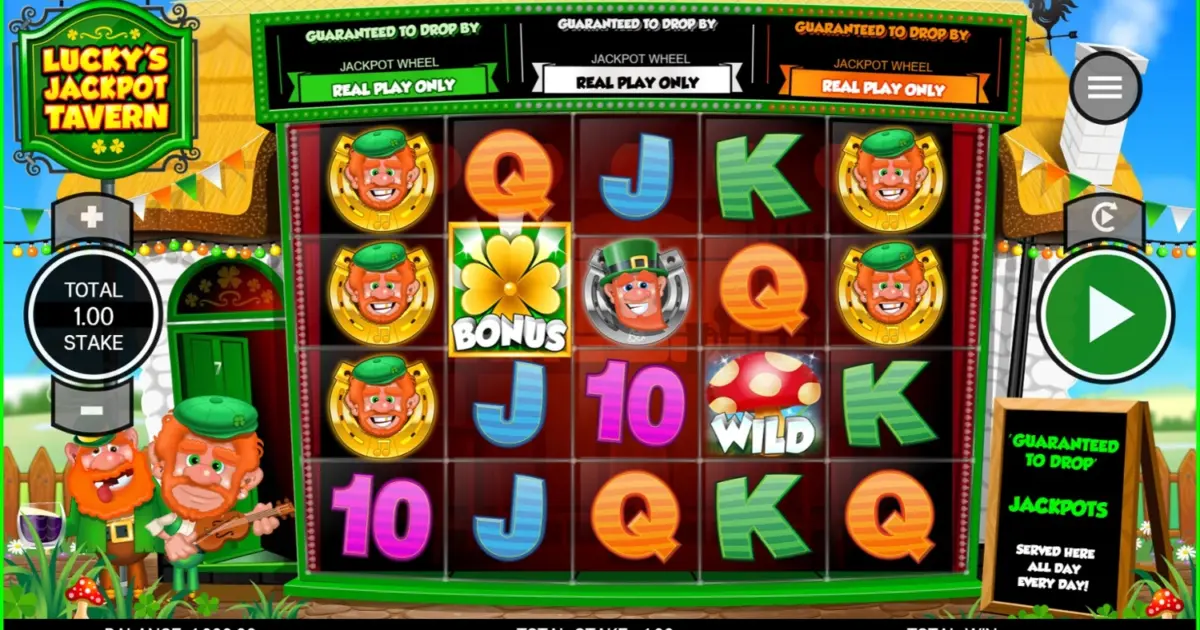
Lucky’s Jackpot Tavern sits at 95.22% RTP—essentially level with Core Gaming’s portfolio average of 95.21%, but 0.49 percentage points below the 95.71% you’ll find across the wider slot market. That half-point shortfall translates to £49.50 less returned per £10,000 wagered in the very long run, a gap that compounds over extended play. The 5-reel grid and tavern theme position this as a classic pub-style slot, but the numbers tell you more about your session than the setting does.
| Specification | Value |
|---|---|
| RTP | 95.22% |
| Reels | 5 |
| Provider | Core Gaming |
| Free demo | Yes |
| Popularity rank | 2,332 (88th percentile) |
The 5-reel grid explained
A 5-reel layout gives the game five vertical columns of symbols that spin and stop independently. Most modern slots use this configuration because it balances screen space with the number of possible symbol combinations—three reels offer too few outcomes, while six or more can feel cluttered. Each reel holds a strip of symbols, and the order in which those symbols appear is fixed. When you press spin, a random number generator selects a stop position for each reel, determining which symbols land on the paylines.
The 5-reel structure has been the industry standard since video slots replaced mechanical machines. It accommodates a wide range of payline counts and “ways to win” mechanics without forcing the developer to add more reels or shrink the symbol size. For you, that means familiar navigation: symbols read left to right, and wins are checked after every spin against whatever payline or combination rules the game applies.
Paylines, ways and how Lucky’s Jackpot Tavern pays
Core Gaming has not published payline or ways-to-win data for this title, so the exact win mechanic remains unspecified. Many 5-reel slots use fixed paylines—often 10, 20, 25 or 30 lines that run left to right in predetermined patterns—while others use a “ways” system, most commonly 243 ways, which pays any matching symbol that appears on consecutive reels starting from the leftmost. A third group uses adjustable paylines, letting you activate fewer lines at lower cost per spin.
Without confirmation, treat any payline figure you see quoted elsewhere as unverified. The paytable inside the game client will show you the actual patterns that trigger wins. If you’re comparing this slot to others in the Core Gaming catalogue, Cobra Cash runs at 95.3% RTP and may share a similar structure, while Furballs offers a notably higher 97.94% return.
95.22% RTP put in context
RTP—return to player—is the percentage of all wagered money that a slot pays back as winnings across millions of spins. A 95.22% RTP means that for every £100 wagered in aggregate, the game returns £95.22 and retains £4.78 as house edge. This is a long-run statistical average; over 100 or 1,000 spins your actual return will swing far from that figure, and individual sessions regularly end above or below it.
Lucky’s Jackpot Tavern sits 0.49 points below the corpus average of 95.71%. Across 10,000 spins at £1 per spin, that gap costs you roughly £49 compared to a slot at market average RTP. Core Gaming’s portfolio averages 95.21%, so this title is fractionally above the provider’s norm but still lags the broader field. If RTP is your priority, Furballs at 97.94% returns nearly three percentage points more.
How the numbers scale
Over 1,000 spins at £1 per spin, a 95.22% RTP game returns £952.20 on average; a 96% game returns £960. The £7.80 difference is modest. Over 50,000 spins the gap widens to £390. RTP matters most to players who log hundreds of sessions on the same title or who play at stakes where every percentage point represents meaningful money.
Volatility and hit patterns
Core Gaming has not published a volatility rating for Lucky’s Jackpot Tavern, so the game’s variance—the size and frequency of wins—is not officially documented. Volatility describes how a slot distributes its RTP: low-volatility games pay smaller amounts more often, keeping your balance stable but capping upside; high-volatility games pay less frequently but deliver larger wins when they hit, causing dramatic swings and requiring a bigger bankroll to weather the dry spells.
Without a confirmed rating, you can infer rough variance by playing the demo and tracking how often the balance moves and by how much. If wins arrive every few spins and rarely exceed ten times your stake, you’re likely looking at low to medium variance. If the balance drops steadily for dozens of spins then jumps sharply, the game skews higher. Missing volatility data is itself useful: it tells you to budget conservatively until you’ve tested the rhythm yourself.
Choosing a stake between unknown and unknown
Core Gaming has not disclosed the minimum or maximum bet for this slot, so stake range remains unspecified. Most modern slots accept bets from £0.10 or £0.20 up to £50, £100 or occasionally £250 per spin, but without confirmed figures you’ll need to check the in-game bet selector before you commit real money. The stake you choose should reflect your total session budget and the game’s volatility: a £50 bankroll at £1 per spin gives you 50 base-game spins, enough to see some pattern in a low-variance game but marginal in a high-variance title where a bonus trigger might take 100 spins or more.
A common guideline is to ensure your bankroll covers at least 100 spins at your chosen stake, giving the game’s RTP and hit frequency time to express themselves. If the minimum bet turns out to be £0.50 and you have £50, you can afford 100 spins; if the minimum is higher, adjust your budget or pick another game. The absence of published stake data is a transparency gap, and you should treat it as a reason to demo first.
Demo play versus real money
Lucky’s Jackpot Tavern offers a free demo, and you should use it. Demo mode runs the same RNG, reel strips and paytable as the real-money version, so win frequency and the feel of the game are identical. The crucial difference: demo credits have no value, so a £500 win in demo costs the provider nothing and pays you nothing. Real-money play converts that same outcome into withdrawable cash, but it also converts losses into actual cost.
Demo play lets you confirm the stake range, test the volatility, and decide whether the game’s rhythm suits your patience and bankroll before you risk a penny. It does not, however, predict your real-money results. Every spin is independent; the RNG does not remember what happened in demo mode, and a hot streak in practice does not make the game “due” to pay when you switch to real money. Each mode uses the same mathematics, and neither tilts the odds.
Set a budget before you play, treat that money as the cost of entertainment, and stop when the budget is gone. Never chase losses, never bet money you need for anything else, and remember that no stake size or betting pattern changes the house edge. This game is for adults aged 18 and over.
Verdict on Lucky’s Jackpot Tavern
Lucky’s Jackpot Tavern delivers a below-average RTP in a field where half a percentage point compounds quickly. At 95.22%, it lags the market by 0.49 points and offers no disclosed volatility, stake range or payline data to help you plan a session. The free demo is available, and that’s where this game belongs until you’ve tested its rhythm and confirmed the bet limits fit your budget. Core Gaming’s back catalogue includes stronger options: Furballs returns 97.94%, nearly three full points higher, while Power Gems at 95.02% sits close to this title but with clearer documentation.
The 5-reel grid is standard, the tavern theme is cosmetic, and the popularity rank of 2,332 suggests this slot sees play but hasn’t broken into the top tier. If RTP and transparency matter to you, compare the numbers before you spin. If the theme appeals and you’re comfortable with the return rate, the demo will show you whether the game’s pacing suits your tolerance for variance. Either way, know the figures before you fund the session.
Frequently Asked Questions
Can I play Lucky's Jackpot Tavern for free without downloading software?
Yes, Lucky's Jackpot Tavern offers a free demo that runs in your browser with no download required. The demo uses the same RNG and paytable as the real-money version, so you see the actual game rhythm and volatility. Demo credits hold no value, but the mode lets you test stake limits and hit frequency before risking your own money.
What does the 95.22% RTP mean for my bankroll?
RTP is a long-run statistical average, not a session guarantee. Over millions of spins, Lucky's Jackpot Tavern returns £95.22 per £100 wagered. In a single session of 500 or 1,000 spins, your result will vary widely—landing well above or below that figure is normal. The 95.22% RTP sits 0.49 points below the market average, costing you roughly £49 per 10,000 spins compared to a slot at 95.71%.
Is Core Gaming a reputable slot provider?
Core Gaming has 43 titles in their portfolio and maintains an average RTP of 95.21%, fractionally below the broader market. Lucky's Jackpot Tavern sits just above that provider average. If you're exploring their catalogue, Furballs delivers 97.94% RTP and Cobra Cash offers 95.3%, both worth comparing before you commit to this title.
How much should I budget per session if volatility is unknown?
Without a published volatility rating, budget conservatively—at least 100 spins at your chosen stake, and preferably 150 to 200 if you want to see a representative sample of the game's rhythm. Play the demo first and track how often your balance swings and by how much. If wins cluster frequently, a smaller bankroll may suffice; if the balance drops for long stretches before a big hit, you'll need deeper reserves.
Does demo play influence my luck when I switch to real money?
No. Every spin uses an independent random number, and the RNG does not carry memory between demo and real-money modes. A winning streak in demo does not make the game "due" to pay—or to withhold—when you deposit. Both modes apply the same 95.22% RTP and the same symbol probabilities, so neither tilts the odds in your favour.