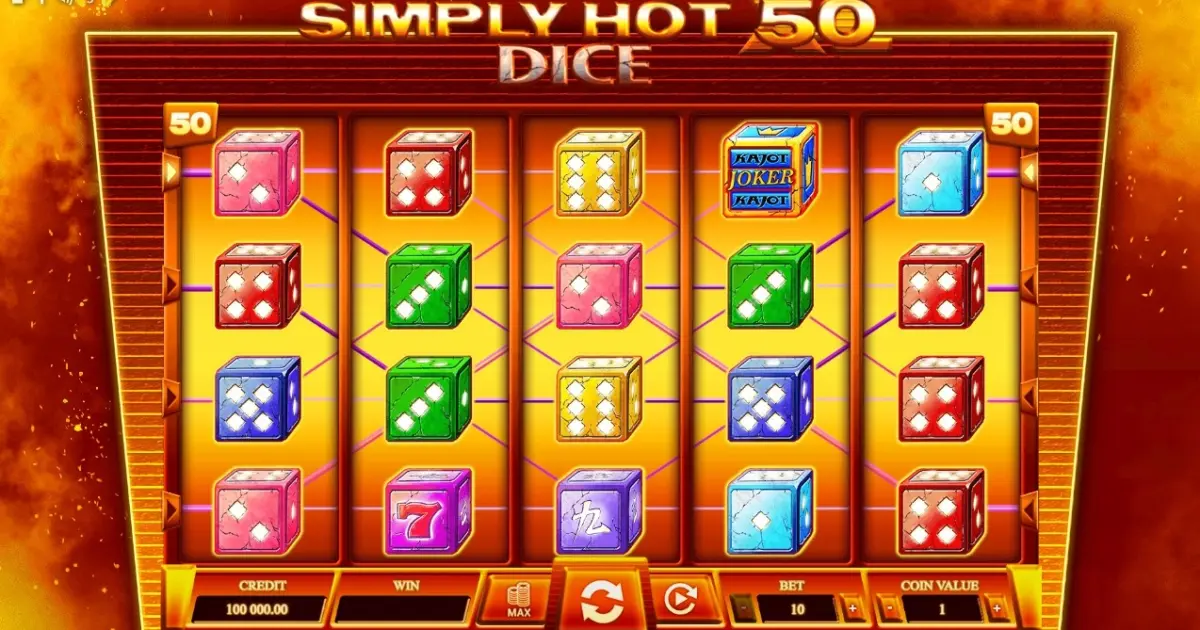
Kajot’s simple hot xl 50 dice slot is a five-reel machine with a published return to player of 96.0%, which sits a shade above the 95.71% average across the games in our database and roughly half a percentage point above Kajot’s own 95.55% house average. A free demo is available, so you can watch it behave without committing money. What Kajot has not published is a volatility rating, a payline count, a stake range or a maximum win, and that absence should shape how cautiously you treat it.
Simple Hot XL 50 Dice at a glance
The numbers that exist are few but useful. A 96.0% return, five reels, and a place in Kajot’s catalogue of 36 titles. It ranks 2,244 in our popularity data, which puts it in the 88.8th percentile — busier than most of the library, though popularity tells you nothing about how the game pays.
| Field | Value |
|---|---|
| Game | Simple Hot XL 50 Dice |
| Provider | Kajot |
| RTP | 96.0% |
| Reels | 5 |
| Category | Slot Machine |
| Theme label | 5-Reels |
| Popularity rank | 2,244 (88.8th percentile) |
| Provider catalogue | 36 games |
| Provider average RTP | 95.55% |
| Free demo | Available |
This suits a reader who cares more about the headline return figure than about feature depth, and who is comfortable evaluating a game by playing it rather than by reading a spec sheet. If you want documented mechanics before you spin, the information simply is not there.
What a 96.0% RTP actually returns
RTP is a long-run statistical average, not a session promise. At 96.0%, the game is modelled to return £96 for every £100 wagered across a very large sample of spins — millions, not hundreds. Your own results will scatter around that line, sometimes wildly.
Work it through. Stake £0.20 a spin for 1,000 spins and you have wagered £200. The expected return on that turnover is £192, an expected cost of £8. That is the average outcome, and a single 1,000-spin session is nowhere near large enough to land on it. You might finish up. You might lose the full £200. Both are consistent with a 96.0% figure, because every spin is independent and carries no memory of the one before.
Against the wider market, 96.0% is mildly favourable: 0.29 percentage points above the 95.71% corpus average, and 0.45 above Kajot’s own average. Over £1,000 of turnover, that 0.29-point edge is worth about £2.90 in expected cost. Real, measurable, and far smaller than the swing you will see in any single sitting. Compare it with Kajot’s Triple Stars Dice, published at 95.0%, and this title is the better long-run proposition of the two by a full percentage point.
Volatility is unpublished, and what that means for your session
Kajot has not published a volatility rating for this game, so any figure you see quoted elsewhere is someone’s guess. That matters, because volatility governs the texture of a session more directly than RTP does.
Two games can both return 96.0% and feel nothing alike. A low-volatility game pays small amounts often, so a fixed bankroll lasts longer and the graph of your balance drifts gently. A high-volatility game pays rarely and larger, which means long stretches of nothing punctuated by occasional spikes, and it needs a deeper bankroll to survive the dry runs without being wiped out. Medium sits between the two.
With no rating, the practical move is to find out for yourself in the demo. Run a few hundred spins at a constant stake and watch two things: how often any win lands at all, and how big the largest one is relative to your stake. Frequent small returns point to the lower end of the scale; long gaps followed by outsized hits point to the higher end. Judge it on what you observe, not on the “50” in the title, which is part of the name and not a documented payline count.
The 5-reel layout and how wins are counted
Five reels is the standard modern arrangement, and it tells you the game is a video slot rather than a three-reel classic. Beyond that, the payline or ways structure is not published here, so the honest answer is that the paytable inside the game is your only authority on how combinations are counted.
In general terms, five-reel slots resolve wins in one of a few ways. Fixed paylines award a prize when matching symbols land on defined patterns, usually left to right. “Ways” or “all ways” systems ignore position and pay on the count of matching symbols per reel. Cluster systems pay on adjacent groups. Each structure changes how many active combinations your stake is buying, which is why two five-reel games at the same stake can produce very different hit patterns.
The same caveat applies to features. Many slots use wilds, scatters or free-spin rounds, and some sell a bonus entry outright — but none of that is documented for this title, so assume nothing until the in-game paytable confirms it. If you want a Kajot game to set alongside this one for layout comparison, Joker 81 and Joker 27 come from the same studio, though neither has a published RTP for a like-for-like maths comparison.
Stake range and sizing a bankroll
No minimum or maximum stake is published, which means you will see the limits on the first screen of the demo rather than here. Check them before you plan anything, because stake range is what converts a bankroll into a number of spins.
The arithmetic is simple and worth doing every time. Divide your session budget by your stake to get your spin count. A £50 budget at £0.20 a spin buys 250 spins; the same £50 at £1 buys 50. At 96.0% RTP the expected cost of that £50 of turnover is £2 either way, but the 250-spin version gives the average far more room to assert itself, while the 50-spin version is almost entirely variance.
Two things to be clear about. Raising or lowering your stake, chasing losses, or changing bet size after a losing run does not alter expected value — the house edge is a fixed percentage of whatever you wager. And because volatility is unpublished, err toward the smaller end of the stake range until you have seen how the game behaves. A deeper spin count is the only protection variance respects.
Playing the Simple Hot XL 50 Dice slot demo before you commit
A free demo is available, and given how much is undocumented about this game, it is the sensible first stop. The demo runs on the same maths as the paid version, so it is the cheapest way to read the paytable, confirm the stake limits, learn the win structure and form your own view on volatility. A few hundred spins costs you nothing but time. Play it with no download by loading it in the browser.
One limit worth stating plainly: demo results do not predict real-money results. A hot streak in free play is variance, nothing more, and the next real spin is independent of everything that came before it.
Slots are paid entertainment with a built-in house edge, not a way to make money. Play only if you are 18 or over, decide what you are willing to spend before you open the game, and stop when that amount is gone. If the spending stops feeling like entertainment, close it.
Verdict: who should play Simple Hot XL 50 Dice
The case for it is the return figure. At 96.0%, it beats both the corpus average of 95.71% and Kajot’s own 95.55%, and it comfortably clears the 95.0% on the studio’s Triple Stars Dice. If you are picking between Kajot titles on documented maths alone, this is the stronger option in that set.
The case against is how little Kajot has published. No volatility rating, no payline count, no stake range, no maximum win. You cannot size a bankroll properly or anticipate the swing profile from the spec sheet, which pushes all of that work into the demo.
So: worth a look if you are comfortable evaluating a game hands-on and you value a slightly above-average return, and easy to skip if you want features and figures documented before you spin. Either way, start free, read the paytable, and decide from there.
Frequently Asked Questions
Can I play Simple Hot XL 50 Dice for free?
A free demo is available, which is the practical starting point for this game. Kajot has not published its volatility, payline count or stake limits, so the demo is where you confirm all of that at no cost. It runs the same 96.0% RTP maths as the paid version.
What is the RTP of Simple Hot XL 50 Dice?
The published RTP is 96.0%, meaning the game is modelled to return £96 per £100 wagered across a very large sample of spins. That is 0.29 percentage points above the 95.71% average across our database and 0.45 above Kajot's own 95.55%. Short sessions will vary widely from it.
Is Simple Hot XL 50 Dice high or low volatility?
Kajot has not published a volatility rating, so treat any figure quoted elsewhere with caution. Judge it in the demo instead: frequent small wins suggest lower volatility, while long dry runs broken by larger hits suggest higher. Volatility affects session length and swing size, not the 96.0% long-run return.
Who is Kajot and what else do they make?
Kajot is the studio behind this title, with 36 games in our database and an average published RTP of 95.55% across them. Other Kajot slots include Joker 81, Joker 27 and Triple Stars Dice, the last of which is published at 95.0% — a full point below this game's 96.0%.
How much should I stake per spin on this slot?
No stake range is published, so check the limits on the game's first screen. Then size from your budget: £50 at £0.20 buys 250 spins, £50 at £1 buys 50. Smaller stakes stretch the spin count, which matters more when volatility is undocumented. Bet size never changes the house edge.