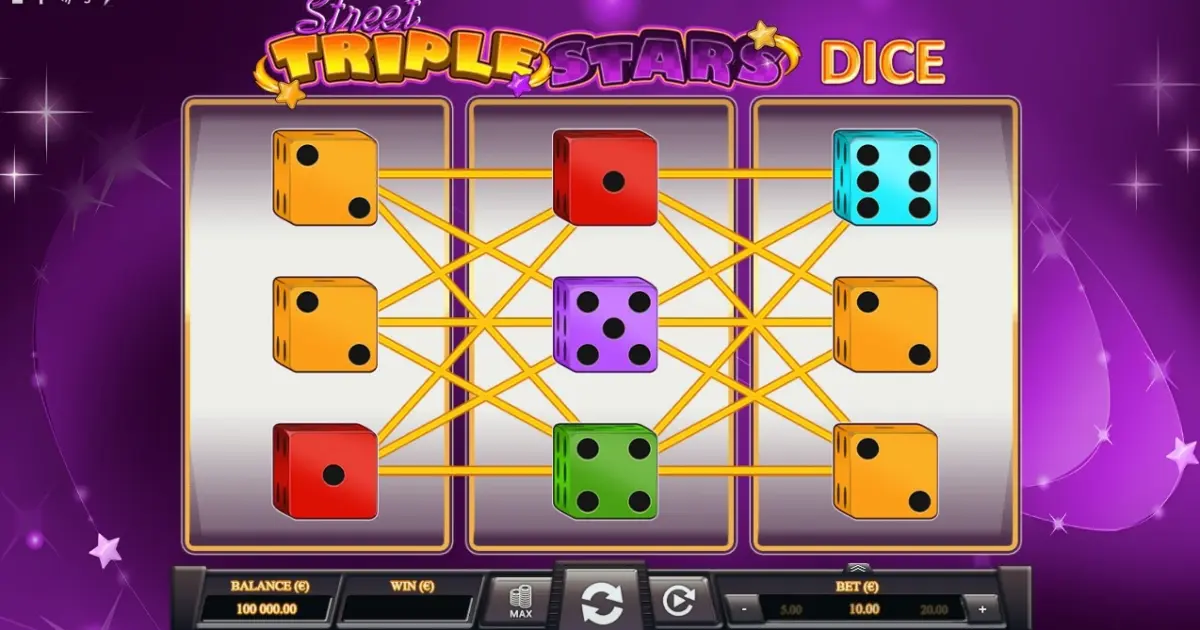
Kajot’s Triple Stars Dice slot sits 0.71 percentage points below the corpus-wide RTP average, which means you are giving up roughly £71 per £10,000 wagered compared to the typical game in this database. Whether that trade-off suits you depends entirely on what you want from a 3-reel format. Here is what the numbers say before you commit a real-money stake.
Who makes Triple Stars Dice
Triple Stars Dice comes from Kajot, a European game studio that holds 36 titles in the catalogue indexed on this site. Kajot operates as a traditional land-based and online slot provider, best known across Central European gaming halls. Their portfolio skews toward fruit machines, card-symbol games, and straightforward mechanical formats rather than narrative-driven video slots with complex bonus structures.
With 36 titles logged here, Kajot is a mid-sized provider. That number tells you something useful: their catalogue is narrow enough that individual titles carry more weight in shaping the brand’s overall reputation. A single underperforming RTP on one game nudges the provider average more visibly than it would for a studio with 500 releases. Triple Stars Dice’s 95.0% RTP pulls that Kajot average down slightly, since the provider’s overall mean sits at 95.55%.
The game itself uses 3 reels and is classified as a slot machine. Beyond those structural facts, Kajot has not published detailed specification sheets for this title in the data available here, which limits what a fair review can claim about its bonus features, payline configuration, or maximum payout potential.
| Provider | Kajot |
|---|---|
| RTP | 95.0% |
| Reels | 3 |
| Free demo | Yes |
Where Triple Stars Dice sits in the Kajot catalogue
Among Kajot’s 36 logged titles, Triple Stars Dice occupies a specific niche. The provider favours the “Joker” naming convention for their classic fruit-and-card hybrids, and two of their other games in this database follow that pattern: Joker 81 and Joker 27. Neither has a published RTP figure in the data available here, so you cannot compare their theoretical returns directly to Triple Stars Dice’s 95.0%.
A third related title tells a different story. Hot Fruits Dice returns 96.0% RTP, a full percentage point above Triple Stars Dice. For a 3-reel, fruit-themed format, that gap represents a meaningfully better expected return over a long session. If you enjoy the mechanical simplicity of Triple Stars Dice but want tighter maths, Hot Fruits Dice deserves a look before you settle on a choice.
Triple Stars Dice holds rank 725 among all games indexed here, placing it in the 96.4th popularity percentile. That ranking reflects player interest rather than mathematical quality, and it confirms this is not a forgotten title — players search for it and spin it regularly despite the below-average RTP.
RTP: 95.0% against a 95.55% house average
At 95.0%, Triple Stars Dice RTP returns £95.00 per £100 wagered across a very large sample. The provider average for Kajot is 95.55%, and the corpus-wide average across all indexed games is 95.71%. This means the game underperforms both benchmarks — by 0.55 points against its own provider and 0.71 points against the broader field.
Here is what that gap means in practical session terms. Over 10,000 spins at £1 per spin, a game at 95.71% returns approximately £9,571 while Triple Stars Dice returns around £9,500. The difference is £71 per £10,000 wagered. That is not enormous on a casual evening, but it compounds across a long-term habit. Players who make this game their primary slot will feel the shortfall more than someone who rotates across titles.
RTP is a long-run statistical average calculated over millions of simulated spins. It tells you nothing about what happens across your next 200 spins. Short sessions will scatter in both directions from that 95.0% figure, sometimes violently. The number is useful for comparing games, not for predicting outcomes.
Volatility and who it suits
Kajot has not published a volatility rating for Triple Stars Dice, and no hit-frequency data is available in the information provided here. That absence matters. Volatility tells you how large and how often wins arrive, and without it, you cannot determine whether this game pays small amounts frequently or withholds wins in longer dry spells before delivering occasional larger hits.
What you can infer from the format is limited. Three-reel games in the classic tradition tend to cluster around medium-to-high volatility, because they typically carry fewer ways to win and rely on specific symbol combinations across all reels. That pattern is common but not universal, and applying it here without confirmation would be guessing. Treat any volatility claim you see quoted elsewhere about this title with caution.
If you are planning a session, assume you need a larger bankroll cushion than the 3-reel simplicity might suggest. Without confirmed hit-frequency data, budget conservatively and set a stop-loss before you spin.
Playing Triple Stars Dice for free
Triple Stars Dice is available as a free demo on this site. The demo uses the same mathematical model as the real-money version, so the spin sequence, symbol landing, and payline evaluation follow identical logic. What it does not predict is how you will perform on a real-money balance, because the two sessions use separate random number generator streams and separate starting balances.
Playing Triple Stars Dice free before staking real currency lets you gauge whether the pace of wins and losses matches your patience. You can identify how the reels land, how often symbols connect across all three, and whether the rhythm suits your session style — all without spending a penny.
When you do move to real play, set a fixed budget before your first spin and treat the entire session as a paid entertainment expense. You are 18 or over, you have a number in mind, and when it is gone, you stop. No loss-chasing, no “one more spin to recover.” That framework protects both your money and your experience.
Similar picks
The “3-Reels” theme in this database contains no other indexed titles alongside Triple Stars Dice. That means you cannot compare it to peers within a dedicated 3-reel category here, because the corpus does not classify any other game under that exact theme tag.
This absence is itself useful information. It tells you that most modern providers and players categorise 3-reel slots through other filters — fruit themes, classic themes, or specific mechanic labels — rather than counting reels. Your best comparison path is within Kajot’s own catalogue, where you already have Hot Fruits Dice at 96.0% as a directly superior alternative in the same format family.
Verdict
Triple Stars Dice delivers the straightforward 3-reel experience Kajot built their reputation on, but the 95.0% RTP is a genuine weakness. It trails both the provider average and the broader field by margins that accumulate noticeably over regular play. With no published volatility data, no confirmed bonus features, and no max-win figure to anchor expectations, you are making a decision on format preference and maths alone.
If the dice-and-stars aesthetic draws you, spin it free first. If you only care about maximising return within a 3-reel Kajot slot, Hot Fruits Dice gives you more expected value for the same session length. Triple Stars Dice is playable but not compelling.
Frequently Asked Questions
Can you play Triple Stars Dice for free?
Yes, Triple Stars Dice is available as a free demo on this site. The demo mirrors the real-money math model using the same 95.0% RTP calculation, so the symbol frequency and paytable logic match the paid version. However, demo results come from a separate random-number sequence and do not predict how your real-money session will unfold.
What is the RTP of Triple Stars Dice?
Triple Stars Dice has a published RTP of 95.0%. That figure places it 0.55 percentage points below Kajot's own catalogue average of 95.55% and 0.71 points below the broader corpus average of 95.71%. Over thousands of spins, this means a measurably lower long-term return compared to most indexed slots.
Is Triple Stars Dice a high or low volatility slot?
Kajot has not published a volatility rating for Triple Stars Dice, and no hit-frequency data exists in the available records. Without that figure, you cannot determine whether the game pays in frequent small amounts or withholds in longer dry spells. General 3-reel trends suggest medium-to-high volatility, but applying that here without confirmation would be speculation.
How does Triple Stars Dice compare to Hot Fruits Dice?
Hot Fruits Dice, also made by Kajot, returns 96.0% RTP — a full percentage point above Triple Stars Dice at 95.0%. Both are slot machines in the same provider catalogue, making the comparison direct. If your goal is maximising expected return from a Kajot title, Hot Fruits Dice offers noticeably better maths.
Can you win real money playing the Triple Stars Dice demo?
No. The free demo operates on a simulated balance with no real currency attached. Wins and losses in the demo exist only within that virtual session. To play for real money, you must register with an operator that hosts Triple Stars Dice in their real-money lobby and fund an account.