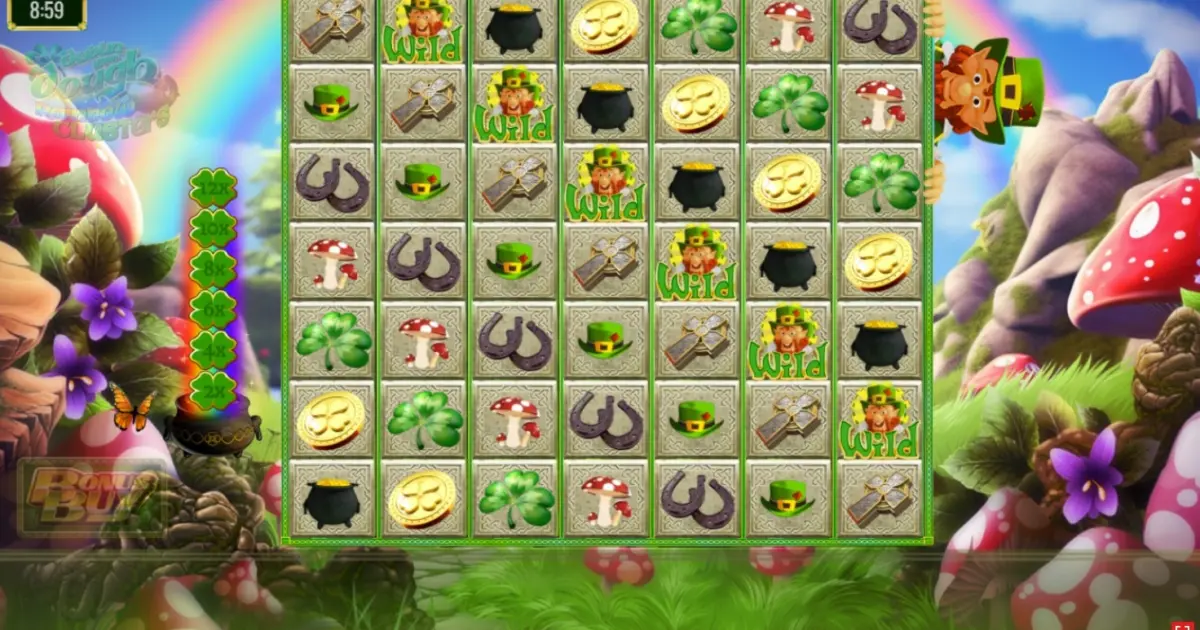
The headline number on the dublin your dough: rainbow clusters slot is a 94.01% RTP, and it is the number that should decide this for you. That figure sits below Rival’s own 94.67% house average and well below the 95.71% average across the games we catalogue. It is a popular title — ranked 2,214, inside the top 12% by traffic — so plenty of people are playing it, but popularity and return rate are separate things.
Dublin Your Dough: Rainbow Clusters at a glance
This is a 7-reel Irish-themed machine from Rival, a studio with 152 titles in our index. The Irish theme is one of the most crowded corners of the market, with 391 games sharing it, so a release here is competing on maths and mechanics rather than novelty.
| Detail | Value |
|---|---|
| Provider | Rival |
| RTP | 94.01% |
| Reels | 7 |
| Themes | Irish, 7-Reels |
| Category | Slot Machine |
| Popularity rank | 2,214 (88.9th percentile) |
| Rival average RTP | 94.67% |
| Database average RTP | 95.71% |
| Free demo | Available |
Who does it suit? Readers who want a straightforward Irish slot from a familiar studio and are not treating RTP as the deciding factor. If you do rank games by return rate, several titles listed further down this page are measurably better on that one metric.
What a 94.01% RTP actually returns
RTP is a long-run statistical average, not a promise about your next hour. At 94.01%, the game is modelled to return £94.01 for every £100 wagered across a sample far larger than any individual session — millions of spins, not thousands.
Work it through. Stake £1 a spin for 1,000 spins and you have wagered £1,000; the modelled return on that is £940.10, an expected cost of roughly £59.90 for the session. Run the same 1,000 spins on a game at the 95.71% database average and the modelled return is £957.10, a cost of £42.90. The 1.7 percentage point gap works out at about £17 per £1,000 wagered.
Whether that matters depends on your volume. Over a single 200-spin sitting at low stakes the difference is pennies and will be swamped by variance. Over a year of regular play it compounds into real money. Note too that this game sits below its own studio’s 94.67% average, so it is not simply a case of Rival pitching lower than the market.
One thing the maths does not do is predict outcomes. Every spin is independent, the result of a fresh random draw, and no run of losses makes a payout more likely on the next one.
Volatility is unpublished, and what that means for your session
Rival has not published a volatility rating for this title, and no figure appears in our data. That absence is worth knowing rather than guessing around, because volatility shapes how a session feels far more than RTP does.
In general terms: a low-volatility game pays small amounts often, so your balance drifts down gently and sessions last a long time on a modest budget. A high-volatility game pays rarely but larger, which means long dry stretches punctuated by occasional spikes, and it needs a much deeper bankroll to ride out. Medium sits between the two.
Two games with identical 94.01% RTPs can therefore produce completely different experiences. The RTP tells you the long-run cost; the volatility tells you how bumpy the road to that average is. Since neither the volatility rating nor a hit frequency figure is available here, the practical answer is to use the demo and watch how your play balance behaves over a few hundred spins. That gives you a feel for the swing size, though it is a sample far too small to say anything reliable about the return rate itself.
The 7-reel layout and how wins are counted
Seven reels is wider than the five-reel standard, and wider grids usually mean the game abandons fixed left-to-right paylines in favour of a different counting method. Rival has not published a payline or ways count for this release, so the exact mechanism is not something this review can state.
What can be said is how wide-grid slots generally work. Some use a “ways” model, where any symbol landing anywhere on consecutive reels counts, producing hundreds or thousands of winning combinations. Others use cluster pays, where a group of matching symbols touching each other anywhere on the grid triggers a payout regardless of column position. Cluster games often pair that with symbol removal and cascading replacements, which can chain several wins from one spin.
The game’s name references clusters, and the seven-reel format is consistent with that family of mechanics, but treat the specifics as unconfirmed until you see the paytable in the game itself. That paytable is the authoritative source, and it is one spin-free click away in the demo. Any site quoting a maximum win multiplier for this title is quoting something Rival has not released.
Stake range and sizing a bankroll
No minimum or maximum stake has been published for this game in our data, so check the bet selector in the demo before assuming anything about affordability. Rival titles typically span a range wide enough for both small-stake and higher-stake play, but that is a general observation about the studio, not a figure for this release.
The sizing principle works regardless. Decide the total you are willing to spend, then divide it by the number of spins you want the session to last. A £40 budget across 400 spins means 10p a spin. At 94.01% RTP, £40 of stake turnover carries a modelled cost of about £2.40, but variance means your actual result on any given night could be well above or below that — that swing, not the average, is what empties a balance early.
What does not work is any staking pattern. Raising or lowering your bet after a result, chasing a loss, or waiting for a “right moment” changes nothing about expected value, because the odds reset identically on every spin.
Playing the Dublin Your Dough: Rainbow Clusters slot demo before you commit
A free demo is available, which means you can load the reels, read the paytable and confirm the stake range without depositing. Since several key figures are unpublished, the demo is genuinely the most informative step you can take here. It also runs in-browser, so a Dublin Your Dough: Rainbow Clusters free demo needs no download and no account.
What the demo cannot do is forecast money outcomes. Demo results are produced by the same random process but a few hundred spins is statistically meaningless against a 94.01% long-run figure, and a strong demo run says nothing about a real-money one.
Slots are 18+ and priced entertainment, not income. Set a budget you would happily spend on any other evening out, treat it as spent the moment you start, and stop when it is gone rather than topping up.
Verdict: who should play Dublin Your Dough: Rainbow Clusters
Play it if you like the wide-grid format and the Irish theme, and you are playing in short, low-stake sessions where a 1.7-point RTP gap costs you loose change. It is a well-trafficked title in the top 12% by popularity, so it clearly holds attention.
Skip it if return rate drives your choices, because the alternatives are clear. Among Irish slots, Leprechaun Wish returns 97.2% — more than three percentage points better on the same theme — and Gold Party sits at 96.5%. If it is Rival you want to stay with, Howl-O-Ween runs 96.25%, comfortably above the studio’s own average.
Honest summary: this is a competent game carrying a below-average return rate and an unusual number of unpublished specifications. Load the demo, read the paytable, and decide from there.
Frequently Asked Questions
Can I play Dublin Your Dough: Rainbow Clusters for free?
A free demo is available, and it runs in your browser with no download and no account needed. That is the most useful thing you can do before committing money here, because the volatility rating, payline count and stake range are all unpublished — the in-game paytable is the authoritative source for them.
What is the RTP of Dublin Your Dough: Rainbow Clusters?
The RTP is 94.01%, meaning the game is modelled to return £94.01 per £100 wagered across a very large sample. That is 1.7 percentage points below the 95.71% average across our database and below Rival's own 94.67% studio average. Over 1,000 spins at £1, the gap is worth roughly £17.
Is Dublin Your Dough: Rainbow Clusters high or low volatility?
Rival has not published a volatility rating for this title, so no reliable figure exists. Low volatility means frequent small payouts and longer sessions on a modest budget; high volatility means rare, larger ones and a deeper bankroll requirement. Watching your balance across a few hundred demo spins gives you a rough feel for the swings.
Who makes Dublin Your Dough: Rainbow Clusters?
Rival developed it, a studio with 152 titles in our index averaging 94.67% RTP. Several of their releases sit meaningfully higher than this one: Howl-O-Ween at 96.25%, and both Ocean Treasure and Vegas Velocity at 96.00%. This title is one of 391 games in our database sharing the Irish theme.
How does it compare to Leprechaun Wish?
Leprechaun Wish returns 97.2% against 94.01% here, a gap of more than three percentage points on the same Irish theme. Across £1,000 of turnover, that difference is worth around £32 in modelled return. If theme is your priority rather than mechanics or studio, Leprechaun Wish is the stronger choice on maths alone.