John Hunter and the Book of Tut Respin Slot is worth a look if you want an Egypt-themed 5-reel game with an above-average return figure and free demo access. Its 96.5% RTP sits 0.79 points above the corpus average of 95.71% and a touch above its provider’s own average, which matters more for long-run maths than any single session. If you are comparing similar titles on numbers alone, that return edge is the clearest reason to try the demo first.
First look at John Hunter and the Book of Tut Respin slot
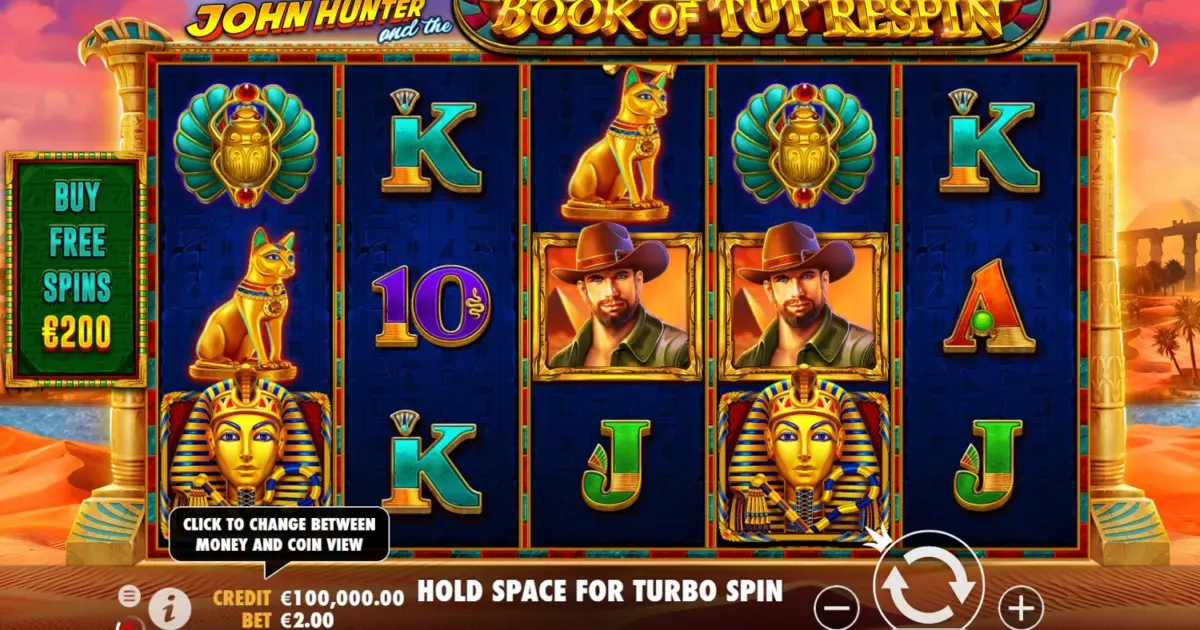
John Hunter and the Book of Tut Respin is listed as a Slot Machine from Pragmatic Play, built on 5 reels and tagged with Egypt and 5-Reels themes. The Egypt label tells you it draws on Egyptian imagery in the way many slots in this category do, without confirming any specific characters, symbols or visual treatment beyond the theme name itself. What is concrete is its catalogue position: it ranks 2041 overall, which puts it in the 89.8th popularity percentile across the tracked corpus, so it sits just outside the top 10% most-played titles but remains widely sampled.
Pragmatic Play lists 739 games in this data set, and this title sits within that large output. That scale helps for comparison because the provider’s average RTP is 96.32%, giving you a baseline for what the studio typically publishes. Free demo play is available for this title, which lets you see the reel layout, paytable structure and stake controls without wagering.
No max win figure, hit frequency, release date or detailed feature list was supplied in the facts available for this review. When those fields are missing, the safest approach is to treat any numbers quoted elsewhere with caution and to base expectations only on what is published here: the reel count, theme, provider and return figure. Missing data is itself information — it means you cannot assess swing size from a claimed top payout or judge bonus frequency from a stated hit rate.
For a first look, the decision is therefore simple. You have a 5-reel Egypt slot from a major provider, with verified demo access and a documented return above both the provider and corpus averages. If that combination aligns with your preferences, the demo gives you a risk-free way to confirm whether the presentation and pacing suit you before considering real-money play.
How a round plays out
With 5 reels confirmed, the game follows the reel-based structure common to many modern slots: reels spin, symbols land, and wins are evaluated against a paytable and a defined set of paylines or ways. The facts for this title do not specify the number of paylines, whether it uses fixed lines or a ways mechanic, or how wilds and scatters behave here. Because those specifics are not published in the supplied data, this section stays at the level of what the reel count implies rather than asserting features for this game.
In general terms, a 5-reel layout usually evaluates wins from left to right across adjacent reels, with a paytable showing symbol values and any special symbols that may substitute or trigger features. Many slots also include concepts such as wilds that substitute for regular symbols, scatters that pay or trigger regardless of line position, and free spins or respins that extend a round. Whether and how any of those concepts appear in this specific title is not stated in the facts, so you should check the in-game help screens in the demo to see what is actually present.
Stake selection, spin initiation and result evaluation remain independent on every round. Each spin is an independent event determined by a random number generator; previous outcomes do not influence the next. Demo play mirrors the same mechanics and interface as real-money play in terms of layout and controls, but demo outcomes do not predict real-money results.
For practical comparison, the most useful action is to open the demo, inspect the paytable for line count and symbol values, and note how the game displays wins and balance changes. That direct observation replaces any assumption about bonus structure. If you compare this title to others, focus on verified numbers such as RTP and reel count rather than on assumed feature sets that are not documented here.
Reading the 96.5% return figure
The published return to player for this title is 96.5% RTP, which is a long-run statistical average, not a promise for any session. It means that across a very large sample — millions of spins — the game is designed to return £96.50 for every £100 wagered in total, with the remaining £3.50 representing the house edge. Over a small sample, results can deviate sharply in either direction.
To make that concrete, if you wagered £1 per spin for 1,000 spins, your total stake would be £1,000 and the theoretical return at 96.5% would be £965, for a theoretical loss of £35 across that sample. The same maths at 500 spins for £0.50 per spin would be £250 staked, £241.25 returned on average, and an £8.75 theoretical loss. These are averages across many players and sessions; your actual session will be higher or lower, and variance ensures short-term swings are normal.
Context helps. Pragmatic Play’s average across 739 titles is 96.32%, so this game sits 0.18 points above its studio average. The corpus average across all tracked titles is 95.71%, so it sits 0.79 points above the broader market average. That difference is modest per spin but meaningful over volume: over £10,000 wagered, a 0.79 point edge versus the corpus average equates to £79 more returned on average (£9,650 versus £9,571).
Among related provider titles, Gates of Olympus at 96.5% matches this return exactly, while Sweet Bonanza at 96.51% is a fraction higher. Those comparisons show that 96.5% is competitive within its stable, not an outlier. Remember that RTP does not affect volatility or hit feel, and it does not change with stake size; every spin carries the same independent expected value derived from that percentage.
Why volatility changes your bankroll maths
The facts supplied for this review do not include a volatility rating for John Hunter and the Book of Tut Respin. Because that field is missing, no low, medium or high label can be assigned here, and any classification you see elsewhere should be treated as unverified unless it comes directly from Pragmatic Play’s official sheet.
Volatility matters because it describes how returns are distributed, not how much is returned on average. A low-volatility profile tends to produce more frequent but smaller wins, which can stretch session length on a fixed budget but rarely produces large swings. A high-volatility profile tends to produce less frequent wins with larger potential gaps between payouts, which can shorten a session on the same budget and requires a larger bankroll to withstand dry spells. Medium volatility sits between those extremes.
Without a published rating, you cannot plan bankroll around an expected swing size for this specific title. The responsible way to adapt is to assume nothing about volatility and to let the demo inform your sense of pacing, while keeping stakes conservative until you have observed variance in practice. Even then, short demo samples do not establish a statistical volatility estimate; they only show recent behaviour.
What remains true regardless of volatility is independence of spins and the role of RTP. A 96.5% RTP defines the long-run average return, while volatility defines the path. Two games can share 96.5% and feel very different because one pays in small steps and the other in occasional larger steps. Because the volatility figure is not available here, focus your session planning on fixed budgets, modest stakes relative to balance, and the understanding that session length is uncertain.
Bet sizing from upwards
The facts available do not publish a minimum bet, maximum bet or default stake range for this title. In other words, the specific figures for bet sizing from the lowest increment upwards were not supplied. That absence matters because stake range directly affects how long a budget lasts and how many spins you can sample.
In general, stake range interacts with bankroll through simple division: bankroll divided by stake equals the number of spins your budget supports before any wins. For example, a £50 budget at £0.20 per spin supports 250 spins; at £0.50 it supports 100 spins; at £1 it supports 50 spins, all before accounting for returns. Wins extend that count, losses shorten it, but the starting maths is fixed. Without a documented minimum for this game, you should confirm the actual limits inside the demo’s stake selector, where the allowed increments and maximum are displayed.
Until you verify those limits, treat any minimum quoted on third-party pages as unconfirmed. Some sites list generic ranges that do not match the version you are playing, and operators can offer different limits by jurisdiction or currency. The demo is the most direct source for what you can actually select.
For planning, choose a stake that gives you a comfortable number of spins for your entertainment budget and stick to it. Increasing stakes after wins or losses does not change expected value; each spin remains independent at the same 96.5% long-run expectation. Steady sizing, rather than progression, keeps the maths transparent and the session duration more predictable.
Where John Hunter and the Book of Tut Respin sits among Egypt slots
The Egypt theme is one of the largest categories tracked, with 908 games in the data set. Within that group, return figures vary, and this title’s 96.5% places it above several well-known peers on the raw percentage alone. That edge does not speak to presentation or feature design, but it does speak to long-run return maths where every tenth of a point compounds over volume.
Compared with Egypt peers supplied for reference, Book of Dead at 94.25% is 2.25 points lower, so over £1,000 wagered the theoretical return difference would be £22.50 in favour of this Pragmatic Play title on average. Book of the Sun at 96.23% is 0.27 points lower, a smaller gap that equates to £2.70 per £1,000 staked on average. On those numbers alone, John Hunter and the Book of Tut Respin retains a mathematical lead against both.
Another peer, Crazy Mummy at 96.0%, sits 0.50 points below this game, which translates to £5.00 per £1,000 staked in theoretical return. Again, this is an average over a large sample, not a per-session guarantee. Popularity also differs: with a rank of 2041 and an 89.8th percentile, this title is sampled less than top-20 Egypt staples, but its return figure remains competitive within the theme.
When you compare Egypt slots, weigh verified figures first — RTP, reel count and demo availability — and then use the demo to judge pacing and paytable structure. Return percentage is the only figure that directly changes long-run cost per £100 staked; everything else shapes how that cost feels across sessions.
The honest verdict
John Hunter and the Book of Tut Respin stands out most clearly on its return figure: 96.5% RTP is above both the provider average of 96.32% and the corpus average of 95.71%, and it beats several Egypt peers on the same metric. The 5-reel structure and Egypt theme place it in familiar territory, and free demo availability lets you verify mechanics and stake controls without wagering.
The trade-off is incomplete disclosure in the supplied facts. Without published volatility, max win, payline count or stake limits, you cannot fully model swing size or session length from this page alone. That is not a flaw in the game itself, but it does mean you should rely on the in-game help and paytable rather than on third-party claims when assessing risk.
If your priority is a higher-than-average RTP within the Egypt category and a straightforward 5-reel setup from a large studio, this title merits a demo session. If you need a documented volatility rating or a stated max win to plan bankroll precisely, you will need to find those figures in the official game sheet or accept that they are not confirmed here.
Play should remain entertainment with a fixed budget. You must be 18+ to gamble, set a deposit and time limit before you start, and never chase losses. Treat any slot as paid entertainment with a cost over time — at 96.5% the long-run cost is £3.50 per £100 staked on average — and use safer-gambling tools and support services if play stops feeling controlled. Demo play is useful for learning, but it does not predict real-money outcomes.
| Feature | Value |
|---|---|
| Provider | Pragmatic Play |
| RTP | 96.5% |
| Reels | 5 |
| Themes | Egypt, 5-Reels |
| Rank | 2041 (89.8th percentile) |
| Free demo | Available |
| Provider average RTP | 96.32% (739 games) |
| Corpus average RTP | 95.71% |
Frequently Asked Questions
Can I play John Hunter and the Book of Tut Respin for free?
Free demo play is listed as available for this title, so you can load the demo to see the 5-reel layout and paytable without wagering. Demo spins use the same interface and controls but do not pay real money and do not predict real-money results. Use it to confirm stake options and pacing before any deposit.
What is the RTP of John Hunter and the Book of Tut Respin and what does it mean?
The published RTP is 96.5%, which means the game is designed to return £96.50 per £100 wagered across a very large sample, leaving a £3.50 house edge. Over 1,000 spins at £1 the theoretical return is £965, but short-term sessions vary widely. RTP is a long-run average, not a per-session promise.
What volatility is John Hunter and the Book of Tut Respin?
No volatility rating was supplied in the facts for this title, so a low, medium or high label cannot be confirmed here. Volatility affects how wins are distributed around the 96.5% average — frequent small wins versus rarer larger gaps — and without it you should plan with conservative stakes and a fixed entertainment budget.
Who makes John Hunter and the Book of Tut Respin and what else do they offer?
The game is by Pragmatic Play, which has 739 titles tracked with an average RTP of 96.32%. Related titles from the same provider include Gates of Olympus at 96.5% and Sweet Bonanza at 96.51%, both very close to this game's 96.5% on return. Provider scale helps you compare maths across a consistent portfolio.
How does John Hunter and the Book of Tut Respin compare to Book of Dead?
On return maths, John Hunter and the Book of Tut Respin at 96.5% is 2.25 points above Book of Dead at 94.25%, which equates to £22.50 more returned per £1,000 wagered on average. Both are Egypt-themed 5-reel slots, but this Pragmatic Play title shows the higher long-run percentage in the supplied data. Check the demo paytables for line structure differences.