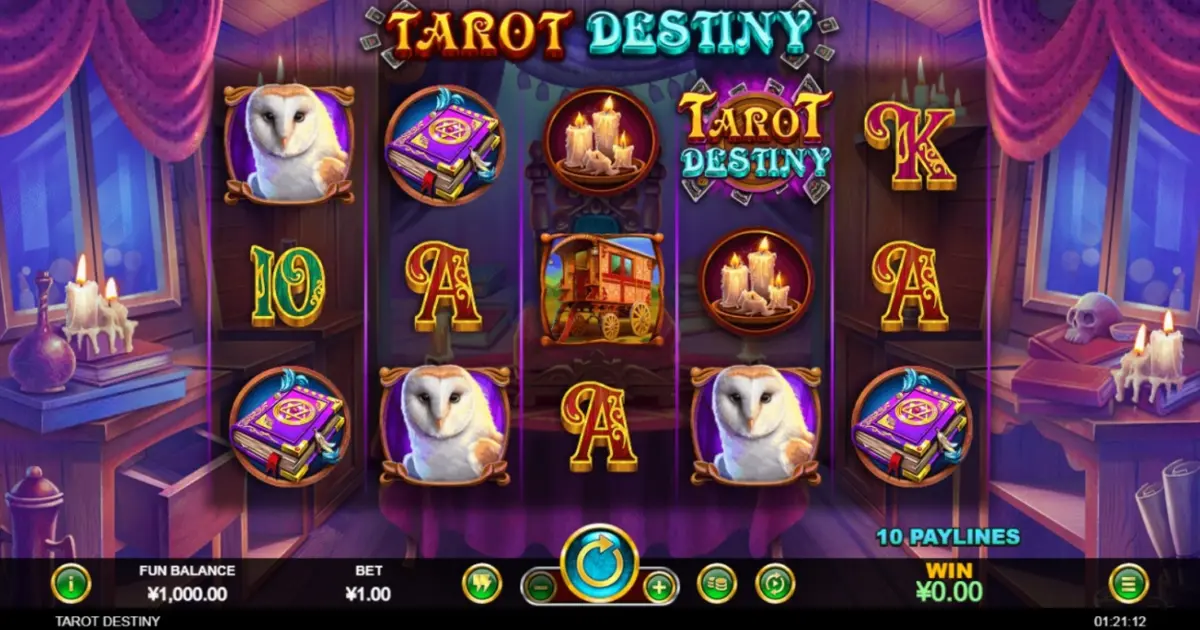
The headline figure on the tarot destiny slot is a 95.0% RTP, and that is below both the RTG Slots house average of 95.75% and the 95.71% average across the games catalogued here. It is a five-reel release built on a magic theme, and it ranks in the top 10% of titles by popularity in this collection, so plenty of people are playing it despite the return figure. If you care about the long-run maths above all else, there are better-priced games on the same shelf. If you want to see what the theme does and the demo costs you nothing, the case is easier.
Tarot Destiny at a glance
Here is what RTG Slots has published, and what it has not.
| Detail | Value |
|---|---|
| Provider | RTG Slots |
| RTP | 95.0% |
| Reels | 5 |
| Themes | Magic, Animals, 5-Reels |
| Type | Slot machine |
| Popularity rank | 1998 (90th percentile) |
| Provider RTP average | 95.75% across 32 games |
| Database RTP average | 95.71% |
| Free demo | Available |
Several fields you might expect are simply absent. There is no published volatility rating, no payline or ways count, no stake range, no max win multiplier and no hit frequency. That absence matters. Volatility and max win are the two figures that tell you how a session is likely to feel, and without them you are going in on the RTP alone. If you see a specific max win number quoted for this title elsewhere, treat it sceptically until RTG Slots publishes one.
This suits a reader who is curious about the theme and content to test it in demo mode. It suits a returns-focused player less well, because 95.0% is a known quantity and it is on the low side.
What a 95.0% RTP actually returns
RTP is a long-run average, not a session forecast. A 95.0% figure means that across an extremely large number of spins, the game is designed to return £95 for every £100 wagered. The remaining £5 per £100 is the house margin.
Work it through. If you were staking £0.50 a spin and played 1,000 spins, you would have wagered £500. At 95.0%, the modelled return on that £500 is £475, leaving a £25 theoretical cost for the session. Play 5,000 spins at the same stake and you have wagered £2,500 against a modelled return of £2,375 and a £125 expected cost. Real sessions will land nowhere near those figures. Variance dominates over anything as short as a few thousand spins, and you can finish well up or lose the lot.
The comparison is where 95.0% looks weaker. The database average is 95.71%, so this title gives up 0.71 percentage points, which is £7.10 more expected cost per £1,000 wagered. RTG Slots itself averages 95.75% across its 32 games, so this is a below-par release by the provider’s own standard. For a concrete alternative, Madame Destiny Megaways carries a published 96.56% RTP, a 1.56-point gap that compounds meaningfully over volume.
Unpublished volatility and what your session will feel like
RTG Slots has not published a volatility rating for this game, so nobody can tell you honestly whether it pays in small frequent amounts or in rare large ones. Anyone claiming otherwise is guessing.
What you can do is understand the two ends of the scale and work out which one you are looking at while you play the demo. Low-volatility games land wins often but small, so balances drift down gently and sessions last a long time on a given bankroll. High-volatility games pay rarely and larger, which means long dry stretches punctuated by spikes, and they need a deeper bankroll to survive the gaps without being wiped out. Medium sits between the two.
Because volatility is undisclosed here, track it yourself: run a few hundred demo spins and watch how often the balance ticks up and how big those upticks are relative to your stake. Frequent small returns point low; long droughts point high. That is not a prediction of anything, just a description of what you observed. Every spin is independent of the last, so patterns you notice do not carry forward.
The 5-reel layout and how wins are counted
Five reels is the standard modern layout, and it is the format most slot mechanics are built around. What five reels does not tell you is how wins are actually counted, and that detail is not in the published data for this game.
Slots resolve wins in a handful of common ways. Fixed-payline games award only on defined patterns across the reels, so the payline count directly sets how many chances each spin has. All-ways or “ways” games pay on any matching symbols in adjacent reels regardless of position, which usually means more small hits. Cluster games ignore lines entirely and pay on grouped symbols. Each structure produces a different rhythm at identical RTP.
Because the payline or ways count is not published for this title, the demo is your only reliable way to see which model applies. Watch which positions light up on a winning spin and the structure becomes obvious within a few dozen spins. If you want a game where the mechanic is stated up front, the Megaways structure in Madame Destiny Megaways is documented, and RTG’s own Magic Forest: Spellbound sits in the same magic bracket if you are exploring the studio’s catalogue.
Stake range and sizing a bankroll
No minimum or maximum stake is published for this game. Check the figures in the paytable before you play with money, because the range sets everything about how long a bankroll lasts.
The arithmetic is simple and worth doing. Divide your session budget by your stake and you get a spin count. A £50 budget at £0.20 a spin is 250 spins; the same £50 at £2 a spin is 25. Same money, wildly different session, and the shorter one is far more exposed to variance because there is less room for a run of blanks. As a rule of thumb, if you want a session that lasts, size your stake so the budget covers several hundred spins.
Two things not to do. Do not increase stakes after losses to chase back a deficit: the RTP is fixed at 95.0% regardless of stake size, so raising your bet raises expected cost proportionally and nothing else. And do not treat a quiet stretch as a signal, in either direction. No betting pattern, staking system or timing choice changes the expected value of a spin.
Playing the Tarot Destiny demo before you commit
A free demo is available, and with this much undisclosed it is genuinely the sensible first step. No download, no deposit, no account. Play it long enough to answer the questions the datasheet does not: how the wins are counted, how often the balance moves, whether the theme holds your attention past the novelty.
One caveat that matters. Demo results tell you nothing about what real-money play will do. A good demo run is variance, not a signal, and the 95.0% RTP applies identically either way. The only thing demo play reliably reveals is whether you enjoy the game.
When you do move to real stakes: this is 18+ entertainment you pay for, not a way to make money. Decide your budget before you start, treat it as spent the moment you sit down, and stop when it is gone rather than topping up. If it stops being fun, that is the point to close the tab.
Verdict: who should play Tarot Destiny
This is a hard game to recommend on the numbers, and easy to recommend as a free demo. The 95.0% return is below the RTG Slots average of 95.75% and below the 95.71% database average, and it comes with no published volatility, no stake range, no payline count and no max win. That is a lot of blanks for a game asking a wider margin than its shelf-mates.
Play it if the magic theme appeals and you are staying in demo mode, or if you already play RTG titles and want to see this one. The 90th-percentile popularity ranking suggests the theme lands for a lot of people.
Look elsewhere if you are optimising for return. Madame Destiny Megaways at 96.56% is the clearest upgrade in the same fortune-telling territory, and Alchemy Elements is worth a look in the same magic category, though its RTP is also unpublished. Verify any figure in the game’s own info panel before you stake anything.
Frequently Asked Questions
Can I play Tarot Destiny for free without downloading anything?
A free demo is available for this game, with no download and no deposit required. It runs on virtual credits, so nothing you win or lose in demo mode is real. Given that RTG Slots has not published volatility, stake range or a payline count for this title, the demo is the most practical way to see how it actually behaves.
What is the RTP of Tarot Destiny and is that good?
The published RTP is 95.0%, which is on the low side. It sits 0.71 percentage points below the 95.71% average across the games in this database, and below the RTG Slots house average of 95.75% across their 32 titles. In practical terms, that gap costs roughly £7.10 more per £1,000 wagered over a very large sample.
Is Tarot Destiny high or low volatility?
RTG Slots has not published a volatility rating, so there is no reliable answer. That is a real gap, because volatility determines whether your balance drifts down slowly with frequent small wins or swings hard between long dry runs. Run the demo and watch how often and how large the returns are to gauge it yourself.
Who makes Tarot Destiny and what else do they produce?
RTG Slots developed it, and they have 32 games in this database averaging 95.75% RTP. Other titles from the studio include Cash Chalet, Snake's Fortune Hunt and Magic Forest: Spellbound, though RTP figures are unpublished for those three. If you are comparing across the catalogue, note this release sits below the provider's own average return.
How does Tarot Destiny compare to Madame Destiny Megaways?
Madame Destiny Megaways carries a published 96.56% RTP against 95.0% here, a 1.56-point advantage that adds up over volume. It also uses a documented Megaways win structure, whereas the win-counting mechanic for this five-reel game is not published. If return matters more than theme preference, the Megaways title is the stronger pick.