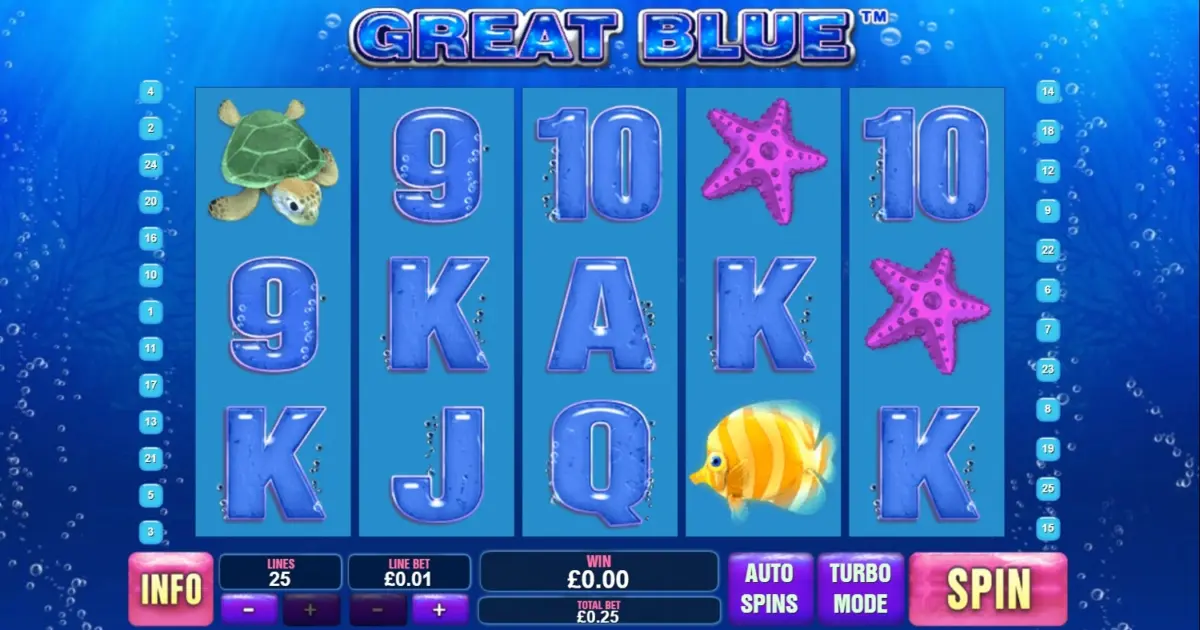
Great Blue is a Playtech slot machine sitting at 96.03% RTP, a figure that puts it just above both the provider average of 95.22% and the broader corpus average of 95.71%. If you are comparing titles by expected return over a long session, this one edges ahead of the typical Playtech release. The trade-off is that volatility data has not been published for this game, so you are working with incomplete information on swing size and bankroll requirements.
Great Blue versus the average slot
The headline number here is that Great Blue sits 0.32 percentage points above the corpus average RTP of 95.71%. That gap may sound small, but over a 10,000-spin session at £1 per spin, it translates to roughly £32 less lost compared to an average slot across the same volume. Over 100,000 spins, the difference grows to around £320. These are long-run statistical expectations, not session outcomes — any individual sitting can deviate wildly — but they do matter if you play regularly and want to stretch your bankroll across more spins. Compared to the provider average of 95.22%, Great Blue returns an additional 0.81 percentage points, which is a more meaningful edge within Playtech’s own catalogue. At rank 1940 with a 90.3% popularity percentile, the game sits in the upper tier of player interest, suggesting it has found a loyal audience despite not being a headline release.
| Provider | Playtech |
|---|---|
| RTP | 96.03% |
| Free demo | Yes |
RTP breakdown: 96.03% in context
An RTP of 96.03% means the theoretical return of £96.03 per £100 wagered across an extremely large sample of spins. In practice, a session of a few hundred spins will show results far from that figure — sometimes well above, sometimes well below. The number is a mathematical average calculated over millions of rounds, not a guarantee for any single visit. For context, the corpus average sits at 95.71%, so Great Blue returns about 32 pence more per £100 wagered than the typical slot in the database. Playtech’s own average across its 162 games is 95.22%, meaning Great Blue outperforms the studio mean by 0.81 percentage points. If you are choosing between several Playtech titles and RTP is your primary filter, Great Blue offers a marginal but real advantage over the studio baseline.
Volatility profile
Playtech has not published a volatility classification for Great Blue. This is not unusual — not every provider labels volatility on every title — but it does leave you without a key piece of information for session planning. Volatility determines how far and how often results deviate from the RTP average: low-volatility games pay smaller amounts more frequently, while high-volatility games pay larger amounts less often. Without a published rating, you cannot reliably predict whether Great Blue will deliver long, steady sessions or short, swingy ones. If volatility matters to your bankroll management, you may want to use the free demo to get a feel for the game’s rhythm before committing any real stake. Treat the demo as a reconnaissance tool, not a prediction of real-money results — every spin is independent, and demo outcomes do not carry over.
Playtech as a studio
Playtech operates a catalogue of 162 games with an average RTP of 95.22%. That places the studio slightly below the corpus-wide average of 95.71%, which means Great Blue’s 96.03% is one of the stronger returning titles in the portfolio. Playtech has been a major name in online gaming for over two decades, supplying both slot content and platform infrastructure to operators worldwide. If you are browsing the broader Playtech library, several other titles sit near or below the studio average. Oceanus Rising carries a 95.05% RTP, while Drinks on the Beach sits at 94.85%. On the other hand, Ji Xiang 8 edges closer to Great Blue with a 95.99% return. These comparisons matter if you are choosing between Playtech titles with RTP as a deciding factor — Great Blue sits near the top of the studio’s range rather than in the middle or lower tier.
Three Playtech alternatives worth comparing
If Great Blue’s combination of RTP and theme appeals but you want to shop around, three Playtech titles offer useful comparison points. Oceanus Rising carries a 95.05% RTP, roughly one percentage point below Great Blue, which over a long session adds up to meaningfully more theoretical loss per £100 wagered. Drinks on the Beach sits at 94.85%, making it one of the lower-returning options in the Playtech stable. For a tighter comparison, Ji Xiang 8 at 95.99% is almost identical to Great Blue’s 96.03% on paper, so the choice between them comes down to theme preference, volatility (if published), and personal feel rather than a meaningful RTP gap. None of these games have published volatility data either, so the demo remains your best tool for getting a sense of how each one plays before you decide.
Getting the most out of the free demo
A free demo of Great Blue is available with no download required, which means you can spin directly in your browser without installing software or creating an account. The demo uses the same math model as the real-money version, so the RTP and reel behaviour are identical — the only difference is that no real funds are at stake. Use the demo to get a sense of spin speed, visual presentation, and how the game feels over a few hundred rounds. Pay attention to how long your virtual balance lasts and whether the session feels steady or erratic, as this gives you a rough impression of the game’s rhythm even without a published volatility rating. Remember that demo results do not predict real-money outcomes. Every spin is independent, and past results have no influence on future ones. Set a budget before you move to real play, treat the session as paid entertainment, and stop when the budget is gone. You must be 18 or older to play.
Should you play Great Blue?
Great Blue makes a solid case on paper: a 96.03% RTP that beats both the Playtech average and the corpus average, a large player base reflected in its 90.3% popularity percentile, and a free demo that requires no download. The main weakness is the absence of published volatility data, which makes it harder to plan your bankroll and session length with confidence. If you prioritise RTP above all else, Great Blue sits near the top of Playtech’s 162-game catalogue, ahead of titles like Oceanus Rising and Drinks on the Beach. If you need a volatility rating to feel comfortable, the lack of one here may push you toward a different title where that information is available. For players who are happy to use the demo as a personal testing ground, Great Blue offers a slightly-above-average return in a well-established package from one of the industry’s longest-running studios.
Frequently Asked Questions
Can I play Great Blue for free with no download?
Yes, a free demo of Great Blue is available with no download required. You can spin directly in your browser without creating an account or installing software. The demo uses the same math model as the real-money version, so the RTP and reel behaviour are identical.
What is the RTP of Great Blue?
Great Blue has a published RTP of 96.03%. This means that over a very large sample of spins, the game theoretically returns £96.03 per £100 wagered. It sits 0.32 percentage points above the corpus average of 95.71% and 0.81 points above Playtech's own average of 95.22%.
Is Great Blue a high or low volatility slot?
Playtech has not published a volatility classification for Great Blue. Without that data, you cannot determine the game's swing size from published figures alone. Using the free demo to observe how your balance moves over a few hundred spins is the best available way to get a rough sense of the game's rhythm.
Who makes Great Blue and what other games do they have?
Great Blue is developed by Playtech, a studio with 162 games in its portfolio and an average RTP of 95.22%. Other Playtech titles include Oceanus Rising at 95.05% RTP, Drinks on the Beach at 94.85%, and Ji Xiang 8 at 95.99%.
How does Great Blue compare to Oceanus Rising?
Great Blue has a 96.03% RTP while Oceanus Rising sits at 95.05%, a gap of roughly one percentage point. Over a 10,000-spin session at £1 per spin, that difference translates to about £100 less theoretical loss on Great Blue compared to Oceanus Rising. Both are Playtech titles, so the comparison is useful if you are choosing within the same studio.