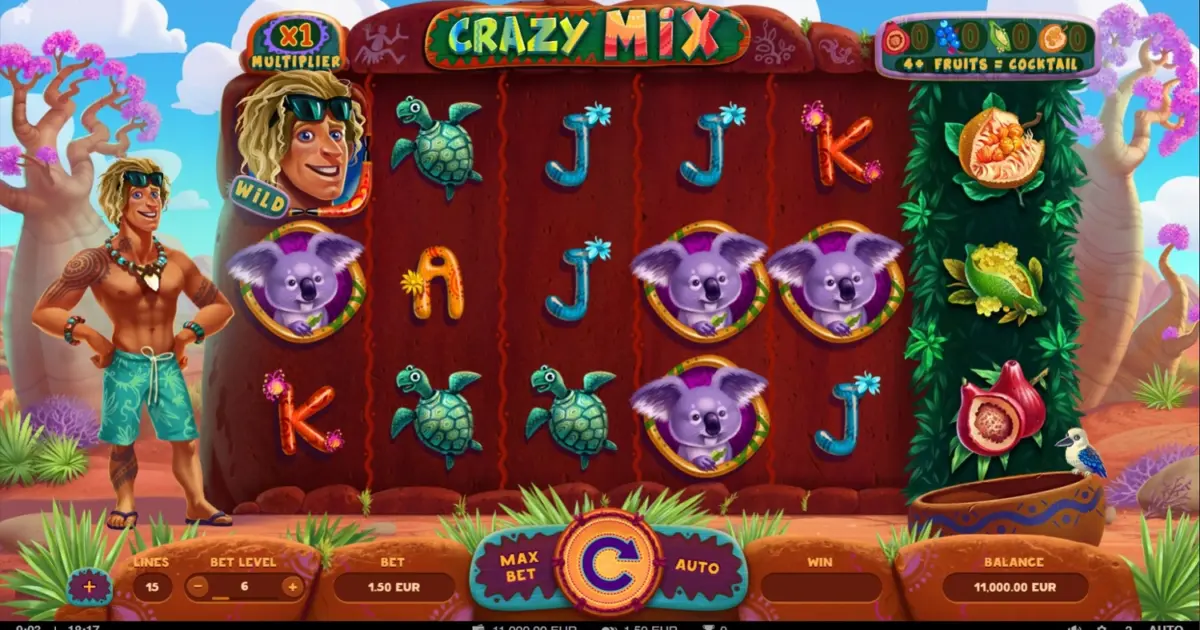
The number worth knowing first: 96.35%. That is the published return-to-player figure for this TrueLab Games release, and it puts the game a fraction ahead of both the studio’s own catalogue average and the wider average of titles indexed on this site. If you want a five-reel game with a return above the norm and a free demo you can load without registering, this one qualifies on both counts.
What follows works through the maths honestly, flags what TrueLab has not published, and tells you plainly who the crazy mix slot suits. There is a fair amount TrueLab has kept to itself here, and that absence is part of the picture.
Crazy Mix at a glance
Here are the confirmed figures, and only the confirmed figures.
| Detail | Value |
|---|---|
| Provider | TrueLab Games |
| RTP | 96.35% |
| Reels | 5 |
| Category | Slot Machine |
| Primary theme | Relax |
| Free demo | Available |
| Popularity rank | 1,926 (90.3rd percentile) |
| Provider catalogue | 55 games, 95.88% average RTP |
Several things you might expect to see in that table are absent because TrueLab has not published them. There is no official volatility rating, no stated paylines or ways count, no minimum or maximum stake, and no maximum win multiplier. If you find a max win figure quoted on another site, ask where it came from before you rely on it.
The game sits in the 90.3rd percentile for popularity among the titles indexed here, which tells you people are finding it and loading it. Popularity says nothing about how it will pay you.
What a 96.35% RTP actually returns
RTP is a long-run statistical average calculated over millions of simulated spins, not a promise about your session. A 96.35% figure means the game is modelled to return £96.35 for every £100 wagered across a very large sample. The remaining £3.65 per £100 is the house edge, and it is baked into the maths permanently.
Put concrete numbers on it. Wager £1 per spin for 1,000 spins and you have staked £1,000. The theoretical return on that turnover is £963.50, an expected loss of £36.50. But 1,000 spins is nowhere near a large enough sample for the average to assert itself. Real outcomes over that many spins can land well above or well below the model, and the wider the swing potential in the maths, the wider that spread gets.
Against the field, 96.35% is a modest but genuine advantage. The average RTP across the games catalogued here is 95.71%, so this title runs 0.64 percentage points above the corpus average. TrueLab’s own 55-game library averages 95.88%, meaning this release is one of the better-returning entries in its own stable. For comparison inside the studio, Hot Devil Slot and Hot Hamster both sit at 96.3%, marginally below.
Unstated volatility and what your session will feel like
TrueLab has not published a volatility rating for this game, so anyone telling you it is low, medium or high is guessing. That matters more than it sounds, because volatility shapes your session far more directly than RTP does.
Two games can share an identical 96.35% return and feel like completely different products. A low-volatility build pays small amounts often, so your balance drifts down gently and a modest bankroll stretches across a long session. A high-volatility build pays rarely but larger, so you can absorb long stretches of nothing before a single spin recovers a chunk of it. Same expected return, wildly different ride.
Without a published rating, the practical answer is to find out yourself in the demo. Load it, play a few hundred spins at a fixed stake, and watch the shape of the balance line. Frequent small returns with shallow dips point one way. Long flat stretches broken by occasional spikes point the other. That observation costs you nothing and tells you what a rating would have.
One thing does not vary: every spin is independent. Nothing that happened on previous spins changes the odds of the next one, and no game is ever due.
The 5-reel layout and how wins are counted
Five reels is the standard modern configuration and the format most players already know. What TrueLab has not confirmed is how wins are actually evaluated across those reels, and that is the detail that determines what a winning combination looks like.
Broadly, five-reel games resolve wins one of three ways. Fixed paylines run defined patterns across the grid, and a combination only counts if it lands on one of them. Ways or all-ways systems drop the pattern requirement and pay any matching symbols in adjacent reels from the left, which usually means many more possible combinations at a smaller average value each. Cluster or grid systems ignore reels as such and pay groups of touching symbols. Each approach produces a different rhythm of hits.
Since none of that is documented for this title, the paytable in the demo is your source. It is worth two minutes before you spin: check whether wins are described as lines or ways, how many there are, and whether the count is fixed or adjustable. Some games let you play fewer lines, which changes your stake per spin but not the underlying return percentage.
Stake range and sizing a bankroll
No minimum or maximum stake has been published for this game, so the figures you need are the ones displayed in the bet menu when it loads. Check them before your first spin rather than after.
The sizing principle applies regardless of what those limits turn out to be. Decide the total you are willing to spend first, then divide by the number of spins you want the session to last. A £40 budget aimed at 400 spins puts you at £0.10 a spin. Aiming at 200 spins doubles that to £0.20 and halves your session length. The arithmetic is simple and it is the only part of the game you control.
Stake size does not change the 96.35% return, only the pounds attached to it. Betting more per spin does not improve your odds, and betting less does not worsen them. Nor does any staking pattern, progression or timing shift expected value by a single penny. The house edge is a property of the maths, not of how you sequence your bets.
If the minimum turns out to be higher than your budget comfortably supports, that is a reason to pick a different game rather than a reason to shorten your session.
Playing the Crazy Mix demo before you commit
A free demo is available, which is the sensible entry point given how much TrueLab has left undocumented. There is nothing to download and no deposit involved, so a Crazy Mix free demo run costs you only time and answers the questions the spec sheet does not: how often it pays, how it counts wins, what the stake range is, and whether the pace suits you.
One limitation to hold onto. Demo mode uses the same certified maths as the paid version, but the results you see in it predict nothing about a real-money session. A good demo run is a small sample, not a signal.
Play only with money you can afford to lose, set a budget before you start and treat it as an entertainment cost rather than a way to make money. Slots are for over-18s. If tracking a budget feels difficult, deposit limits and self-exclusion tools exist for exactly that reason.
Verdict: who should play Crazy Mix
This suits players who weight published return above documented features. At 96.35% it beats the corpus average by 0.64 points and edges TrueLab’s own catalogue mean, and the demo removes any cost from finding out whether the rest of it works for you.
It suits you less if you want to know what you are getting before you load it. The missing volatility rating, payline structure, stake range and max win leave a lot to discover on the fly. Players who plan sessions around a known risk profile will find that frustrating.
If the return figure is what draws you, Big Bass Splash runs higher at 96.71% and gives you more documented ground to stand on. Inside TrueLab’s own library, Fruity Park sits slightly lower at 96.15% if you want a comparison point from the same studio. Either way, spend the demo spins first.
Frequently Asked Questions
Can I play Crazy Mix for free without downloading anything?
A free demo is available for this TrueLab Games title, with no download and no deposit required. It runs the same certified maths as the paid version, so it is the practical way to check the stake range, paytable and hit rhythm, all of which TrueLab has left unpublished. Results in demo mode do not predict real-money outcomes.
What is the RTP of Crazy Mix and is that good?
The published RTP is 96.35%, meaning the game is modelled to return £96.35 per £100 wagered across a very large sample. That is 0.64 points above the 95.71% average of games catalogued here and ahead of TrueLab's own 95.88% studio mean. It is a modest edge, not a large one, and it applies only over huge sample sizes.
Is Crazy Mix high or low volatility?
TrueLab Games has not published a volatility rating for this game, so any figure quoted elsewhere is unverified. Volatility determines whether your balance drifts down gently with frequent small returns or sits flat through long dry stretches. The free demo answers it directly: play a few hundred spins at a fixed stake and watch the shape of the balance line.
Who makes Crazy Mix and what else do they have?
TrueLab Games developed it, and the studio has 55 titles indexed here with an average RTP of 95.88%. Other TrueLab slots include Hot Devil Slot and Hot Hamster at 96.3% each, plus Fruity Park at 96.15%. This release at 96.35% is among the better-returning entries in their catalogue.
What stake should I use on Crazy Mix?
No minimum or maximum stake has been published, so check the bet menu when the game loads. Set your total budget first, then divide by the spins you want: £40 across 400 spins is £0.10 per spin. Stake size changes the pounds at risk, never the 96.35% return or your odds on any given spin.