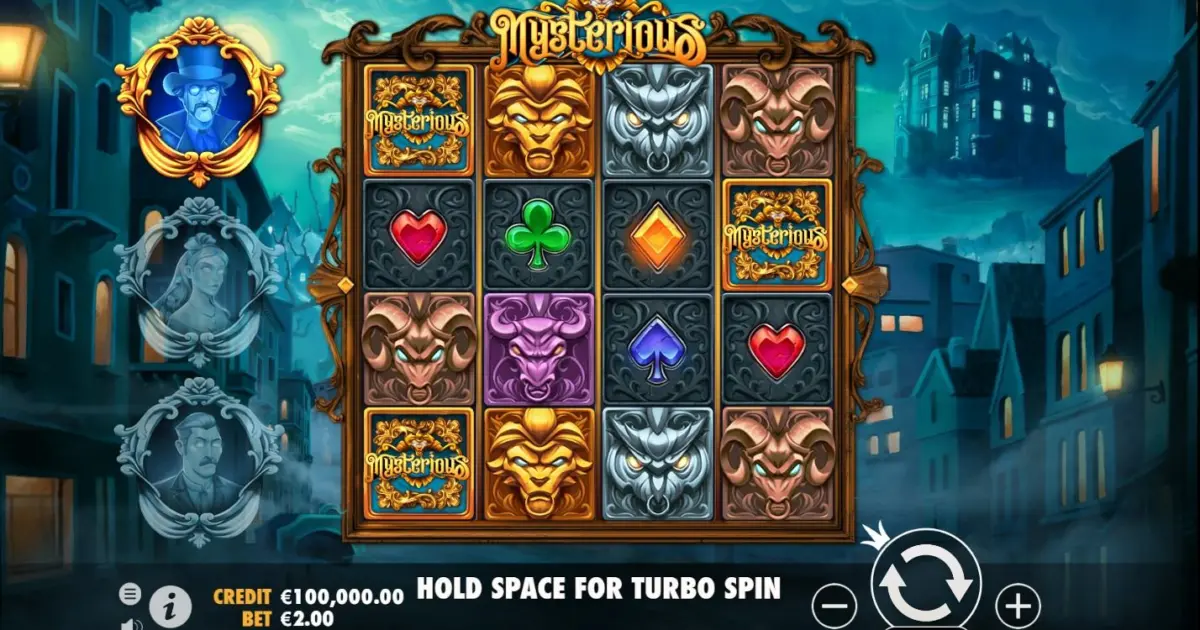
The number that matters most here is 96.5%. That is the theoretical return on the mysterious slot from Pragmatic Play, and it puts the game above both its own studio’s average of 96.32% and the 95.71% average across the games catalogued on this site. The second thing worth knowing is that it runs on four reels rather than the usual five, which is unusual enough to change how the grid feels.
Beyond those figures, Pragmatic Play has published very little about this title. There is no confirmed payline count, no stated volatility rating, no max win figure and no stake range on record. That absence is worth taking seriously, and this review is honest about where the data stops.
| Figure | Value |
|---|---|
| Game name | Mysterious |
| Provider | Pragmatic Play |
| RTP | 96.5% |
| Reels | 4 |
| Category | Slot Machine |
| Theme label | 4-Reels |
| Popularity rank | 1774 (91.1st percentile) |
| Provider catalogue size | 739 games |
| Free demo | Available |
The 4-reel grid explained
Four reels is the defining structural fact on record for this game, and it is the only theme label attached to it. Most online slots use five reels, so a four-reel layout is a deliberate departure rather than an oversight.
What does dropping a reel actually do? In general terms, every reel a slot removes cuts the number of positions where a winning combination can form or fail. On a five-reel game, a payline needs five matching symbols for a top-tier hit, and that fifth reel is where most near-misses die. On four reels, the longest combination is shorter, so the top combination is mathematically easier to complete. Designers usually compensate by reducing what that combination pays, or by trimming the number of high-value symbols on the strips. The maths has to balance somewhere.
The practical consequence for you is that four-reel games often feel more frequent and less explosive than their five-reel counterparts, though that is a tendency across the format rather than a promise about this specific title. Pragmatic Play has not published the reel strip composition or symbol set, so the exact character of the grid is something you will only learn by loading the demo and watching it spin.
Paylines, ways and how Mysterious pays
No payline or ways count has been published for this game. That is a genuine gap, because payline structure is one of the biggest drivers of how a slot behaves round to round.
Here is what the two main systems do in general. Fixed-payline games define set patterns across the reels; you stake on all of them each spin, and a win needs matching symbols landing on one of those specific paths. Ways-based games instead pay any combination of matching symbols on consecutive reels, regardless of row position, which produces more small wins and fewer large ones at the same RTP. A four-reel ways game would typically advertise a figure like 256 ways, arrived at by multiplying the symbol positions on each reel.
Many slots also carry wilds that substitute for other symbols, scatters that trigger free spins, and multipliers that scale a win once it lands. None of those are confirmed for this game. If you see a site listing a specific bonus round, free-spin count or multiplier value for Mysterious, treat it as unverified. The honest position is that the paytable is unpublished, and the demo is the only reliable way to read it.
96.5% RTP put in context
RTP is a long-run statistical average, not a session forecast. A 96.5% figure means the game is modelled to return £96.50 for every £100 wagered across a sample far larger than any individual will ever play. Over 1,000 spins at £1, expected loss is £35, but real outcomes scatter widely around that figure in both directions.
The comparison is where this number earns its keep. At 96.5%, the game sits 0.18 points above the 96.32% average across Pragmatic Play’s 739 titles, and 0.79 points above the 95.71% corpus average. On £10,000 of total wagering, that 0.79-point edge is about £79 less expected cost than an average game. Not transformative, but not nothing either.
It also matches the studio’s better-known releases exactly. Gates of Olympus and Joker’s Jewels both run at 96.5%, while Sweet Bonanza edges ahead at 96.51%. So on returns alone, you are getting the same deal as the headline games. The difference will be in volatility and mechanics, not the return figure.
Volatility and hit patterns
No volatility rating has been published for this game. Since volatility, not RTP, determines what a session actually feels like, that is arguably the more significant gap of the two.
Two games can share an identical 96.5% return and behave nothing alike. A low-volatility game pays small amounts often, so your balance drifts down gradually with frequent small recoveries and your bankroll lasts longer at a given stake. A high-volatility game pays rarely but larger, which means long dry stretches punctuated by occasional significant hits; the same £100 disappears faster if the swings run against you early. Medium sits between the two.
Hit frequency is the related figure, describing what share of spins return anything at all. It is also unpublished here. One thing worth stating plainly: every spin is independent. Results carry no memory of what came before, so a game is never due, warm or cold, and no staking pattern or timing changes the expected outcome. Twenty blank spins tell you nothing about the twenty-first. The demo will give you a rough feel for swing size, and that is the only volatility read available.
Choosing a stake between the game’s minimum and maximum
The stake range for this game has not been published, so you will see the actual limits when you open it. Pragmatic Play generally supports a wide spread across its catalogue, but the specific floor and ceiling here are unconfirmed and worth checking in the demo before you commit real money.
The principle applies regardless of the numbers. Decide your total session budget first, then divide by the number of spins you want it to cover. A £50 budget aimed at 250 spins means £0.20 per spin. Set the stake to fit the budget, not the other way round.
Because volatility is unrated here, err toward the cautious end of whatever range the game offers. Higher swings need more spins to average out, and staking near the maximum shortens your session dramatically if the game turns out to be high variance. Stake size does not alter the 96.5% return one way or the other; it only changes how quickly your bankroll moves. Raising your stake after losses does not recover anything and simply speeds up the maths.
Demo play versus real money
A free demo is available, and it is the sensible starting point given how much is unpublished. You can play Mysterious free with no download, using virtual credits, and read the paytable, symbol set and reel behaviour directly rather than relying on second-hand descriptions.
What the demo cannot do is predict real-money results. It runs the same RNG and the same 96.5% model, but a few hundred demo spins is far too small a sample to reveal a long-run average, and a good or bad demo run says nothing about what follows with your own money. Use it to answer whether you enjoy the game and understand how it pays. Nothing more.
Slots are paid entertainment, not income. Play only if you are 18 or over, set a budget you are comfortable losing before you start, and stop when it runs out rather than topping it up. If it stops being fun, close it.
Verdict on Mysterious
The case for this game rests on two verified facts: a 96.5% RTP that matches Pragmatic Play’s best-known releases and beats the 95.71% corpus average by 0.79 points, and an uncommon four-reel structure. It also sits in the 91.1st percentile for popularity at rank 1774, so a meaningful number of players have found it.
The case against is the documentation. No published volatility, no payline count, no stake range, no max win. If you want to know the risk profile before you commit, this game will not tell you upfront, and you will have to work it out from demo play.
For a four-reel curiosity at a competitive return, it is worth the demo. If you want the same 96.5% with a well-documented feature set and a known volatility rating, Gates of Olympus or Joker’s Jewels give you that certainty at an identical return figure. Load the demo, read the paytable, then decide.
Frequently Asked Questions
Can I play Mysterious for free?
A free demo is available, so you can spin Mysterious with virtual credits and no deposit. This is worth doing because Pragmatic Play has not published the payline count, volatility rating or stake range for this title. The demo runs the same 96.5% RTP model and lets you read the paytable directly.
What is the RTP of Mysterious?
The RTP is 96.5%, meaning the game is modelled to return £96.50 per £100 wagered across a very large sample. That sits above Pragmatic Play's 96.32% catalogue average and 0.79 points above the 95.71% average across the games listed here. It is a long-run figure, not a session prediction.
Is Mysterious a high volatility slot?
No volatility rating has been published for this game, so the risk profile is genuinely unknown before you play. Two slots can share the same 96.5% return and behave completely differently: low volatility pays small and often, high volatility pays rarely and larger. A demo session gives you a rough feel for swing size.
Who makes Mysterious and what else do they produce?
Pragmatic Play developed it, and the studio has 739 games catalogued here with an average RTP of 96.32%. Their better-known titles include Gates of Olympus and Joker's Jewels, both at 96.5%, and Sweet Bonanza at 96.51%. Mysterious matches the first two exactly on return.
How does Mysterious compare to Gates of Olympus?
Both run at 96.5% RTP, so the expected return is identical. The difference is documentation and structure: Mysterious uses four reels with an unpublished payline count and no volatility rating, while Gates of Olympus is extensively documented. If you want a known risk profile at the same return, the latter is the clearer choice.