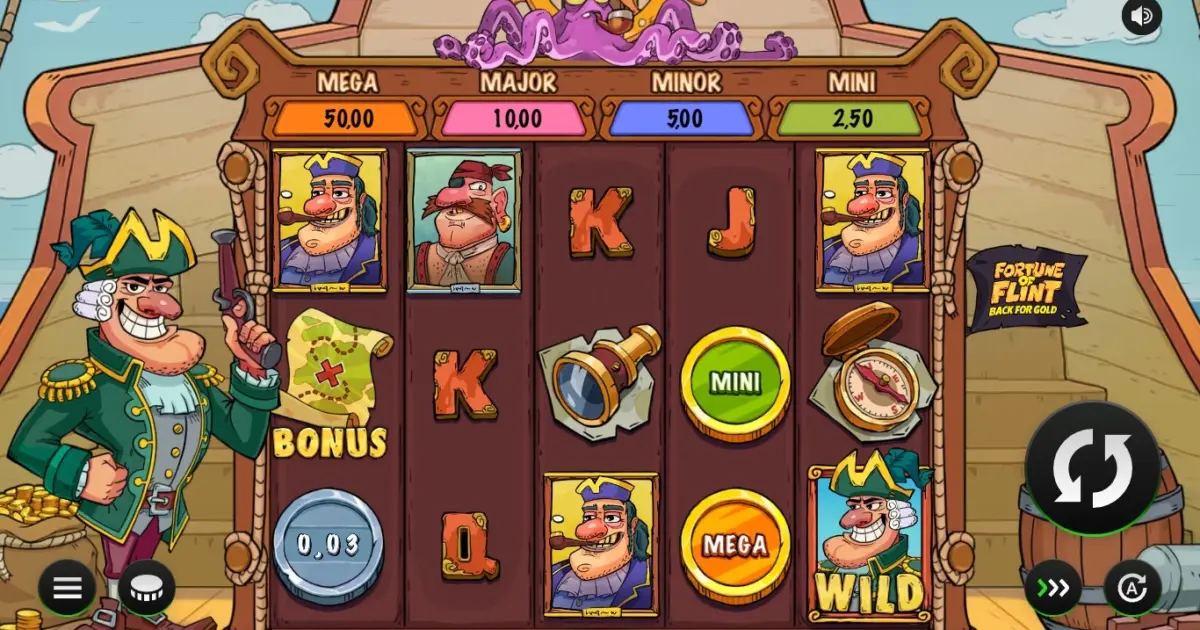
Gamebeat’s five-reel pirate release runs at a published RTP of 96.23%, which puts it slightly ahead of the typical slot in our database and marginally ahead of Gamebeat’s own catalogue average. That is the strongest factual case for it. The weaker part is how little else has been published: no volatility rating, no max win multiplier, no stake range, no hit frequency.
Fortune of Flint: Back for Gold Slot versus the average slot
The average RTP across the games we track is 95.71%. This one sits 0.52 percentage points above that figure, which is a real but modest edge. Translated into money, a 95.71% game returns roughly £95.71 per £100 wagered over a very large sample; 96.23% returns about £96.23. Over a thousand £0.20 spins — £200 staked — the difference in expected return is a little over £1.
That is worth understanding properly. Half a percentage point of RTP will not change how a single session feels. Session outcomes are dominated by variance, not by the house edge, and variance over a few hundred spins swamps a £1 difference in expectation. Where RTP does matter is in the aggregate: if you play thousands of spins across a year, choosing games above the average rather than below it costs you meaningfully less over that whole period.
So treat 96.23% as a tie-breaker rather than a reason to play. It tells you the game is not one of the stingy outliers. It tells you nothing about whether you will enjoy it, how long your bankroll will last, or how large the swings will be, because those questions belong to volatility, and that number has not been published here.
RTP breakdown: 96.23% in context
RTP is a long-run theoretical average calculated over millions of simulated spins, not a promise about your session. A 96.23% figure means the game is mathematically designed to keep about 3.77% of everything wagered through it over that enormous sample. Your actual outcome over a hundred or a thousand spins can land anywhere — well above 100% return, or at zero.
Every spin is independent. The reels have no memory of the last result, no running total to settle, and no mechanism that adjusts the odds based on what has already happened. A run of dead spins does not make anything more likely on the next one, and a good run does not borrow from your future. This is why no stake pattern, timing choice or progression system can shift expected value: you cannot change a fixed percentage by rearranging when you bet.
Here is how the figure sits against the reference points available:
| Metric | Value |
|---|---|
| RTP | 96.23% |
| Reels | 5 |
| Provider | Gamebeat |
| Primary theme | Pirates |
| Game type | Slot Machine |
| Gamebeat catalogue average RTP | 96.18% |
| Site-wide average RTP | 95.71% |
| Popularity rank | 1,574 (92.1st percentile) |
| Free demo | Available |
The gap to Gamebeat’s own average is 0.05 points — statistically meaningless. This is a studio-typical release, not a flagship built around a headline return figure.
Volatility profile
Gamebeat has not published a volatility rating for this title, and no max win multiplier or hit frequency figure is available either. That absence is worth taking seriously rather than filling in with guesswork, because volatility is the number that actually predicts how your session will feel.
In general terms: low-volatility slots pay small amounts often, which keeps a bankroll ticking over and produces long, level sessions with shallow swings. High-volatility slots pay rarely but larger, which means long stretches of nothing punctuated by occasional bigger hits — and they need a substantially deeper bankroll relative to stake to survive those dry runs. Medium sits between the two. Two games with identical 96.23% RTP can deliver completely different experiences depending on where they sit on that scale.
Without a rating, the practical answer is to find out empirically. Run a few hundred spins in the demo at a fixed stake and watch the shape of the balance line: frequent small recoveries suggest the lower end, long flat declines broken by spikes suggest the higher end. That is not a precise measurement, but it is far better than assuming.
Gamebeat as a studio
Gamebeat has 64 games in our database with an average RTP of 96.18% — a consistent studio that generally sits above the 95.71% site-wide average without chasing headline return figures. That consistency is useful information: it suggests the 96.23% here is a deliberate house standard rather than a one-off.
If you want to sample the range, Pin-Up Fortune Double runs at 96.11% and Giggly Greedy Story at 96.08%, both fractionally below this release and close enough that RTP should not decide between them. Book Of Mummies sits lowest of the three at 96.03%, a 0.20-point gap from the game reviewed here — still above the site average, and still a difference you would need thousands of spins to notice.
The pattern across all four is a tight cluster in the 96.0% to 96.3% band. Choose on theme and mechanics, because the maths barely separates them.
Three Pirates alternatives worth comparing
There are 293 pirate-themed games in our database, so the label alone narrows very little. On the numbers, this release compares well against its closest theme neighbours.
- 1 Reel Caribbean Treasure — 95.42% RTP, roughly 0.8 points below, and a single-reel format that is structurally a different kind of game rather than a like-for-like swap.
- Jaws and Jewels Power Combo — 94.25% RTP, nearly two full points lower. Over £1,000 staked that is about £20 more expected cost.
- Cursed Pirates — 94.00% RTP, the weakest of the group on return, and 2.23 points behind the game reviewed here.
On RTP alone, 96.23% beats all three theme alternatives listed, in one case by more than two percentage points. That is a genuinely wide gap by slot standards. It does not mean the others are bad games — mechanics, pacing and feel are not captured by a single percentage — but if return is your deciding factor within the pirate category, this one wins the comparison outright.
Getting the most out of the free demo
A free demo is available, which lets you play with virtual credits and no money at stake. Use it to answer the questions the published data cannot: how quickly the balance moves, whether the pacing suits you, and how the interface handles. Demo results do not predict real-money outcomes — the sample is too small and the credits are not real — but the mechanics are the same.
A useful approach is to pick one stake, stick to it for a few hundred spins, and note how often the balance recovers. That gives you a rough feel for the volatility Gamebeat has not disclosed. Trying it with no download and no account keeps the exercise cost-free.
If you move to real money: this is 18+ entertainment, not income. Set a budget you are comfortable losing before you start, treat it as the price of the session the same way you would a cinema ticket, and stop when that budget is gone rather than topping it up.
Should you play Fortune of Flint: Back for Gold?
It is a reasonable pick if you want a five-reel pirate slot with an above-average return. 96.23% clears the 95.71% site average by half a point and beats every pirate alternative listed here, in one case by more than two points. Its 92.1st-percentile popularity rank suggests plenty of people have found it playable.
The reservation is the missing data. No volatility rating, no max win, no stake range means you cannot plan a bankroll or set expectations for swing size before you load it. If you see a max win figure quoted elsewhere, treat it sceptically — Gamebeat has not published one. Try the demo first, judge the pacing yourself, and go in knowing that the RTP edge is real but small.
Sources. Volatility, max win: Bigwinboard, checked 27 Nov 2026.
Frequently Asked Questions
Can I play Fortune of Flint: Back for Gold for free?
A free demo is available, so you can spin with virtual credits and no money at stake. It runs in the browser with no download needed. The demo uses the same five-reel mechanics as the real-money version, though results in demo mode do not predict real-money outcomes because the sample is small and the credits are not real.
What is the RTP of Fortune of Flint: Back for Gold?
The published RTP is 96.23%, meaning the game is designed to return about £96.23 per £100 wagered across a very large sample of spins. That is 0.52 points above the 95.71% site-wide average and 0.05 above Gamebeat's 96.18% catalogue average. It is a long-run theoretical figure, not a session forecast.
Is Fortune of Flint: Back for Gold high or low volatility?
Gamebeat has not published a volatility rating for this title, so there is no verified answer. Higher volatility means rarer but larger payouts and a need for a deeper bankroll; lower volatility means smaller, more frequent returns. The practical route is a few hundred demo spins at a fixed stake to observe how the balance behaves.
Who is Gamebeat and what else do they make?
Gamebeat is the studio behind this release, with 64 games in our database averaging 96.18% RTP. That is consistently above the 95.71% site-wide average. Their catalogue includes Pin-Up Fortune Double at 96.11%, Giggly Greedy Story at 96.08% and Book Of Mummies at 96.03% — a tight cluster rather than wide variation.
How does it compare to Cursed Pirates?
On return it is clearly ahead: 96.23% against 94.00% for Cursed Pirates, a gap of 2.23 percentage points. Over £1,000 staked that is roughly £22 more expected cost on the lower-RTP title. Both are pirate-themed, and there are 293 games carrying that label, so mechanics and pacing may still decide your preference.