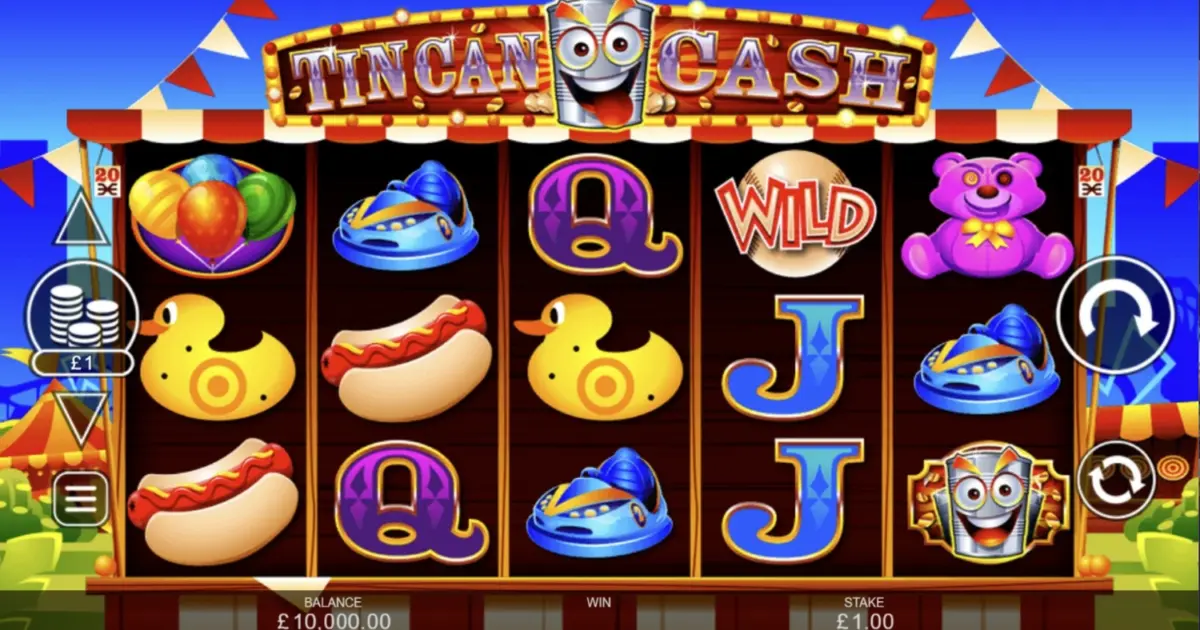
Before you commit time or money, here is the short answer: Tin Can Cash slot from Inspired Gaming carries a 95.0% RTP, which sits below both the provider average and the market-wide average. The studio has not published a volatility classification, payline structure, or stake range, so you will need to discover most of the session profile by playing the free demo yourself.
The 5-reel grid explained
Tin Can Cash uses a standard 5-reel layout. Across the online slot market, five reels is the most common structure because it supports both traditional left-to-right paylines and cluster or ways-based mechanics without overcomplicating the screen. A 5-reel grid typically holds between three and four visible rows, though Inspired Gaming has not specified the row count for this title.
The theme field in the game’s metadata reads only “5-Reels,” which is a structural descriptor rather than a narrative theme. That means you should expect no strong story, character set, or branded tie-in — the grid itself is the organising principle. Many five-reel slots from this era lean on classic fruit or number symbols; whether Tin Can Cash follows that pattern is something you will confirm by loading the game.
If you have played other Eggspendables from the same provider, you will recognise the same five-reel canvas, though Eggspendables returns a notably higher 97.0% RTP on that identical structure.
Paylines, ways and how the Tin Can Cash slot pays
Inspired Gaming has not published a payline count, ways mechanic, or any detail about how winning combinations form on this game. That absence is meaningful for your planning: without knowing whether the slot uses fixed lines, adjustable lines, or a ways system, you cannot calculate your effective cost per spin before the game loads.
As a general rule, five-reel slots tend to use between 10 and 50 paylines or a 243-ways format. Fixed-line games force you to stake on every line at once, so your total bet is the line bet multiplied by the number of lines. Adjustable-line games let you reduce that multiplier, lowering cost per spin but also reducing the number of simultaneous ways to win. Ways-based games remove the line concept entirely and pay for matching symbols on adjacent reels regardless of vertical position.
None of these descriptions are confirmed for Tin Can Cash. Treat any payline count you see quoted on third-party sites as unverified until the in-game information screen confirms it. If you want to understand how Inspired Gaming handles line structures in titles they do document, Frontier Fishing provides a useful comparison point with a 94.5% RTP.
95.0% RTP put in context
Return to player is a long-run statistical average calculated across millions of spins. A 95.0% RTP means that, across a very large sample, the game retains 5.0% of all money wagered. For every £100 you stake over a session that genuinely reaches hundreds of thousands of spins, £95 is theoretically returned to players collectively — though any individual session will land far from that line.
Contextualised, Inspired Gaming’s own catalogue averages 95.01% across its 150 published titles, so Tin Can Cash sits precisely at the studio’s house norm. The wider market, however, averages 95.71%, placing this slot 0.71 percentage points below the field. Over a 10,000-spin session at £1 per spin, that gap represents roughly £71 less theoretical return than an average market title would deliver across the same sample.
95.0% is not a terrible number, but it is not competitive with the best titles available. If RTP is your primary filter, the provider’s own Santas Winning Wishlist matches it at 95.0%, while Eggspendables offers two full percentage points more. The math here is straightforward: a higher RTP does not change your individual luck, but over long enough play it changes your expected loss rate.
Volatility and hit patterns
No volatility rating has been published for Tin Can Cash. Inspired Gaming lists it neither as low, medium, nor high variance in the available metadata. That omission forces you to infer the game’s risk profile from observation or to accept uncertainty when budgeting a real-money session.
As a general framework: low-volatility slots return smaller wins more frequently, producing shorter dry stretches and a steadier balance curve. They suit players who want a session to last longer at a given bankroll. High-volatility slots concentrate returns into fewer, larger events, meaning extended losing streaks punctuated by rare payouts. Medium volatility sits between those poles.
Without a published volatility label or hit frequency, you cannot predict which pattern Tin Can Cash follows. The practical approach is to play the free demo at minimum stake, track how many spins pass between wins, and note the ratio between small and large payouts. That observational method costs you nothing but time and gives you a personal read on swing size.
Remember that even a high-volatility game is not “due” after a losing streak. Each spin is statistically independent of the last. Volatility describes the shape of the distribution over thousands of spins, not a predictable rhythm within a single session.
Choosing a stake when the range isn’t published
Neither a minimum bet nor a maximum bet has been recorded for this title. That means the stake range is unknown until you open the game, and any review quoting specific figures has either loaded the game or guessed.
What you can reason about is the relationship between stake, bankroll, and session length in general terms. If the minimum bet is £0.20 and you have £20 to play, that gives you 100 spins before your balance is exhausted with zero returns — assuming no wins. Double the stake and you halve the session. The unknown multiplier (whether the game uses 10 lines, 25, or a ways mechanic) compounds this uncertainty because the total cost per spin depends on it.
A practical rule for an unlisted game: start at the lowest available stake in the demo, confirm the cost per spin, then divide your intended real-money bankroll by that figure. If the result is under 200 spins, you are buying a very short session and should either reduce your stake or accept the risk of rapid depletion.
Demo play versus real money
The free demo for Tin Can Cash is available without download, and it uses the same random number generator configuration as the real-money version. What the demo does not give you is the emotional feedback of wagering actual funds — the tendency to chase losses, increase stakes after a win, or play longer than planned when money is at stake.
Use the demo to answer questions FACTS cannot: what is the payline structure, what is the cost per spin, how frequent are wins, and does the bonus round (if one exists) feel worth the base-game grind. Play Tin Can Cash free for at least 200 spins to get a rough read on the rhythm before you consider real stakes.
When you do move to real money, treat the session as paid entertainment with a fixed budget. You must be 18 or over. Set a loss limit before you spin, and stop when you reach it regardless of how the last few spins went. No outcome on a demo session predicts your next real-money result — both are independent random events governed by the same RTP, not by each other.
Verdict on Tin Can Cash
Tin Can Cash is a serviceable five-reel slot whose main problem is a lack of published data combined with a below-market RTP. The 95.0% return is neither scandalous nor compelling — it matches Inspired Gaming’s house average but trails the wider market by 0.71 percentage points. For a provider that ships 150 titles, that puts the game in the lower half of its own catalogue by value.
The absence of a volatility label, stake range, payline count, and bonus-feature description means you cannot make an informed session plan from reading alone. You must play to learn, which is fine if you use the demo first but wasteful if you jump to real stakes without a bankroll strategy.
If you are specifically shopping for Inspired Gaming slots with better published numbers, Eggspendables delivers 97.0% RTP with the same reel count. Tin Can Cash makes sense for you only if the grid style or theme appeals after you see it, or if you are already inside a provider’s lobby and want a low-commitment game to fill time between higher-RTP titles.
| Spec | Value |
|---|---|
| Provider | Inspired Gaming |
| RTP | 95.0% |
| Reels | 5 |
| Volatility | Not published |
| Paylines | Not published |
| Bet range | Not published |
| Free demo | Available |
| Popularity rank | 1558 (92.2nd percentile) |
Frequently Asked Questions
Can I play Tin Can Cash for free without signing up?
Yes, the free demo is available without download or registration. The demo runs the same RNG configuration as the real-money version, so it is useful for learning the payline structure and win frequency before committing funds. However, demo results do not predict your real-money outcomes since each spin is an independent random event.
What is the RTP of Tin Can Cash and is it good?
Tin Can Cash has a 95.0% RTP, which is below the market-wide average of 95.71% and matches Inspired Gaming's own catalogue average of 95.01%. Over very large sample sizes this means the game retains 5.0% of all wagers. The same provider's Eggspendables offers 97.0%, a two-percentage-point improvement worth considering if RTP is your priority.
What is the volatility of Tin Can Cash?
Inspired Gaming has not published a volatility rating for Tin Can Cash. Without a stated low, medium, or high classification, you cannot predict whether wins will come frequently in small amounts or rarely in large ones. Your best option is to play 200 or more free spins and track the gap between wins to form a personal read on the game's swing profile.
How does Tin Can Cash compare to other Inspired Gaming slots?
Inspired Gaming ships 150 titles with an average RTP of 95.01%, so Tin Can Cash sits exactly at the studio norm. Eggspendables from the same provider returns 97.0% and Frontier Fishing returns 94.5%. Tin Can Cash at 95.0% is middle-of-the-road for this developer and below average for the broader market.
Is Tin Can Cash suitable for a low-budget session?
The stake range is not published, so you cannot confirm the minimum bet before loading the game. As a general rule, low-volatility games with small minimum stakes suit tight budgets because they stretch your bankroll across more spins. Since neither factor is confirmed here, open the demo, check the minimum stake, and divide your budget by the cost-per-spin to see how many spins you can realistically afford.