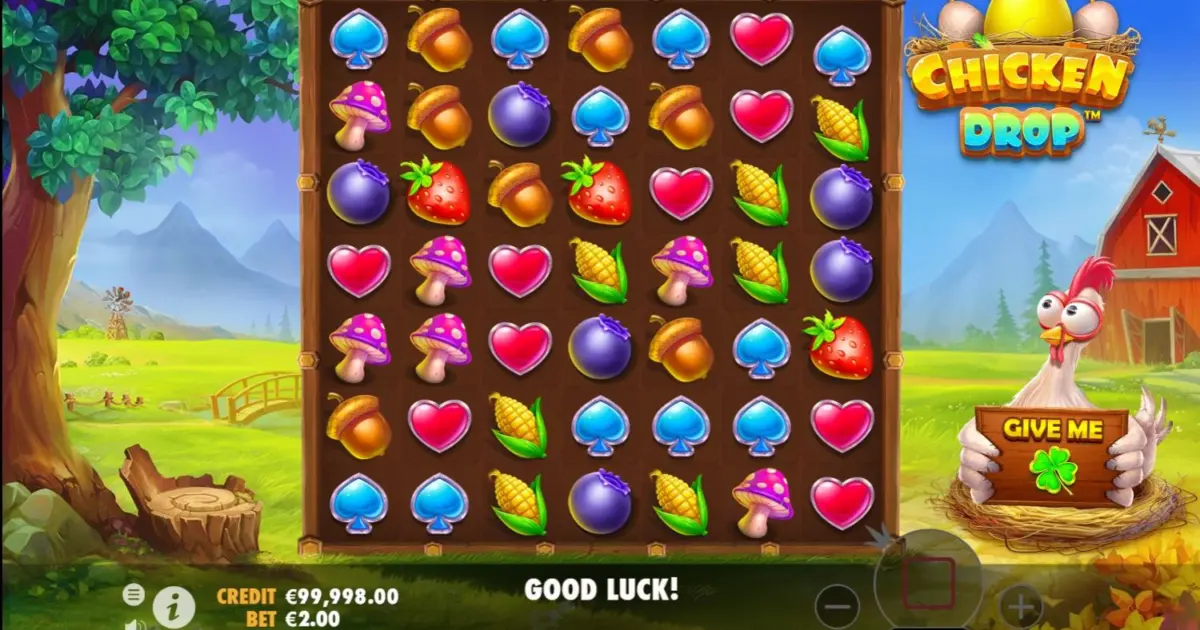
The chicken drop slot from Pragmatic Play runs a 96.5% RTP across a 7-reel grid, and it ranks 1512th in our database — the 92.4th popularity percentile, so plenty of people are playing it. That RTP is the main reason to consider it: 0.79 percentage points above the average slot we track.
What you will not find below is a description of bonus rounds, multipliers or symbols. Pragmatic Play has not published volatility, stake limits, hit frequency or a max win figure for this title in the data available here, and inventing those numbers would be worse than admitting they are missing. What follows is the maths that is verifiable, and what it implies for a session.
Chicken Drop at a glance
Here are the figures that exist:
| Field | Value |
|---|---|
| Provider | Pragmatic Play |
| RTP | 96.5% |
| Reels | 7 |
| Primary theme | Farm and Garden |
| Other themes | 7-Reels, Easter, Relax |
| Type | Slot Machine |
| Popularity rank | 1512 (92.4th percentile) |
| Free demo | Available |
| Volatility | Not published |
| Max win | Not published |
| Stake range | Not published |
This suits a player who wants a well-above-average return figure from a major studio and is comfortable working out the risk profile for themselves in the demo. If you need a stated volatility rating and a max win multiplier before you commit, the gaps here will bother you.
What a 96.5% RTP actually returns
RTP is a long-run statistical average, not a session promise. At 96.5%, the game is modelled to return £96.50 for every £100 wagered across a very large number of spins — millions, not hundreds. The 3.5% house edge is what remains.
Work it through. Wager £1 per spin for 1,000 spins and you have staked £1,000; the modelled return on that turnover is £965, an expected loss of £35. But 1,000 spins is a tiny sample against the population the figure describes. Real 1,000-spin sessions land all over the place — well up, well down, and everything between. The average only asserts itself over volumes no individual player reaches.
Against the field, 96.5% is genuinely good. The average across every slot in our database is 95.71%, so this title sits 0.79 percentage points above the corpus average. On £1,000 of turnover that difference is about £7.90 in modelled return. Pragmatic Play’s own average across 739 titles is 96.32%, so this one is slightly ahead of its own studio’s typical figure too.
Two things RTP does not tell you: how the returns are distributed, and what any single spin will do. Every spin is independent of the last.
Volatility and what your session will feel like
No volatility rating is published for this game, which is the single biggest gap in the data. It matters because volatility, not RTP, determines what a session feels like.
Two games with identical 96.5% RTP can behave completely differently. A low-volatility slot pays small amounts often; balances drift rather than lurch, sessions last longer on a given budget, and results cluster near the average sooner. A high-volatility slot pays rarely and larger; long dry stretches are normal, and the same bankroll can vanish in a fraction of the spins — or produce a result far above average. Medium sits between the two.
Because the rating is absent, treat the risk profile as unknown and plan for the more demanding case. Practically, that means budgeting for a shorter session than you expect and using the demo to observe how the balance actually moves. Count how many spins pass between wins and how big the swings get relative to your stake. That behaviour, watched over a few hundred demo spins, tells you more than a one-word label would.
What no volatility figure changes: a game is never “due”, “hot” or “cold”. Outcomes carry no memory of previous spins.
The 7-reel layout and how wins are counted
Seven reels is unusual. Most slots run three or five, so a 7-reel grid is a wider playing field with more symbol positions per spin.
Beyond the reel count, the win mechanic is not specified in the data available. Slots generally resolve wins one of a few ways: fixed paylines, “ways” systems that count symbols by reel position, cluster systems that pay for groups of adjacent matching symbols, or tumble mechanics where winning symbols are removed and replaced within the same spin. Wide grids are often paired with cluster or ways mechanics rather than long payline lists, because the position count makes traditional lines unwieldy — but that is a general pattern, not a claim about this game.
Since no payline or ways count is published here, the paytable in the demo is your source. Open it before spinning and check how wins are formed, whether stake is divided across lines, and what the symbol hierarchy looks like. Two minutes in the paytable removes all the guesswork this section cannot.
Stake range and sizing a bankroll
Minimum and maximum stakes are not published in the data here, so check them in the game client before you plan anything. Once you have the real minimum, the arithmetic is simple: divide your budget by your stake to get your spin count.
A £50 budget at £0.20 per spin is 250 spins. The same £50 at £1 per spin is 50. Neither is right or wrong, but they are very different sessions, and with volatility unknown here, the longer spin count is the safer way to learn how the game behaves.
Stake size does not change the house edge. Betting more per spin raises turnover, which raises both the modelled loss in absolute terms and the size of the swings — it does not shift the 96.5% figure by a fraction. No staking pattern, progression or timing changes expected value either, because independent spins cannot be sequenced into an advantage.
Playing the Chicken Drop demo before you commit
A Chicken Drop free demo is available, and given how much is unpublished about this title, that is the practical way to fill the gaps: real paytable, real stake range, real feel for the swings, no money at risk.
One limit worth being clear about. Demo results do not predict real-money results and cannot pay out. A hot streak or a dead run in demo mode is a small sample from the same independent-spin process, nothing more. Use the demo to learn the mechanics and check the numbers, not to judge whether the game “pays”.
If you do move to real money: this is 18+ entertainment you pay for, like a cinema ticket. Set a budget before you open the game, treat it as spent the moment you do, and stop when it is gone rather than topping up. Never stake money you need for anything else.
Verdict: who should play Chicken Drop
The case for it is the return figure. 96.5% beats the 95.71% corpus average and Pragmatic Play’s 96.32% studio average, and the 92.4th popularity percentile suggests it holds attention. The case against is the missing data: no volatility, no max win, no stake range published.
Within the Pragmatic Play catalogue, Gates of Olympus matches it at 96.5% and Sweet Bonanza edges ahead at 96.51%, both with a longer track record if you prefer a better-documented title. Staying with farmyard themes, Barn Festival sits close at 96.45%, while Rednecks drops to 95.0% — 1.5 points below, and a real difference over sustained turnover.
Try the demo, read the paytable, then decide. It is one of 108 Farm and Garden titles we track, and the RTP puts it near the front of that group.
More from Pragmatic Play
- Big Bass Vegas Double Down Deluxe — 96.5% RTP
- Big Bass Hold and Spinner Megaways — 96.7% RTP
- Big Bass Return to the Races — 96.07% RTP
- Hot to Burn — 96.71% RTP
- 3 Buzzing Wilds — 96.03% RTP
- Pirates Pub — 96.03% RTP
- Cosmic Catch — 96.5% RTP
- Cash Box — 96.02% RTP
Frequently Asked Questions
Can I play Chicken Drop for free without downloading anything?
A free demo is available for this Pragmatic Play title, so you can try the 7-reel game with virtual credits and no deposit. The demo uses the same maths as the real-money version, including the 96.5% RTP, which makes it the practical way to check the paytable and stake range before committing money.
What does the 96.5% RTP on Chicken Drop mean for me?
It means the game is modelled to return £96.50 per £100 wagered across a very large sample, leaving a 3.5% house edge. Over 1,000 spins at £1 that implies a £35 expected loss, but individual sessions vary widely. At 96.5% it sits 0.79 points above the 95.71% database average.
Is Chicken Drop high or low volatility?
Volatility is not published for this game, so treat the risk profile as unknown. That matters because volatility, not RTP, controls session length and swing size — a low-volatility slot pays small and often, a high-volatility one pays rarely and larger. Watch a few hundred demo spins to gauge how the balance actually moves.
Who makes Chicken Drop and what else do they produce?
Pragmatic Play developed it. They have 739 titles in our database with an average RTP of 96.32%, so this game sits slightly above their own studio norm. Their catalogue includes Gates of Olympus and Joker's Jewels, both at 96.5%, and Sweet Bonanza at 96.51% — all comparable returns.
How much should I budget for a session on Chicken Drop?
Minimum and maximum stakes are not published here, so check them in the game client first, then divide your budget by your stake. A £50 budget at £0.20 per spin gives 250 spins; at £1 it gives 50. With volatility unstated, the longer spin count is the safer starting point.