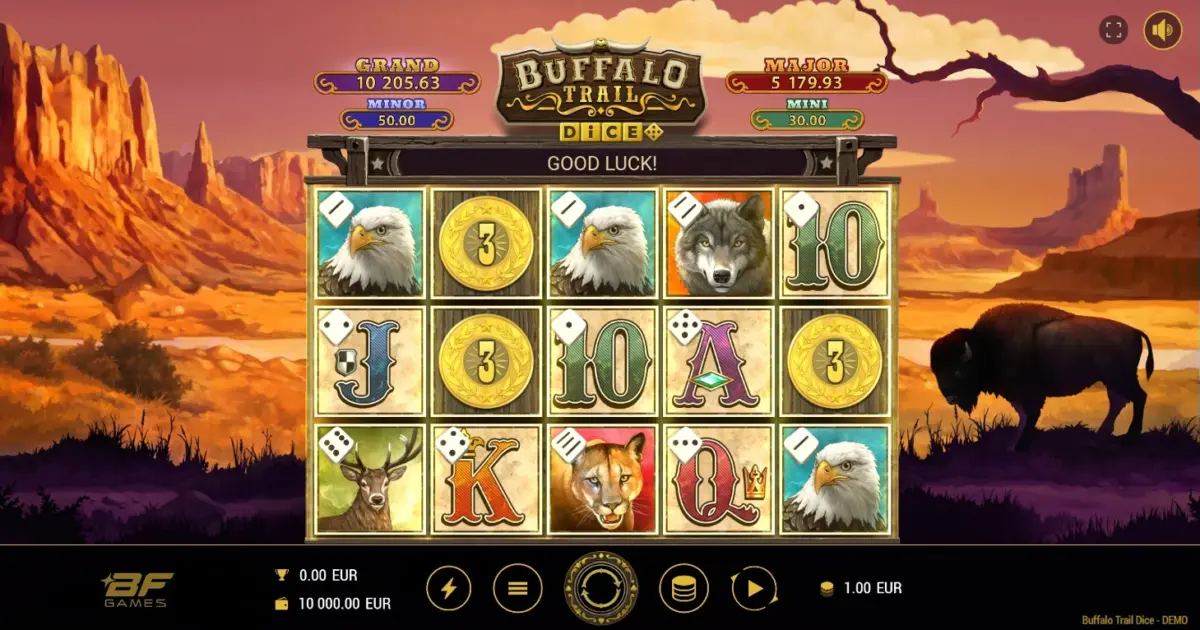
Buffalo Trail Dice is a five-reel release from BF Games with a published return-to-player figure of 96.16%. That puts it above the studio’s own portfolio average of 95.77% and 0.45 percentage points above the 95.71% average across every title in our database, which is a small but real edge in your favour over a long sample. It also ranks 1509th for popularity here, placing it in the top 92.4% of games by traffic, so plenty of people have already gone looking for it.
The catch is what BF Games has not published. There is no official volatility rating, no max win multiplier, no hit frequency and no stake range in the data available for this title. That is a meaningful gap, and this review will not paper over it.
Is Buffalo Trail Dice worth playing?
If you want a mainstream RTP from an established studio and you are happy to establish the game’s rhythm yourself in demo mode, yes. If you need to know the maximum win or the volatility band before you commit a budget, this one asks you to do more homework than most.
The 96.16% figure is the strongest argument in its favour. Most online slots cluster between roughly 94% and 96.5%, and anything above 96% sits comfortably in the upper half of that range. BF Games has 117 titles in our database, and this one returns more than the studio’s typical release.
What tilts the other way is the missing paperwork. A slot’s RTP tells you the long-run average return; volatility tells you how wildly your balance moves on the way to that average. Without a volatility rating you cannot size your bankroll properly in advance. You can only observe. The free demo makes that observation cheap, which is the practical answer: spin a few hundred rounds for nothing and watch what the balance does.
| Provider | BF Games |
|---|---|
| RTP | 96.16% |
| Reels | 5 |
| Theme | Animals |
| Free demo | Yes |
What 96.16% RTP means over 1,000 spins
RTP is a theoretical average calculated across millions of simulated spins, not a promise about your session. At 96.16%, the game is modelled to return £96.16 for every £100 wagered over that very large sample. The 3.84% remainder is the house edge.
Put that against 1,000 spins at £0.20 a spin. Total staked: £200. Expected return at 96.16%: £192.32, an average theoretical loss of £7.68. That is the maths, not the forecast. Your actual result after 1,000 spins could sit far above or far below it, because 1,000 spins is a tiny sample against the numbers used to calculate RTP.
Two things follow. First, every spin is independent: the outcome of the next round is not affected by the last ten, or the last thousand. There is no point at which a slot becomes “due”. Second, no stake pattern, timing choice or bet progression changes the 3.84% edge. Doubling your stake doubles both your expected return and your expected loss in absolute terms; the percentage stays fixed.
The comparison that matters more is against alternatives. Against a 95.71% corpus average, 96.16% saves you about £0.90 in expected cost per £200 wagered. Small per session. Not nothing across a year.
How volatile is Buffalo Trail Dice?
BF Games has not published a volatility rating for this title, so nobody can tell you honestly. Treat any confident low, medium or high label you see quoted elsewhere as unsourced.
Here is what the three bands generally do to a session, so you can classify it yourself in the demo. Low-volatility slots pay small amounts often. Your balance drifts down gently between hits, sessions last a long time on a modest bankroll, and the biggest single win is usually a modest multiple of your stake. High-volatility slots do the opposite: long stretches with nothing, then occasional outsized hits that carry the whole session. The same 96.16% RTP can describe either behaviour, because RTP says nothing about distribution. Medium sits between the two and is where most mainstream releases land.
To place this game yourself, run 200 to 300 demo spins at a fixed stake and watch two things: how many spins pass between wins, and how large the best win is relative to your stake. Frequent small returns point low. Long dry runs broken by a big hit point high. This tells you what bankroll the game needs. It does not predict your real-money results, and it never will, because the demo runs on the same independent random outcomes.
What the Animals theme brings to the game
The game is tagged Animals, American and 5-Reels. Between the name and those labels, you can reasonably expect North American wildlife iconography, buffalo included. What the symbols actually look like, what the soundtrack does, and how the animations behave are not documented in the data available, and describing them would be invention.
Animals is one of the largest theme categories in our database, with 1,788 titles carrying the tag, so the dressing alone will not distinguish this release. Theme rarely changes the maths anyway. It changes whether you enjoy sitting with the game for an hour, which is not a trivial consideration when you are paying for entertainment, but it does not shift the 3.84% house edge by a hundredth of a point.
The “Dice” element in the name suggests some dice-linked presentation or mechanic. BF Games has not documented what it does here, and a name is not a specification. Many slots use branded mechanic names for features ranging from a simple symbol substitution to a full bonus round, so the label tells you nothing reliable. Load the free demo and find out in a couple of minutes.
Stakes, session length and bankroll
The minimum and maximum stake for this title are not published in the data available, so check them on the game’s paytable before you set a budget. That is a two-second check and it determines everything below.
The arithmetic is straightforward once you know your stake. Decide what you are prepared to spend, then divide by stake per spin to get your rough spin count. A £50 budget at £0.20 a spin buys 250 spins before any returns; at £1 a spin it buys 50. Returns extend that, and at 96.16% they will extend it substantially on average, but the starting figure is the honest one to plan against.
Volatility is the other input, which is why the missing rating matters practically rather than academically. A high-variance game can burn through 100 spins without a meaningful return, so it needs a deeper bankroll relative to stake than a low-variance one. Since you cannot look that figure up here, the conservative move is to stake as though variance is high: pick a spin count you would be content to lose entirely, then set your stake to fit it. If demo play shows frequent small returns, you can revise upward later.
Alternatives if Buffalo Trail Dice is not for you
If you want a documented mythology theme instead of wildlife and a slightly better return, Strength of Hercules posts 96.31% RTP, the highest figure among the comparable titles here. Hercules Power Wild sits just behind at 96.20%, also above this game.
Staying with the same studio, Book of Gods returns 96.12% and Sweet Reward 96.08%. Both are marginally below Buffalo Trail Dice, so if the BF Games house style suits you, there is no return-based reason to switch away from this one. Anyone wanting a different mechanic entirely could look at Megaways-style variable-ways formats, where the number of ways to win changes each spin rather than staying fixed across five reels.
The spread across all these games is roughly a quarter of a percentage point. On £200 wagered that is about £0.50 of expected cost. Pick on format, pace and whether you enjoy the game, then use RTP as the tie-breaker rather than the deciding factor.
Final take
Buffalo Trail Dice earns a cautious recommendation on the strength of one number: 96.16% RTP, above both the BF Games average of 95.77% and the wider 95.71% benchmark. Everything else about it is undocumented, which is not the same as bad, but it does shift the burden of assessment onto you. The free demo is available with no download, so that assessment costs nothing but time.
Slots are paid entertainment, not income. Play only if you are 18 or over, set a budget before you start and treat it as the price of an evening rather than money you expect back. Nothing you observe in demo mode predicts what real-money spins will do, because every spin is an independent random event.
Verdict: a solid-return five-reel release with a thin data sheet. Worth 200 free spins of your attention to see whether the pace suits you.
Frequently Asked Questions
Can I play Buffalo Trail Dice for free?
A free demo is available for this title, and it runs in your browser with no download required. Demo mode uses the same random outcome engine as real-money play, so it is a genuine way to judge the pace and hit pattern. It cannot pay out real money, and results there do not predict cash results.
What is the RTP of Buffalo Trail Dice?
The published return-to-player figure is 96.16%, meaning the game is modelled to return £96.16 per £100 wagered across a very large sample. That leaves a 3.84% house edge. It sits above the BF Games portfolio average of 95.77% and 0.45 points above the 95.71% average across our whole database.
Is Buffalo Trail Dice high or low volatility?
BF Games has not published a volatility rating for this game, so no honest answer exists from the data. Ignore confident labels quoted elsewhere. Run 200 to 300 demo spins at a fixed stake instead and watch the gaps between wins and the size of the best hit relative to your stake.
Who makes Buffalo Trail Dice and what else do they produce?
BF Games developed it. The studio has 117 titles in our database with an average return of 95.77%, so this release beats their typical figure. Other BF Games slots include Book of Gods at 96.12% RTP and Sweet Reward at 96.08%, both marginally below this one on published return.
What stake should I use on Buffalo Trail Dice?
The minimum and maximum stake are not published in the available data, so check the paytable in-game first. Then divide the budget you are prepared to lose by your stake per spin: £50 at £0.20 buys 250 spins before returns. Since volatility is undocumented, plan conservatively.