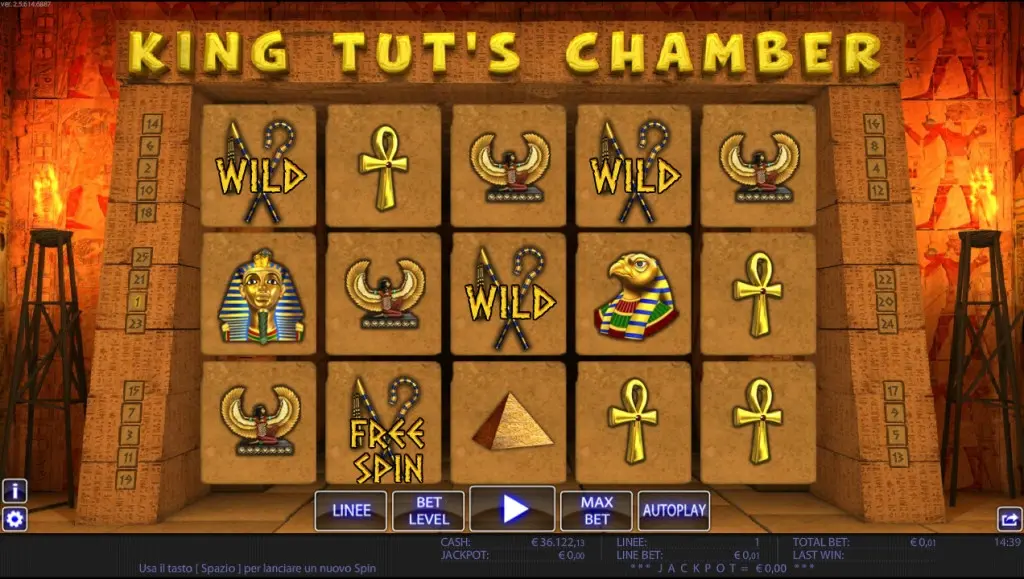
King Tut’s Chamber is worth a look if you want an Egypt-themed 5-reel game you can try for free before risking bankroll, but the maths is middling rather than generous. The king tut’s chamber slot returns 94.95% on paper, which is 0.76 points below the corpus average of 95.71% and below Worldmatch’s own average of 95.61%, so you are not gaining an edge on return alone. Ranked 1437 with a popularity percentile of 92.8, it is a well-known niche choice, not a top-100 traffic driver, and the free demo is the sensible way to see if its pacing suits you.
Is King Tut’s Chamber worth playing? king tut’s chamber slot verdict
That depends on what you value most: theme and access, or statistical return. If you enjoy Egypt themes and want a straightforward 5-reel Slot Machine you can try without registration, King Tut’s Chamber ticks those boxes and the free demo is available. If you are filtering primarily on numbers, the 94.95% RTP is objectively below both the average Worldmatch game and the broader corpus average, which makes it harder to justify on value alone.
The popularity data adds context. At rank 1437, the game sits outside the most-played tier, yet its 92.8 popularity percentile indicates sustained interest among players who seek Egypt content specifically. Worldmatch has 112 titles in this dataset, with an average RTP of 95.61%, so this release sits 0.66 points below its studio siblings on return. That difference is not huge over a handful of spins, but it compounds over time, as the next section shows.
There are also practical gaps in what has been published. Worldmatch has not disclosed a max win figure, hit frequency, payline or ways count, or a detailed bonus feature breakdown for this title in the FACTS supplied. Missing data is itself useful: you cannot plan for a feature you cannot verify, and you should treat any third-party claim about free spins, multipliers or jackpots with caution until the provider publishes it.
Every spin remains independent, and demo play does not predict real-money results. If you do try it, set a budget, use the demo to gauge pace, and treat paid spins as entertainment rather than a recovery mechanism.
| Figure | Value |
|---|---|
| Game name | King Tut’s Chamber |
| Provider | Worldmatch |
| RTP | 94.95% |
| Reels | 5 |
| Primary theme | Egypt |
| Other themes | 5-Reels |
| Subcategory | Slot Machine |
| Provider average RTP | 95.61% |
| Corpus average RTP | 95.71% |
| RTP vs corpus | -0.76 points |
| Provider game count | 112 |
| Egypt theme game count | 908 |
| Popularity rank | 1437 |
| Popularity percentile | 92.8 |
| Free demo available | Yes |
What 94.95% RTP means over 1,000 spins
RTP is a long-run statistical average, not a promise for any single session. A 94.95% RTP means that across an extremely large sample of wagers, the game is designed to return £94.95 for every £100 staked, with the house retaining £5.05 on average. That average is calculated over millions of spins, so your 20, 100 or even 1,000 spins can sit well above or below it.
To make it concrete, imagine 1,000 spins at £1 per spin. You would have staked £1,000 in total. At the theoretical RTP, the expected return would be £949.50 and the expected net position would be -£50.50. Change the stake and the maths scales linearly: at £0.20 per spin, theoretical expected return is £189.90 on £200 staked; at £2 per spin, it is £1,899 on £2,000 staked. These are averages, not forecasts, and variance ensures real outcomes spread widely around them.
Context matters. The corpus average in this dataset is 95.71%, which would return £957.10 on the same £1,000 sample — £7.60 more than King Tut’s Chamber in expected terms. Worldmatch’s average of 95.61% would return £956.10, £6.60 more. Over 1,000 spins those differences look modest, but over 10,000 spins at £1 the gap versus the corpus average grows to about £76 in expected return.
Stake size does not alter RTP. Raising or lowering your bet, switching bet timing, or chasing losses cannot change the expected value per spin because each spin is independent. What stake size does change is how quickly your bankroll meets that average, which is why session planning matters more than any system.
How volatile is King Tut’s Chamber?
Worldmatch has not published a volatility rating for King Tut’s Chamber in the FACTS provided, so there is no official low, medium or high label to report. That absence matters because volatility, separate from RTP, shapes how a session tends to feel: how often wins may land, how large the swings can be, and how much bankroll you might need to ride out dry spells.
In general terms, many slots are described on a volatility spectrum. Low-volatility concepts often imply more frequent but smaller returns and a smoother bankroll curve, while high-volatility concepts imply less frequent hits with larger potential swings and a greater chance of long losing stretches before a bigger result. Medium sits between the two. These are useful mental models for comparing games, but they are not features of this specific title unless the provider states them.
Without a declared figure or a published hit frequency, you cannot reliably estimate session length or risk profile from the label alone. The only way to infer feel is to observe play, and the free demo is the least costly place to do that. Treat demo observations as an indication of pace, not a preview of real-money returns, because each spin remains random and demo outcomes do not carry over.
If you prefer predictability, the lack of a volatility disclosure should give you pause, especially combined with a below-average RTP. If you are comfortable testing unknown pacing with small stakes and a firm stop-loss, the Egypt theme and 5-reel structure may still appeal, but budget for uncertainty rather than for an assumed low-risk grind.
What the Egypt theme brings to the game
The primary theme is Egypt, with a secondary tag of 5-Reels, which locates King Tut’s Chamber in one of the largest theme groups in the dataset. With 908 Egypt-themed games counted, this is a crowded category where most titles draw on mythology and ancient Egypt as a naming convention. That label tells you about the subject matter — it does not confirm specific characters, symbols, animations, music or bonus mechanics, because none of those visual or audio details are included in FACTS.
Theme, for decision-making, is best understood as atmosphere rather than maths. An Egypt label may signal a familiar setting if you enjoy that subject, but it does not change the 94.95% RTP, the 5-reel structure, or the independent nature of each spin. A 5-reel setup is simply the grid format: five vertical reels that spin and stop independently. It tells you nothing about paylines, ways to win, or feature frequency unless the provider publishes those counts.
What the theme does offer is comparison. Because Egypt titles are so numerous, you can readily find alternatives with different returns or providers if the numbers here do not suit you. The theme’s popularity also explains the game’s 92.8 percentile despite a mid-table rank: a lot of players search for Egypt content, so even outside the top 500 the audience remains sizable.
If you choose games mainly for theme, the missing detail means you should rely on the demo to see whether the presentation matches your taste. If you choose mainly on numbers, let the RTP, provider average and corpus average weigh heavier than the label, since theme alone cannot improve expected return.
Stakes, session length and bankroll
No specific stake range, minimum bet, maximum bet, payline count or ways count has been published for King Tut’s Chamber in the FACTS available, so this section focuses on principles you can apply to any 5-reel slot once you see the actual limits in the lobby.
As a general concept, stake size controls exposure per spin and therefore how many spins a given bankroll can support. A £50 bankroll supports 250 spins at £0.20, 50 spins at £1, and 25 spins at £2, before accounting for any returns. RTP does not alter that arithmetic; it only describes the long-run average return across a very large sample. In the short run, variance dominates, which is why two players staking the same amount can have very different session lengths.
With a 94.95% RTP, the house edge is 5.05%. Over a large sample that edge compounds as total amount wagered, not as a fee deducted once. For example, over 1,000 spins at £0.50, total staked is £500 and theoretical expected return is £474.75, a £25.25 theoretical deficit on average. Again, that is an average — real sessions will deviate — but it illustrates why bankroll planning should assume losses are possible even with frequent small wins.
Because volatility and hit frequency are not disclosed for this title, adopt a conservative approach: decide a total budget for entertainment, divide it into a spin count you are comfortable losing, and set time and loss limits before you start. Every spin is independent, so increasing stakes after losses or extending a session to recover does not improve expected value. When data is missing, smaller stakes and shorter sessions are the most direct way to limit variance exposure while you assess pace in demo mode.
Alternatives if King Tut’s Chamber is not for you
If the 94.95% return is the sticking point, several related games offer a higher theoretical return while keeping a similar reel or theme appeal. Monte Carlo Jewels is another Worldmatch title but with a published RTP of 96.2%, which is 1.25 points above King Tut’s Chamber and above both the provider and corpus averages. That difference adds about £12.50 in expected return per £1,000 wagered, though you trade the Egypt setting for a different theme.
Staying within Egypt, Book of the Sun posts 96.23% RTP, also above the corpus average and 1.28 points higher than King Tut’s Chamber. With 908 Egypt games available, it is one of the closer like-for-like thematic alternatives if you want to keep the subject matter but improve the statistical average.
For a lower-RTP contrast that shows why filtering on numbers matters, Bloody West from the same provider sits at 94.64%, slightly below King Tut’s Chamber, while Book of Dead is another well-known Egypt option at 94.25%. Comparing those figures side by side makes it easier to see where King Tut’s Chamber sits: not the lowest in its family, but not a value leader either. Use the free demo on each to compare pace and presentation, remembering that theme and provider do not override maths and that each spin remains independent.
Final take
King Tut’s Chamber offers a familiar Egypt theme on a 5-reel Slot Machine from an established provider with 112 titles, backed by a free demo and a mid-tier popularity profile. The headline number — 94.95% RTP — is clear and verifiable, but it sits 0.76 points below the corpus average and below Worldmatch’s own average, which weakens the value case if return is your primary filter.
The lack of published detail on volatility, paylines, stake limits, hit frequency and max win also limits how precisely you can plan. Missing information is not a flaw in itself, but it means you should not assume low risk, frequent features or a particular payout structure. Test in demo, check the actual stake range in your lobby, and treat any numbers you see quoted elsewhere without a provider source as unverified.
If you enjoy Egypt settings and want a game you can sample at no cost before committing, it can fill a short, low-stakes entertainment slot. If you are hunting for the strongest statistical return in this catalogue, other Egypt and Worldmatch alternatives with 96%+ RTP will look more compelling on paper.
Play responsibly and keep it as entertainment. You must be 18+ to play, set a budget you can afford to lose before you spin, and use deposit, loss and time limits if you need them. Every spin is random and independent — previous results do not influence the next — so avoid chasing losses and stop if it stops being fun. If gambling becomes a concern, use self-exclusion tools and seek support from a recognized help organization in your country.
Frequently Asked Questions
Can I play King Tut’s Chamber for free without risking money?
Yes, the FACTS show free demo availability for King Tut’s Chamber, so you can try it without staking real cash. Demo play uses the same 5-reel structure for practice, but outcomes remain random and do not predict real-money results. Check the demo in your region to confirm access before you play.
What is the RTP of King Tut’s Chamber and what does it mean?
The published RTP is 94.95%, which is 0.76 points below the corpus average of 95.71%. RTP is a long-run average: across a huge sample it implies £94.95 returned per £100 wagered, with £5.05 retained on average. Your short-term sessions can vary widely around that figure because each spin is independent.
How volatile is King Tut’s Chamber — is it high risk?
No volatility rating, hit frequency or max win figure is included in the FACTS for King Tut’s Chamber, so risk profile cannot be stated. Volatility normally describes swing size and session choppiness, separate from RTP. Without an official label, use the free demo to gauge pace and budget cautiously for uncertain swings.
Who makes King Tut’s Chamber and what else do they offer?
King Tut’s Chamber is made by Worldmatch, which has 112 games in this dataset with an average RTP of 95.61%. Related titles from the same provider include Monte Carlo Jewels at 96.2% RTP and Bloody West at 94.64%. That catalogue size gives you room to compare returns within one studio.
How does King Tut’s Chamber compare to other Egypt slots?
At 94.95% RTP, King Tut’s Chamber sits below the corpus average and below some Egypt peers. For comparison, Book of the Sun is 96.23% and Crazy Mummy is 96.0%, both higher, while Book of Dead is 94.25%, slightly lower. Theme is similar, but the statistical averages differ, affecting expected return over many spins.