Shake Shake Money Tree slot is a 5-reel Asian-themed game from Ruby Play returning 96.48% RTP, which places it 0.77 percentage points above the 95.71% corpus average. It ranks in the 93rd percentile for popularity across this site’s catalogue. Whether it suits your session depends on factors Ruby Play has not published, and this review addresses that gap directly rather than filling it with assumptions.
Shake Shake Money Tree at a glance
The table below consolidates every confirmed specification. Rows are omitted where Ruby Play has not released the data — a deliberate choice, since presenting guesses as facts would mislead you more than a blank cell.
| Specification | Value |
|---|---|
| Provider | Ruby Play |
| RTP | 96.48% |
| Reels | 5 |
| Theme | Asian |
| Paylines / Ways | Not published |
| Volatility | Not published |
| Stake range | Not published |
| Max win | Not published |
| Free demo | Available |
Ruby Play operates 145 titles at an average RTP of 96.40%. Shake Shake Money Tree sits fractionally above that provider mean and comfortably above the industry-wide figure. The 93rd-percentile popularity rank tells you this game draws real traffic, but popularity measures curiosity and spin volume equally — it does not signal payout quality on its own.
What a 96.48% RTP actually returns
RTP is a long-run statistical average calculated across millions of simulated spins, not a promise for your individual session. The practical implication: for every 100 units wagered over a very large sample, the game returns approximately 96.48 units to the player pool. Your personal outcome over 100, 500 or 2,000 spins will scatter around that mean in either direction.
Work through a concrete scenario. If you stake one unit per spin across 1,000 spins, you wager 1,000 units total. The expected return is 964.8 units, leaving a theoretical net loss of 35.2 units. Contrast that with a 95.71% game (the corpus average), which would return 957.1 units on the same wagering — a difference of 7.7 units per 1,000 spins. The gap is real but modest; it compounds over tens of thousands of spins and becomes negligible over short sessions where volatility dominates the result.
Compared to other Rush Fever 7s from the same provider, which returns 96.90%, Shake Shake Money Tree gives up 0.42 percentage points. That is the difference between losing roughly 4.2 units per 1,000 spins — small in absolute terms, but consistent across every session if your play volume is high.
Volatility and what your session will feel like
Ruby Play has not published a volatility rating for this title. That absence matters more than most readers realise. Two games with identical RTP figures can feel completely different across 200 spins: a low-volatility game distributes returns in frequent small amounts, while a high-volatility game concentrates payouts into infrequent larger events and leaves you staring at a draining balance in between.
Without a published volatility figure, you cannot plan your session length around expected swing size. A game at 96.48% RTP with high volatility demands a larger bankroll buffer than a low-volatility equivalent at the same return percentage, because the dry spells between wins can last hundreds of spins. General slots knowledge tells you that 5-reel Asian-themed games frequently lean medium-to-high volatility, but that is a pattern, not a specification, and treating it as fact here would be irresponsible.
If you encounter a claimed volatility rating on another site, check whether Ruby Play lists it in the game’s own info panel or paytable. Their Volcano Rising publishes its figures clearly, which suggests the data exists when the provider chooses to disclose it.
The 5-reel layout and how wins are counted
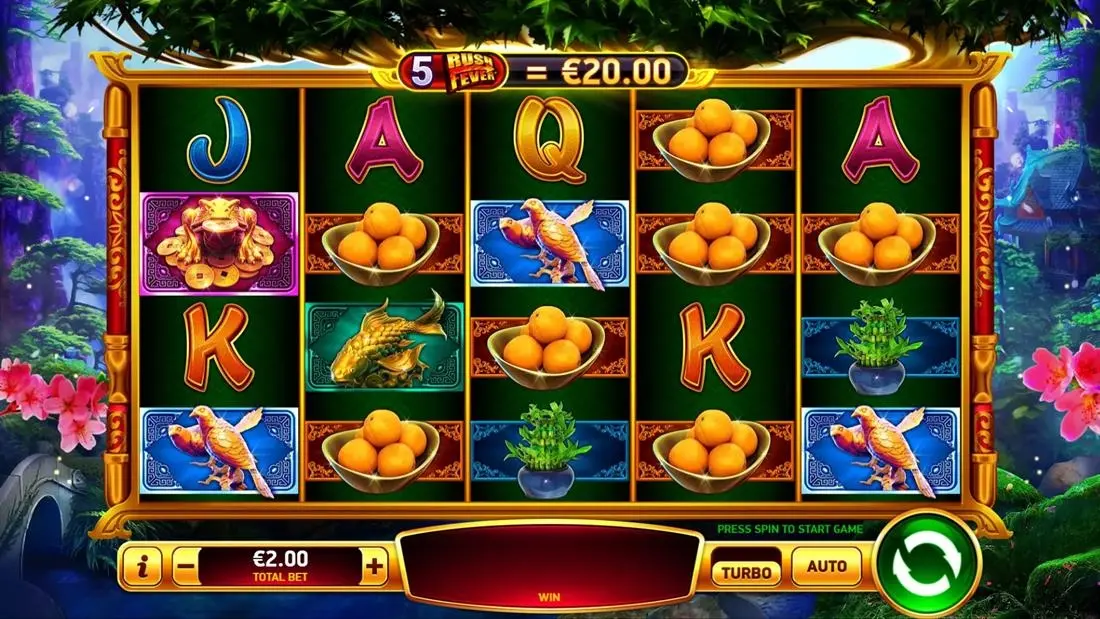
Five reels is the standard configuration across most modern video slots, including the bulk of Asian slots reviewed on this site. What determines how wins are counted — fixed paylines, ways, cluster pays, or grid-based mechanics — depends entirely on the paytable structure, and Ruby Play has not published the payline or ways count for Shake Shake Money Tree in the data available to us.
Practically, this means you should open the in-game info screen before spinning for real money. The number of ways or paylines directly affects hit frequency: a 20-line game and a 243-ways game at identical RTP deliver very different pacing. More lines generally mean more frequent but smaller wins per spin cycle; fewer lines mean fewer but potentially larger individual payouts. Until you see the count in the game’s own documentation, treat any figure quoted in third-party reviews as unverified.
Stake range and sizing a bankroll
No minimum or maximum stake data is published for this game. Without those figures, precise bankroll planning is impossible, but the general principle remains fixed: your total session budget should be large enough that the minimum spin cost represents a small fraction of it, so that normal variance does not wipe you out before the long-run RTP has a chance to express itself.
A widely used heuristic is to budget 250–500 times your per-spin stake, though this assumes medium volatility. If the game turns out to be high-volatility — which you can only determine by playing the free version and noting the gap between wins — you would want the higher end of that multiplier or beyond it.
Ruby Play’s broader catalogue (Immortal Ways Magic Gems among them) does not enforce a uniform stake architecture across its 145 titles, so you cannot infer this game’s limits from a sibling. Confirm the range in the game interface itself before deciding your session size.
Playing the Shake Shake Money Tree Slot demo before you commit
A free demo is available, and using it is the single most efficient way to close the information gaps this review flags. In demo mode you can read the paytable, count the ways or paylines, observe the win frequency across a few hundred spins, and identify the stake range the game exposes. None of that costs you a penny, and all of it directly addresses the missing data above.
Play the Shake Shake Money Tree free demo with the same pacing you would use with real money. Spin at the pace you would actually maintain, not at maximum speed, so you experience the rhythm of wins and gaps realistically. What you will learn in the demo — the volatility feel, the feature triggers, the bankroll depletion rate — is genuinely useful information for planning a real session. What you will not learn is your real-money result: demo outcomes are generated by the same RNG logic but carry no financial consequence, so a “hot” streak in the demo has zero predictive weight for a live play.
Set a budget before you play for money, treat the stake as the price of entertainment rather than an investment, and stop when that budget is spent. This game is for adults 18 and over.
Verdict: who should play Shake Shake Money Tree
The case for this game rests on two solid numbers: a 96.48% RTP that clears both the provider average and the corpus benchmark, and enough player interest to place it in the 93rd percentile. The case against rests on what Ruby Play has withheld — no volatility rating, no stake range, no payline count, no max win. Those omissions do not make the game bad, but they make pre-session planning genuinely difficult.
If you are comfortable accepting uncertainty and prefer to judge a slot by experience rather than specification, the above-average return means you are wagering against a favourable house edge whenever you do spin. If you prefer to know exactly what your bankroll must absorb before you commit — the way games like Mystic Fortune Deluxe make possible with published data — this is not the right starting point.
The demo resolves most of the gaps in under fifteen minutes. Play it, note the volatility you observe, and then decide with real numbers in hand rather than a provider’s silence.
Frequently Asked Questions
Is there a free version of Shake Shake Money Tree?
Yes, a free demo is available for Shake Shake Money Tree. Ruby Play's title can be played in no-cost mode, which lets you read the paytable, gauge the win frequency, and test stake levels without depositing real money.
What is the RTP of Shake Shake Money Tree and how does it compare?
Shake Shake Money Tree returns 96.48% RTP. That sits 0.77 percentage points above the corpus average of 95.71% and just above Ruby Play's own provider average of 96.40%, meaning the long-run house edge is 3.52%.
What volatility does Shake Shake Money Tree have?
Ruby Play has not published a volatility rating for Shake Shake Money Tree. Without that figure you cannot pre-plan session length or bankroll buffer precisely, so playing the free demo and observing win frequency is your best substitute.
Who makes Shake Shake Money Tree and what else do they offer?
Ruby Play develops Shake Shake Money Tree. The provider has 145 titles in the catalogue, including Rush Fever 7s at 96.90% RTP and Volcano Rising at 96.46%, both of which publish more complete specification data.
Can playing the Shake Shake Money Tree demo predict real-money wins?
No. The demo uses the same random number generator but carries no financial consequence, so results in free play have zero predictive value for live spins. Each real-money spin is an independent event regardless of what the demo showed.