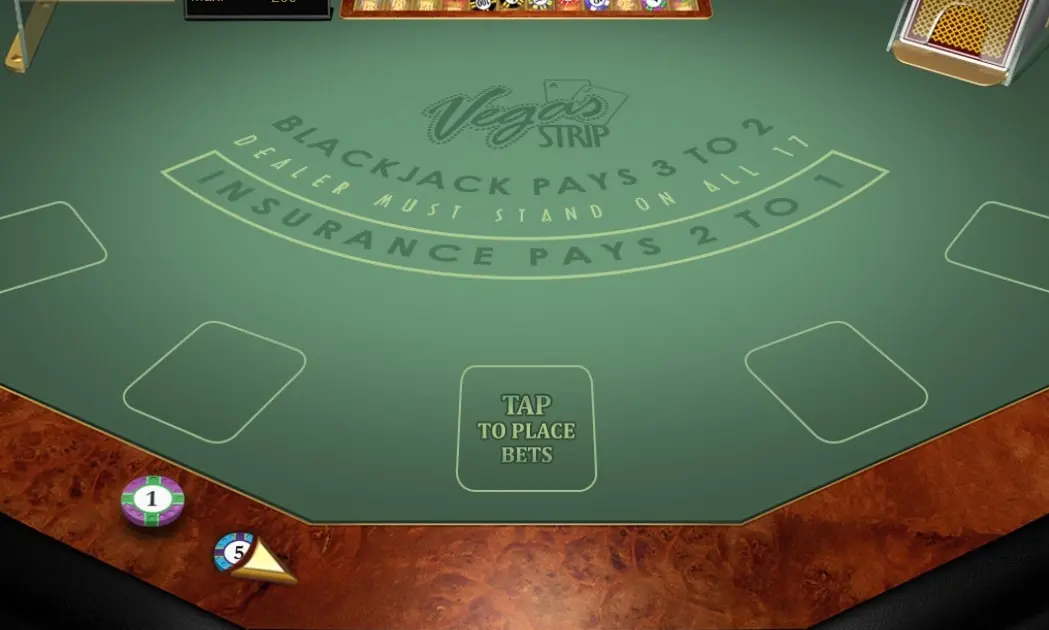
Yes — on paper. Vegas Strip Blackjack GOLD posts a 99.7% RTP, which is 0.29 percentage points above the site average and matches the best theoretical returns available in online blackjack. That number, however, is not a promise of what you will get. It is the ceiling, reachable only by a player who executes the basic-strategy chart flawlessly on every dealt hand. If you have not memorised the chart, treat the published RTP as aspirational rather than achievable.
Is Vegas Strip Blackjack GOLD a fair table?
Games Global lists the RTP at 99.7%, derived from a house edge of 0.3%. In blackjack the house edge is not a fixed property of the software; it is the residual after perfect play against a specific rule set. A 0.3% edge is competitive for a multi-deck RNG table and places this game near the top of the provider’s own portfolio (average RTP across their four blackjack titles is 99.65%).
The critical caveat is universal: any figure above 99% assumes zero errors. One insurance bet per hundred hands, one missed split of 8-8 against a dealer’s 6, one unnecessary hit on hard 16 — each drags your realised return below the headline. If you have not drilled the chart until it is reflexive, expect to play at something closer to 98.5% regardless of what the paytable states.
| Provider | Games Global |
|---|---|
| RTP | 99.7% |
| Free demo | Yes |
Games Global and this table
Games Global carries four blackjack titles on this platform, and their portfolio average RTP is 99.65% — already above the site-wide blackjack average of 99.41%. This table sits at the top of that group.
Two siblings share similar mechanics. Single Deck Blackjack GOLD also posts 99.7%, but a one-deck shoe changes both the basic-strategy chart and your bankroll volatility, so the optimal plays diverge. Vegas Downtown Blackjack GOLD returns 99.6%, and the title implies different rule choices — notably a dealer hitting soft 17, which costs the player roughly 0.2%. If you prefer European no-hole-card structure, European Blackjack GOLD at 99.6% is the closer fit, though the absence of hole-card peeking adds its own strategic wrinkle.
Rule set: what the title implies
The game name signals “Vegas Strip” rules, which in live and online play conventionally means a four-deck shoe, the dealer standing on all 17s including soft 17, and doubling after split being permitted. If those three conditions hold here, the combined effect keeps the base house edge near 0.4–0.5% before any player error — consistent with the published figure.
Games Global does not publish these parameters individually for this table in the data available to us, so you must verify them inside the in-game rules screen before wagering real money. Deck count matters: moving from four to eight decks adds roughly 0.03–0.05% to the edge. The soft-17 rule matters more: if the dealer actually hits soft 17 on this table, the 99.7% claim becomes difficult to reconcile with the maths and warrants scrutiny. Do not assume the hint; confirm it.
The maths of a blackjack hand
Each rule at a blackjack table shifts the house edge by a measurable amount. Standing versus hitting on soft 17 moves the edge by about 0.22 percentage points. A 3:2 blackjack payout versus 6:5 is worth roughly 1.4% — the single most damaging downgrade in the game. If this table pays 6:5, a 99.7% RTP would be arithmetically impossible under perfect play, so you can infer 3:2 from the published figure alone.
Four decks versus eight: fewer decks help the player because a concentrated shoe produces more naturals and makes certain doubling and splitting decisions more profitable. Doubling after split recovers about 0.14%. Re-splitting aces is worth another 0.06–0.08%. Late surrender, if offered, saves roughly 0.07%. None of these are exotic; they are the standard levers a player uses to judge whether a table is generous or merely advertised as generous.
Common mistakes that cost you the edge
Insurance is a losing proposition at standard odds. It carries a house edge between 5.8% and 7.5% depending on deck count, far exceeding the base game. The only exception is card counting against a dealt shoe — not applicable at an RNG table that reshuffles every hand.
Deviating from basic strategy on close decisions is the second major leak. Standing on hard 16 against a dealer 10 feels wrong but is correct; splitting a pair of 10s against a 6 feels right but is wrong. Each deviation you make compounds over a session.
Side bets such as Perfect Pairs or 21+3 carry house edges between 2% and 8% on their best paytables, and much more on weaker ones. They are independent wagers layered on top of your main bet. A disciplined player who wants to maximise hourly expectation should either ignore them or size them at a fixed small fraction of their main wager, treating them as pure entertainment with a known negative return.
Trying it free first
The demo version of this table is available at no cost, and using it is the most efficient way to confirm the rule set, locate the in-game paytable, and practise the basic-strategy decisions until they become automatic. Free play does not predict your real-money results — the RNG sequence is independent — but it does let you verify the dealer’s soft-17 behaviour, the blackjack payout ratio, and whether doubling after split is enabled.
When you do transition to real money, set a session budget before you deposit and treat it as the cost of entertainment rather than an investment. Blackjack variance can swing a short session in either direction regardless of skill. 18+ only. If gambling stops feeling like recreation, stop before the next hand.
Final take on Vegas Strip Blackjack GOLD
This is a competent, honest table in a provider portfolio that is already above the site average. The 99.7% RTP is credible for a four-deck, stand-soft-17, double-after-split structure paid at 3:2. You will not beat the edge here — no blackjack strategy eliminates the house advantage permanently — but you can minimise it by playing the chart, refusing insurance, sizing your bets so one cold streak does not end your session, and verifying the actual rules rather than trusting the title alone.
If you are new to basic-strategy blackjack, the free version is a low-risk way to build the muscle memory that makes the theoretical return reachable in practice. If you already play the chart cold, this table is a fair environment to do it in.
Frequently Asked Questions
Can I play Vegas Strip Blackjack GOLD for free?
Yes. The demo version is available without deposit or account registration on this site. It uses the same rules and RNG structure as the real-money version, so it is useful for verifying whether the dealer stands on soft 17 and confirming the blackjack payout ratio before you commit funds.
What is the actual RTP of Vegas Strip Blackjack GOLD?
Games Global publishes 99.7%, which corresponds to a 0.3% house edge. That figure assumes perfect basic-strategy execution on every hand. A player who makes even occasional deviations will realise a lower return, so the published RTP should be treated as a theoretical ceiling rather than an expected outcome.
How do the rules on this table affect the house edge?
The title implies a four-deck shoe, dealer standing on soft 17, and doubling after split — a combination that supports an edge near 0.3–0.5%. If the dealer actually hits soft 17, the edge rises by roughly 0.22 percentage points. Confirm the in-game rules screen before assuming the hint is accurate.
Does card counting work at Vegas Strip Blackjack GOLD?
No. This is an RNG table that reshuffles the shoe for every hand, meaning no information from previous cards carries forward. Counting requires a continuous shoe where the ratio of high to low cards drifts. Against a full reshuffle, the count resets each hand and offers no edge whatsoever.
How does it compare to Single Deck Blackjack GOLD?
Both are listed at 99.7% RTP, but the strategy charts differ substantially. A single-deck game has more naturals per shoe and slightly different doubling and splitting logic. If you already know four-deck basic strategy cold, this Vegas Strip table lets you apply it directly without re-learning a new chart.




