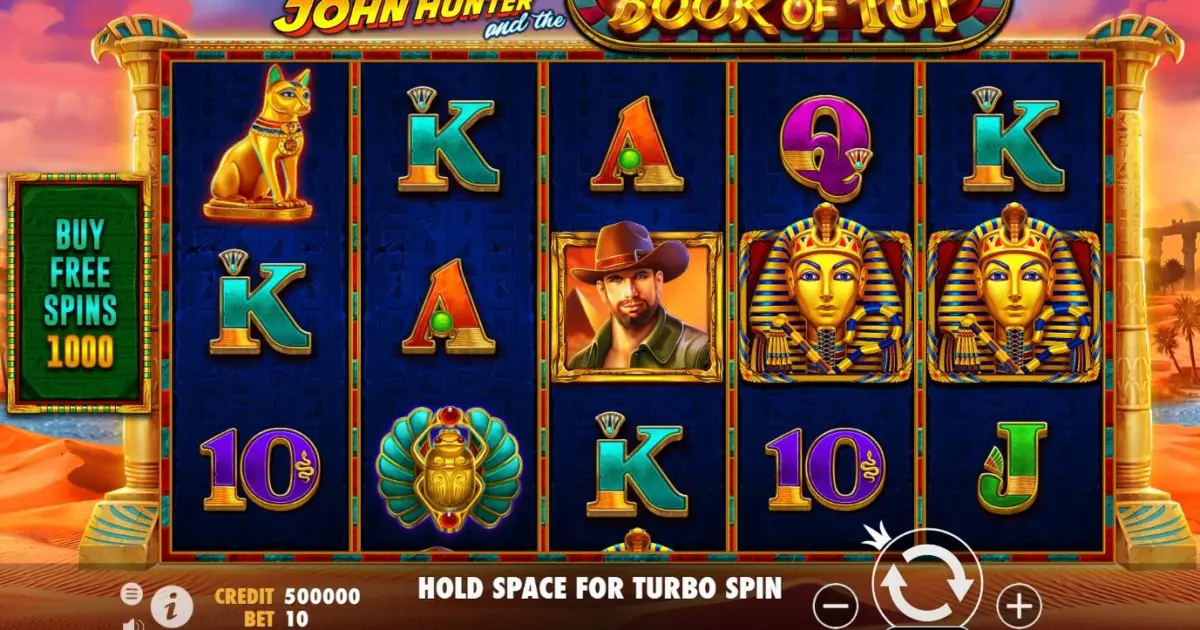
John Hunter and the Book of Tut slot is Pragmatic Play’s archaeology-themed entry in a crowded Egypt market. The headline number — a 96.5% RTP — clears the industry average comfortably, and the provider makes a free demo available so you can check the rhythm without depositing.
First look at the John Hunter and the Book of Tut slot
Pragmatic Play built this title around a 5-reel grid, placing it squarely in the provider’s standard slot architecture. The theme label is “Egypt,” which means the visuals draw on the familiar iconography of tombs, relics, and exploration that this genre has worn smooth over two decades. You will not find a reinvented aesthetic here; you will find a recognisable setup with Pragmatic Play’s production values behind it.
The data available for this review does not include a volatility rating, a maximum-win ceiling, a hit frequency, or a stake range published by the provider. That absence matters. A slot can carry a strong theoretical RTP and still deliver a brutal session if volatility is high and the max win is capped low. Without those numbers, your best pre-deposit source is the free demo itself, where you can observe the cadence of wins across a few hundred spins and form your own read on swing size.
How a round plays out
With five reels confirmed, this slot uses the reel-and-row format Pragmatic Play defaults to across most of its catalogue. You spin, symbols land, matching combinations along active paylines or ways produce a return, and the cycle repeats. The exact number of paylines or ways is not published in the data set available here, so treat any specific claim you read elsewhere with caution.
The “Book of” prefix in the title signals a design pattern common across Egypt slots: a book symbol that often doubles as wild and scatter, typically unlocking a free-spin round where a special expanding symbol takes over. Many slots in this sub-genre follow that template. Whether this particular title uses that exact mechanic is something you will confirm in the demo, not from these facts.
What is certain is the provider. Pragmatic Play ships 739 games in this data set alone, and their slots share a consistent interaction model — quick spins, an autoplay toggle, and a paytable screen that lists symbol values. You already know how to operate this machine if you have spun any other Pragmatic Play title.
Reading the 96.5% return figure
96.5% RTP means that across a very large sample of spins, the game returns 96.50 in currency for every 100 wagered. That is a theoretical long-run average, not a prediction for your session. You could walk away up after 50 spins or down after 500, and both outcomes are consistent with a 96.5% return.
Contextualised, the number is solid. Pragmatic Play’s own catalogue averages 96.32% RTP across 739 tracked titles, so this game sits 0.18 points above its provider norm. The broader corpus of slots reviewed here averages 95.71%, placing this title 0.79 percentage points above the field. In practical terms, that gap translates to roughly 0.79 fewer units lost per 100 wagered over a very long session compared to an average slot. It is not a game-changer, but it is the difference between a mediocre return and a genuinely competitive one.
No single RTP figure guarantees short-term behaviour. Volatility governs how wins cluster, and the RTP governs how much the house retains across the full distribution. You need both to plan a session properly.
Why volatility changes your bankroll maths
Pragmatic Play has not published a volatility rating for this title in the data available to us. That is a gap you need to fill yourself, and the demo is the cheapest way to do it.
Here is the framework. If the game is medium volatility — which is Pragmatic Play’s most common setting across their catalogue — expect moderate win sizes at a moderate frequency, with enough variance to require a 200-spin bankroll cushion at your chosen stake. High volatility would mean long dry stretches punctuated by occasional large hits, demanding a 300-to-500-spin cushion and a willingness to ride losses. Low volatility keeps your balance relatively flat, returns small wins frequently, and lets a smaller bankroll sustain longer sessions but caps upside potential.
The absence of a published rating does not make the game unknowable. A 200-spin demo session will reveal the character quickly. Count how many spins pass without a return. Note the size of your biggest hit relative to your average. That is your personal volatility assessment, and it is worth doing before you switch to real money.
Bet sizing and what the absence of a published range means
The data set does not include a minimum or maximum stake for this game. Pragmatic Play’s slots typically open at $0.20 per spin and top out near $100, but without confirmation for this specific title, treat those numbers as indicative only.
What you can reason about is the relationship between stake and bankroll. A 96.5% RTP implies that for every 100 units you wager over the long run, 3.5 units are house retention. At a $1-per-spin stake, that is 3.5 cents per spin in expected cost. At $5, it is 17.5 cents. At $20, 70 cents. The percentage does not change; the absolute drag on your wallet scales linearly with your stake.
Plan your session by deciding how many spins you want to afford before you choose a stake. Divide your entertainment budget by 200 for medium-volatility play or 350 for high. That gives you a per-spin ceiling that keeps you in the game long enough for the RTP to have any statistical relevance. Every spin is independent; no sequence of previous outcomes changes the probability of the next one.
Where it sits among Egypt slots
The Egypt theme is one of the most saturated genres in online slots, with 908 titles in this data set alone. Standing out requires either a stronger number or a distinctive mechanic.
On raw RTP, this Pragmatic Play release has a clear edge over the genre’s most recognisable title. Book of Dead runs at 94.25%, which is 2.25 percentage points below this game. Over 10,000 spins at a $2 stake, that gap compounds to roughly $450 in expected return difference. Crazy Mummy sits at 96.0% — closer, but still half a point behind. Book of the Sun at 96.23% is within a quarter-point, making it the most competitive comparison on pure return.
Against Pragmatic Play’s own catalogue, the game holds its ground. Gates of Olympus also returns 96.5% but uses a completely different mechanic and theme. If you want Egypt with a provider you already trust for high-volatility gameplay, this title earns a look.
The honest verdict
John Hunter and the Book of Tut is a solidly built Pragmatic Play slot with a genuinely above-average RTP and a familiar theme. The 96.5% return is competitive within its genre and its provider’s own catalogue. The 5-reel format means you already know the interaction model.
The honest limitation is what is not here: no published volatility rating, no confirmed max win, no stake range, no hit frequency. These are not trivial omissions. A slot’s theoretical return tells you the house edge; volatility tells you how painful the edge feels in practice. You will need to source those answers from the demo or from the game’s own paytable screen.
At a popularity percentile of 97.8, this title is well-known, which means player reviews with firsthand volatility observations are easy to find. Check those before committing.
Slots are entertainment with a fixed cost per spin. Set a budget before you start, treat losses as the price of the experience, and stop when that budget is spent. If gambling stops feeling like entertainment, contact a support line available in your region.
| Field | Value |
|---|---|
| Provider | Pragmatic Play |
| RTP | 96.5% |
| Reels | 5 |
| Themes | Egypt, 5-Reels |
| Popularity rank | 445 (97.8th percentile) |
| Provider avg RTP | 96.32% |
| Corpus avg RTP | 95.71% |
| Volatility rating | Not published |
| Max win | Not published |
| Bet range | Not published |
| Free demo | Available |
Frequently Asked Questions
Can I play John Hunter and the Book of Tut for free without depositing?
Yes. Pragmatic Play offers a free demo of this slot that runs on virtual credits with no registration or deposit required. The demo uses the same 96.5% RTP engine as the real-money version, so you can observe spin behaviour and win frequency before deciding whether to stake actual money.
What does the 96.5% RTP mean for my session?
The John Hunter and the Book of Tut slot returns 96.5% of all wagered money over a statistically large sample. In a 10,000-spin session at $1 per spin, the expected return is $96,500 against $10,000 wagered, meaning roughly $350 in house retention. Short sessions will deviate wildly from this figure.
Is this slot high or low volatility?
Pragmatic Play has not published a volatility rating for this title in available game information. Based on the provider's general tendency toward medium-to-high volatility slots and the Book-of genre convention, expect moderate-to-large swings. Confirm by playing the free demo for at least 200 spins.
How does it compare to Book of Dead?
John Hunter and the Book of Tut carries a 96.5% RTP compared to Book of Dead's 94.25%, a 2.25-percentage-point advantage that compounds to meaningful difference over thousands of spins. Both use 5-reel grids and draw on Egypt themes, but the Pragmatic Play title returns more per unit wagered on paper.
Can playing the demo version predict real-money results?
No. The demo runs on a random number generator that produces independent outcomes per spin, identical in mechanism to the real-money version. A hot streak in the demo is as meaningless for predicting real outcomes as a cold streak in live play. Each spin is statistically independent of every previous one.




