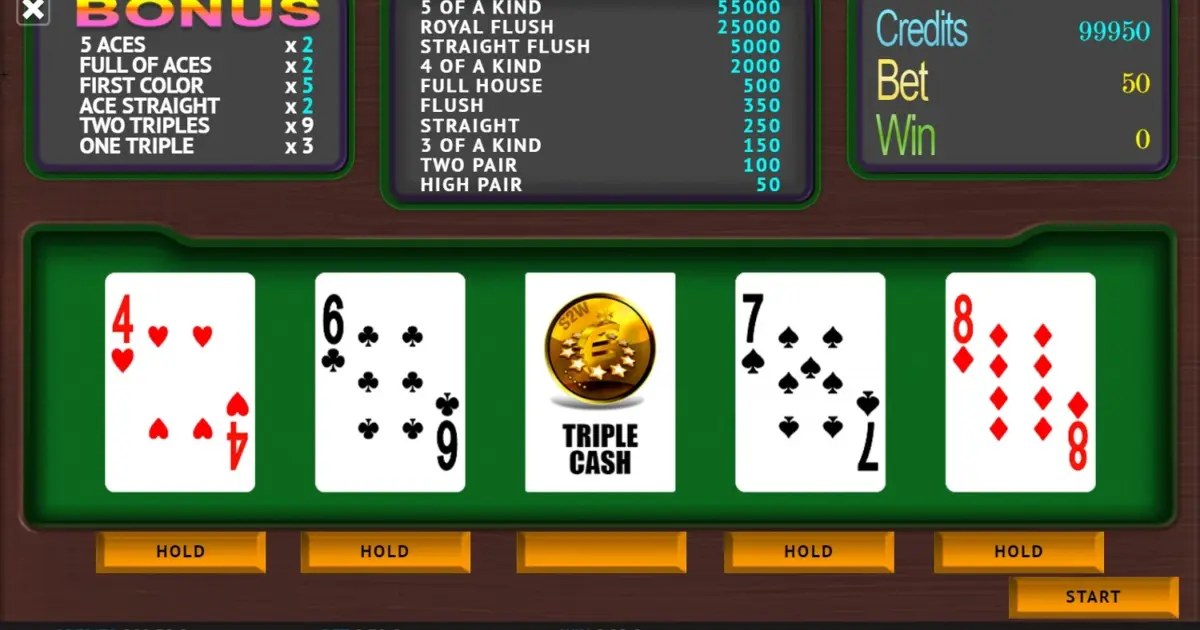
Triple Cash Video Poker is a straightforward video poker release from Spin2win that earns its spot on a demo review site because it lets you practice hold-and-discard decisions without risking a cent. Whether it belongs in a real-money session depends on two things the game’s listing does not fully disclose: the exact paytable and, consequently, the precise return to player. That gap matters more here than in almost any other casino category, because video poker returns are fully determined by the payout schedule and a solved optimal strategy — there are no hidden reel weights or mystery symbol frequencies.
Triple Cash at a glance
Spin2win is the studio behind Triple Cash Video Poker, and the provider’s catalogue averages a 97.5% RTP across its titles. That average gives a useful ballpark, but video poker is the one game family where a single line on the pay chart — say the full house or flush payout — can swing the return by a full percentage point or more. Triple Cash sits at rank 24 in the current corpus with a popularity percentile of 83.6, meaning it draws solid traffic relative to the library. Spin2win has six games total in the database, so Triple Cash represents a meaningful share of the provider’s output. A free demo is available, which is the right place to start: it lets you inspect the paytable and test the strategy before any real stakes enter the picture.
Which variant is this, and what it means for strategy
The title “Triple Cash” does not by itself name a standard video poker family such as Jacks or Better, Deuces Wild, or Joker Poker, so the first thing to do in the demo is open the pay table and identify the base rules. That identification matters because each variant has a completely different solved optimal strategy. Jacks or Better pays from a pair of jacks upward and uses a relatively conservative hold chart; Deuces Wild makes all twos wild and pays only from three of a kind up, demanding a much more aggressive approach to chasing four-of-a-kind hands; Joker Poker adds a wild card that reshuffles priorities again. The “Triple” in the name may refer to a multiplier mechanic, a bonus for certain hands, or a triple-play multi-hand format — the demo will make that clear within a few dealt hands. Whatever the mechanic, the core principle holds: learn the variant, then learn its specific strategy chart, because deviating from the optimal holds lowers your return with every hand.
What a 97.5% RTP requires: perfect strategy
Spin2win’s corpus average of 97.5% is a reasonable starting estimate, but in video poker that number is only meaningful when paired with perfect play. “Perfect play” means following the mathematically optimal hold-and-discard decision for every possible dealt hand — a solved chart, not a gut feeling or a betting system. The classic illustration is Jacks or Better: a 9/6 paytable (9-for-1 full house, 6-for-1 flush) returns about 99.5% with perfect strategy, while an 8/5 version drops to roughly 97.3% and a 6/5 version falls below 95%. The difference is entirely two numbers on the pay chart. For Triple Cash, the exact RTP depends on this specific paytable, which the listing does not publish. In practice, even small strategy errors cost real money over hundreds of hands — the gap between optimal and average play is typically 0.5% to 2% of return. The free demo is the ideal place to drill the correct holds until they become automatic.
Reading the paytable before you play
Before committing real money, open the in-game pay table and check the payouts for the hands that matter most. In most video poker variants, the full house and flush payouts are the single biggest lever on RTP — the difference between a generous and a stingy version can be a full percentage point or more. The table below shows the kind of hand-rank comparison to look for, using well-known general figures for common video poker variants as a reference point:
| Hand Rank | Full-Pay Jacks or Better | Common Reduced Pay |
|---|---|---|
| Royal Flush | 250 for 1 (max coins) | 250 for 1 |
| Straight Flush | 50 for 1 | 50 for 1 |
| Four of a Kind | 25 for 1 | 25 for 1 |
| Full House | 9 for 1 | 6 for 1 |
| Flush | 6 for 1 | 5 for 1 |
| Straight | 4 for 1 | 4 for 1 |
| Three of a Kind | 3 for 1 | 3 for 1 |
These are reference numbers for a well-known variant, not Triple Cash’s confirmed payouts — but they illustrate exactly what to compare. If Triple Cash pays 9-for-1 on a full house and 6-for-1 on a flush, you are in the territory of a competitive return. If those numbers are lower, the RTP drops accordingly. Always verify this game’s actual pay chart in the demo before playing for money.
Hold and discard basics for this variant
Once you have identified the base variant and its paytable, the optimal strategy becomes a ranked list of hold priorities. For a Jacks or Better-style game, the hierarchy is roughly: always hold a royal flush or straight flush; keep four cards to a royal over a made full house; hold three cards to a royal over a made flush; and work down through pairs, draws, and high cards in a specific order. For Deuces Wild, the chart changes dramatically because wild twos are the most valuable cards in the deck — you break a made hand more often to chase four-of-a-kind with deuces in your hold. The “Triple” mechanic in this game may add another layer, such as a bonus payout for certain hands or a triple-play format where the same held cards are dealt across multiple independent hands. In a multi-play format, the per-hand RTP stays the same, but variance increases because you are playing many hands simultaneously. The demo lets you experiment with these decisions and see the outcomes without financial pressure, which is the most efficient way to internalize the correct holds.
Playing the Triple Cash demo
The free demo of Triple Cash Video Poker is available directly on this page with no download required — just launch it and start dealing. Use the demo for three things: first, read the full pay table so you know the exact payouts for every hand rank; second, practice the optimal hold-and-discard strategy until you can make the right decision on every dealt hand without hesitation; third, get a feel for the game’s variance and session swings so the real-money experience does not surprise you. Demo play does not predict real-money outcomes — every deal is independent, drawn from a freshly shuffled 52-card deck — but it does build the skill foundation that determines your long-run return. If you play for real money later, set a budget you can afford to lose before you start, stick to it, and treat the session as entertainment you pay for, not a source of income. Video poker rewards patience and precision, not speed or superstition.
Verdict: who should play Triple Cash
Triple Cash Video Poker by Spin2win is best suited to players who already understand that video poker is a math game, not a luck game, and who are willing to learn the specific paytable and strategy before wagering real money. If you are new to video poker, the free demo is the right starting point — use it to learn the variant’s rules and the optimal hold chart without any financial risk. If you are an experienced player, the key question is whether this particular paytable is competitive enough to justify a real-money session, and only the in-game pay chart can answer that. For comparison, you might also try Triple Star 2000 or Champion Poker from the same provider to see how different Spin2win titles handle their payout structures. Triple Cash’s solid popularity and free demo availability make it a reasonable entry point, but the paytable is the final arbiter — always check it first.
Frequently Asked Questions
Is Triple Cash Video Poker available to play for free?
Yes, a free demo of Triple Cash is available on this page with no download required. The demo lets you inspect the paytable and practice the optimal hold-and-discard strategy before risking any real money.
What is the RTP of Triple Cash Video Poker?
Spin2win's library averages 97.5% RTP, but the exact return for Triple Cash depends on its specific paytable, which the listing does not publish. Always check the in-game pay chart — the full house and flush payouts alone can swing the return by a full percentage point.
What video poker variant is Triple Cash based on?
The name does not identify a standard family like Jacks or Better or Deuces Wild, so you need to check the pay table in the demo to confirm the base rules. The variant determines the optimal strategy chart, which is different for every paytable.
Why does the paytable matter more in video poker than in other casino games?
Video poker is dealt from a single 52-card deck with no hidden weighting, so the return is fully determined by the paytable and optimal play. A two-number change on the pay chart — say full house and flush payouts — can drop the RTP by more than a full percentage point, a swing far larger than most other casino categories.
Can any betting pattern improve my chances in Triple Cash?
No, every deal is independent from a freshly shuffled deck, so no staking system changes the expected return. The only factor you can control is following the optimal hold-and-discard strategy for this game's specific paytable, which maximizes the long-run RTP.