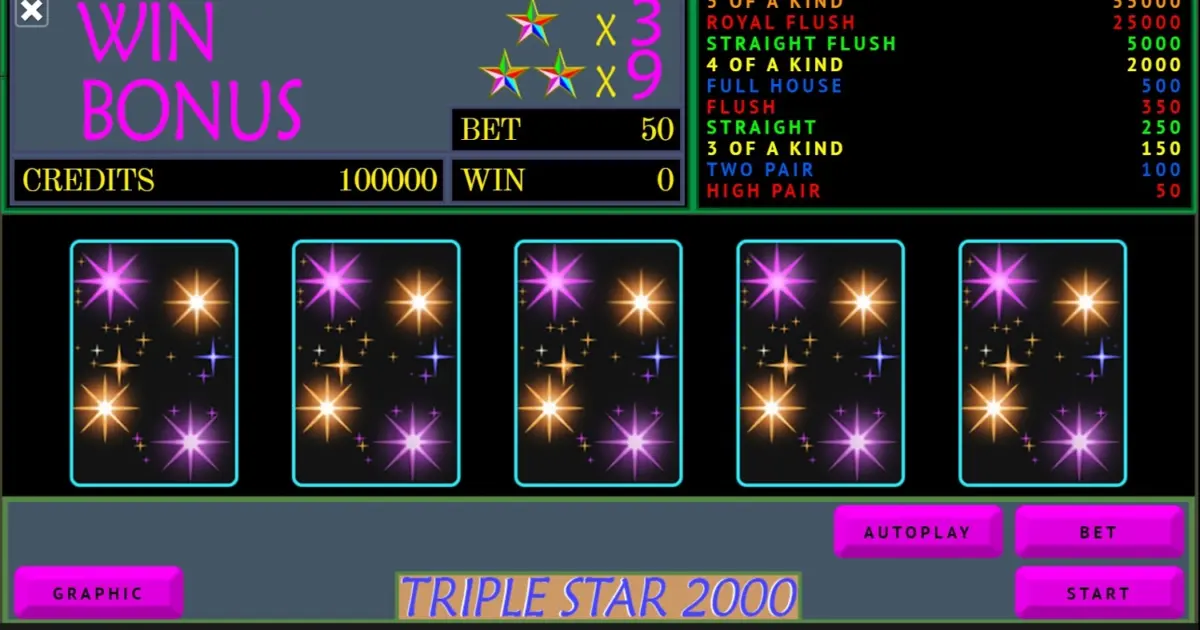
You can play Triple Star 2000 video poker free on this site, and that is genuinely useful here, because Spin2win has not published an RTP or a paytable for this specific title. Without those two numbers, no reviewer can tell you whether the game returns 96% or 99.5%—a spread that matters enormously in video poker, where the difference between a good and a mediocre paytable is often right under two percent. What follows explains what we can say with confidence from the game’s structure, what remains unknown, and how you can resolve the gaps yourself before committing a bankroll.
Triple Star 2000 and the Spin2win game range
Spin2win is a small provider: its catalogue on this site lists 6 games total, so Triple Star 2000 sits in a compact range rather than a sprawling library. If you are already comfortable with the provider’s presentation and want to compare other Champion Poker, which may share a similar interface, the learning curve between titles is shallow. Another option is Triple Cash, whose “triple” naming convention could hint at a multi-play format similar to what the name Triple Star 2000 suggests, though without a published rulebook from Spin2win this remains speculation. The third title in the provider set is Great Mountain, which carries no RTP listing either—so the absence of published return data is not unique to Triple Star 2000 but appears to be a broader pattern across this provider’s video poker output.
| Provider | Spin2win |
|---|---|
| Free demo | Yes |
| Site-wide average RTP | 97.5% |
The missing RTP and the strategy it assumes
In video poker the RTP is not a fixed property of the software in the way it is for a slot. It is a mathematical consequence of two inputs: the paytable the operator displays and whether the player follows the optimal hold/discard chart for that exact paytable. A single number change—a flush paying 5 coins instead of 6—can shift the theoretical return by half a percentage point or more. Because Spin2win has not published a paytable or an RTP figure for Triple Star 2000, any percentage quoted elsewhere online would be unverifiable. The corpus-wide average across video poker games indexed on this site is 97.5%, which sits roughly where an 8/5 Jacks or Better pays, well below the 99.5% you would get from a 9/6 paytable with perfect play. Treat that average as a rough anchor, not a guarantee for this specific game.
Which hands to hold, in general terms
Every video poker game you encounter will be built on one of a small number of variant families, and the correct strategy chart is determined by which family it belongs to and what paytable numbers appear on screen. The universal hierarchy runs from highest-paying hand down: a natural royal flush always tops the list, followed by four of a kind, full house, flush, straight, three of a kind, and then the pair threshold (jacks or better in the most common variant). When no made hand qualifies, you hold the highest cards to maximise the chance of pairing them. High pairs outrank three cards to a royal; four to a flush outranks an open-ended straight draw. If the Triple Star 2000 title screen or help menu reveals which variant it is—check whether the pair pays on jacks or requires queens, whether there is a joker or wild deuce—then you can look up the published strategy chart for that variant and that paytable and apply it directly.
Wild cards, bonuses and how they change the maths
If Triple Star 2000 includes a wild card or a bonus mechanism—and the “triple” in the name may refer to a multi-play mode, a triple-card bonus, or something else entirely—that single design choice reshapes the entire strategy. In a Deuces Wild variant, all four 2s become flexible cards, the minimum qualifying hand shifts to three of a kind, and the return-per-hand volatility drops because wild cards complete draws far more often. In a Joker Poker variant, one extra wild card raises the royal flush frequency above its natural rate and typically requires the paytable to compensate elsewhere by paying less on lower hands. In a multi-hand format, the same five-card deal plays simultaneously across several independent decks, multiplying your per-hand cost and variance while leaving the per-hand RTP unchanged. Without a published ruleset, you cannot know which of these structures applies here. Open the game’s information or paytable screen before your first real-money spin and read it carefully; that screen is where the answers live. If you want a reference point for how wild cards swing returns, try the provider’s other titles that do publish a paytable and compare the hand frequencies in your session log.
Variance in video poker versus slots
Video poker’s variance is structurally transparent: you can compute the standard deviation per hand from the paytable and the probability of each outcome, because each deal draws from a single shuffled 52-card deck and every combination is equally likely. There is no hidden reel weighting, no “hot” or “cold” streak encoded in the software—each hand is an independent event. A slot’s variance, by contrast, is set by the provider and often only disclosed as a vague low/medium/high label. For a player with a fixed budget, this means video poker gives you more control: by choosing a paytable with higher returns, you lower the house edge, and by playing a variant like Jacks or Better instead of one with a 4-of-a-kind bonus, you reduce variance for the same bankroll. The trade-off is that the royal flush still pays the largest single-hand return, so the top-heavy payout distribution means long stretches of break-even pairs punctuated by occasional large hits.
Playing responsibly
Video poker rewards concentration, and the temptation to chase a missed royal or a near-miss four of a kind is real. Set a session budget before you open the game, treat the money as entertainment spend that leaves your wallet regardless of outcome, and stop when that budget is gone. Every deal is independent—no sequence of hands “due” changes the odds on the next card. If you find yourself increasing stakes to recover losses, that is the signal to close the game.
Verdict on Triple Star 2000
Triple Star 2000 is a legitimate video poker entry from a small provider, playable for free without download, and those are practical positives. The honest verdict, however, is incomplete until Spin2win publishes a paytable and RTP. For a numerate video poker player, that is the single most important data point—more important than graphics, more important than theme. The game’s popularity percentile of 89.3 suggests players find it entertaining, but entertainment value without a known return is an asymmetry of information you cannot fix by playing longer. Try the Triple Star 2000 free demo here to learn the rules and identify the variant family. Then, before staking real money, check whether the in-game paytable matches a published strategy chart for that variant. If it does, you have a measurable edge to play for. If it does not, or if the paytable is hidden, the mathematics that make video poker the most transparent casino game stop working in your favour.
Frequently Asked Questions
Can I play Triple Star 2000 video poker for free?
Yes, a free demo version is available on this site with no download required. You can play with simulated credits to learn the rules, identify the variant family, and read the in-game paytable before deciding whether to play for real money. Demo play does not predict real-money outcomes because every deal is an independent event from a shuffled deck.
What is the RTP of Triple Star 2000 video poker?
Spin2win has not published an RTP figure or a paytable for this specific title. In video poker, the RTP is determined entirely by the paytable and the player's adherence to optimal strategy for that table. The corpus average across video poker games on this site is 97.5%, which is a rough reference point but not a guarantee for Triple Star 2000. Check the in-game pay chart before staking real money.
Which video poker variant is Triple Star 2000?
The name does not directly identify a standard variant family such as Jacks or Better, Deuces Wild, or Joker Poker. The "triple" prefix may refer to a multi-play format where one deal plays across several independent hands simultaneously, but without a published ruleset from Spin2win this cannot be confirmed. The variant family matters because it determines which strategy chart you should follow.
Why does the paytable matter so much for Triple Star 2000 specifically?
Unlike a slot where the return is set internally and never fully disclosed, video poker's return is calculated from the visible paytable plus a solved strategy. A single coin change on the full house or flush row can swing the RTP by a full percentage point. Because Spin2win has not published that paytable publicly, you cannot verify the return before playing—making the in-game pay screen the critical first thing to read.
How does Triple Star 2000 compare to other Spin2win video poker games?
Spin2win offers 6 games total on this platform. Triple Cash and Champion Poker are listed alongside Triple Star 2000, but none of these titles carry a published RTP figure, so a direct numerical comparison is not possible from available data. The provider's compact catalogue means a similar interface across titles, but the paytable—which decides the return—could differ from game to game.