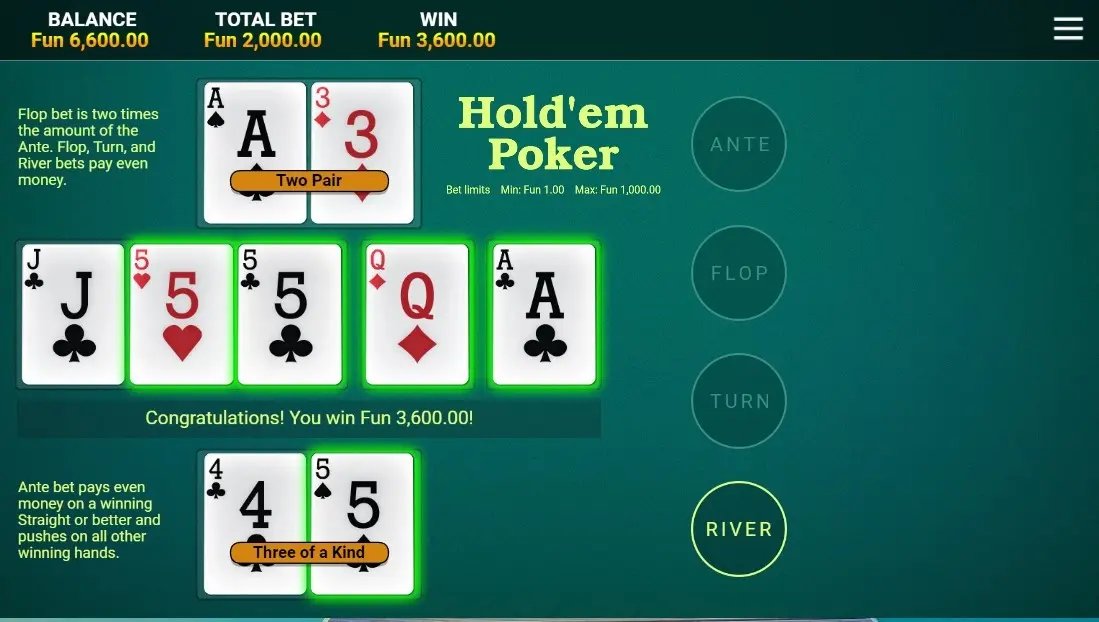
Hold em Poker by OneTouch returns 92.58% with optimal play, placing it well below the typical video poker benchmark of 97–99%. Whether that five-point gap is a deal-breaker depends entirely on what you want from a poker-style game and how disciplined your strategy is, so read the breakdown below before deciding if this table earns your time.
Hold em Poker in one minute
This is a video poker title from OneTouch, a provider with four games in our catalogue averaging 94.54% return. The game falls under the Cards theme and, unlike a slot machine, its outcome is determined by a shuffled deck of 52 cards dealt each hand. There is no hidden reel weighting, no bonus-frequency counter, and no progressive meter ticking up in the background. Your return depends on two things: the payout schedule printed on the paytable, and whether you make the mathematically correct hold/discard decision on every single deal.
The name “Hold em” references the community-card poker format popularised by Texas Hold’em, but this listing does not include the exact card distribution rules, the number of holes dealt, or which specific hand ranks trigger which payouts. Those details live on the in-game paychart, and checking them before playing for money is non-negotiable — a single number changed on the paytable can swing the return by a full percentage point or more in any video poker game.
What perfect strategy actually means here
In video poker, “optimal strategy” is a solved, publishable hold/discard chart for each paytable. It is not a betting system — no progression, no hot-hand theory, no “play max coins after a cold streak.” The chart tells you which cards to keep and which to discard for every possible starting hand, minimising the house edge over an infinite number of deals. Deviating from the chart lowers your long-run return, but it does not change the deck itself. Every hand is dealt from a freshly shuffled 52-card deck, so a royal flush is never “due,” and a cold streak does not create a hot one.
Because this game is titled “Hold em Poker” rather than a classic variant like Jacks or Better or Deuces Wild, the strategy chart you need is specific to this title’s paytable. If OneTouch has published an optimal strategy for this exact game — check their support materials or the in-game help screen — follow it to the letter. If they have not, you are making decisions without a solved framework, and the 92.58% figure on paper is unlikely to survive the errors a human makes across hundreds of hands. The Russian Poker title from the same provider follows a different decision framework entirely, built around community-card comparisons rather than hold/discard choices, so strategy from that game does not transfer.
Where the 92.58% comes from
The return-to-player figure in video poker is the expected value of one unit wagered, assuming perfect play across every possible starting hand and every subsequent decision. It is calculated by multiplying the probability of each completed hand by its listed payout, summing those products, and expressing the total as a percentage of the wager. A 92.58% RTP means the game retains approximately 7.42% per unit wagered — roughly three times the house edge you would face on a 9/6 Jacks or Better table, which returns about 99.5%.
Compared to the category average of 97.5%, this game sits about 4.92 percentage points below benchmark. Over 1,000 hands at one coin each, that gap represents roughly 49 fewer coins returned than an average video poker game would give back. The figure is derived from the game’s specific paytable combined with a solved optimal strategy, not from any behavioural or volatility adjustment. If you play fewer than perfect, your actual return drops below 92.58% — the published number is a ceiling, not a floor.
Paytable differences that change everything
This listing does not include the exact paytable for Hold em Poker. Without those numbers — what a full house pays, what a flush pays, whether four-of-a-kind is split by rank — you cannot independently verify or reproduce the 92.58% figure. In a slot, the RTP is hidden behind an unquantifiable weighting table. Here, the return is fully transparent and mathematically derivable, which makes the missing paychart a genuine obstacle to your evaluation.
The classic example from Jacks or Better illustrates the principle: the 9/6 paytable (9-for-1 full house, 6-for-1 flush) returns about 99.5%, while the 8/5 version of the same game drops to roughly 97.3%, and 6/5 tables fall below 95%. Two single-digit numbers on a screen swing the return by more than four percentage points. For High Hand Hold em Poker, the related title from the same provider, the RTP is listed at the identical 92.58%, which suggests they share a paytable structure or calculation method. Check the in-game paychart before playing this game for money, and compare its numbers against any published strategy table if one exists.
| Game | Provider | RTP |
|---|---|---|
| Hold em Poker | OneTouch | 92.58% |
| In Between Poker | OneTouch | 94.6% |
| Russian Poker | OneTouch | 98.42% |
| Jacks or Better | Red Rake Gaming | 99.55% |
| Category average | — | 97.5% |
Multi-hand and multi-play formats, explained
Many video poker titles offer a multi-play mode: you deal one five-card hand, choose which cards to hold, and that same hold/discard decision is applied across multiple independent decks simultaneously. The per-hand paytable and strategy remain unchanged — multi-play is a variance amplifier and a hands-per-minute accelerator, not an RTP modifier. If you play five hands simultaneously at one coin each, you are risking five coins per deal cycle across five independent 52-card decks, each carrying the same 92.58% expected return.
This listing does not confirm whether Hold em Poker includes a multi-play mode. The related title Jacks or Better by Red Rake Gaming typically offers 3-hand through 10-hand multi-play, and that format is common enough that you should check this game’s bet-level interface before playing. If multi-play is available here, understand that your session variance increases roughly in proportion to the number of simultaneous hands, while your expected loss per coin wagered stays at 7.42%. The math does not bend because you are playing ten screens instead of one.
Trying the demo first
The game offers a free demo you can play no download required. Use it for exactly what it is: a way to learn the interface, test how quickly the game deals, and practise the hold/discard decisions without risking money. Demo play does not predict real-money outcomes — the deck does not know whether your wager is a credit or a coin. What the demo does offer is repetition: you can deal hundreds of hands and see how frequently strong payouts appear, building pattern recognition that helps when you play under pressure.
Video poker is the most mathematically honest game in a casino because its return is fully determined by published numbers rather than hidden weighting. That transparency cuts both ways: you can see a bad deal coming from the paychart before you sit down. Set a budget before playing for real money, treat the session as entertainment you are paying for rather than income, and stop when the budget is exhausted. The 92.58% figure means the house retains roughly 7.42% per unit over the long run — no staking pattern, no hot-hand theory, and no “one more spin” logic changes that expectation.
Who should play Hold em Poker
This is a game for players who specifically want the Hold’em-style community-card format inside a video poker shell, and who understand they are accepting a roughly 7.42% house edge in exchange for that format. If your primary goal is minimising expected loss per hour, other OneTouch video poker games deliver better returns — Russian Poker at 98.42% is a full five percentage points more generous. If you are drawn to this game’s presentation, its pace, or its specific hand-comparison mechanics, play it for the format, not the maths.
The 92.58% figure is the published return with optimal play. You must actually play optimally to approach it, and because no standard strategy chart for this exact game appears in public reference materials, verify your decisions against the provider’s own help documentation. At a rank of 9 within our Cards video poker listings and a popularity percentile of 94.3%, enough players engage with this title to make it a recognisable game in the OneTouch catalogue. The decision comes down to format preference versus return optimisation — two values that pull in opposite directions here.
Frequently Asked Questions
Can you play Hold em Poker free without downloading software?
Yes. OneTouch provides a browser-based demo that requires no download. The free version deals from the same single 52-card deck and shows the same paytable as the real-money version, so you can study the game's interface and practise hold/discard decisions before wagering actual funds.
What determines the 92.58% RTP in Hold em Poker?
Two things determine this figure: the exact payout schedule listed on the game's paytable and the assumption that the player follows a mathematically optimal hold/discard strategy for every possible starting hand. Without the published paychart, you cannot independently reproduce the calculation, and any deviation from optimal play will push your actual return below 92.58%.
Is Hold em Poker a Jacks or Better variant or something different?
The title references the Texas Hold'em community-card poker format rather than a classic video poker variant. Unlike Jacks or Better (which pays on pairs of jacks or higher) or Deuces Wild (where all 2s are wild), this game likely uses a different hand-comparison structure. OneTouch has not published the specific ruleset or strategy chart in available documentation, so check the in-game help screen.
Why does the paytable matter more in this game than in a slot?
Video poker is the most mathematically transparent casino game because its entire return is derivable from published payout numbers and solved strategy probabilities. In a slot, the weighting table is sealed inside the software and invisible. Here, changing one number on the paychart — say the full house payout — can swing RTP by a full percentage point. That is why verifying the paytable before playing for money is critical.
How does Hold em Poker compare to other OneTouch video poker games?
Russian Poker from the same provider returns 98.42%, roughly six percentage points better than Hold em Poker at 92.58%. In Between Poker sits in the middle at 94.6%. The OneTouch catalogue averages 94.54%, meaning Hold em Poker and its sister title High Hand Hold em Poker both fall below the provider's own mean, making them the riskier choices for return-focused players.