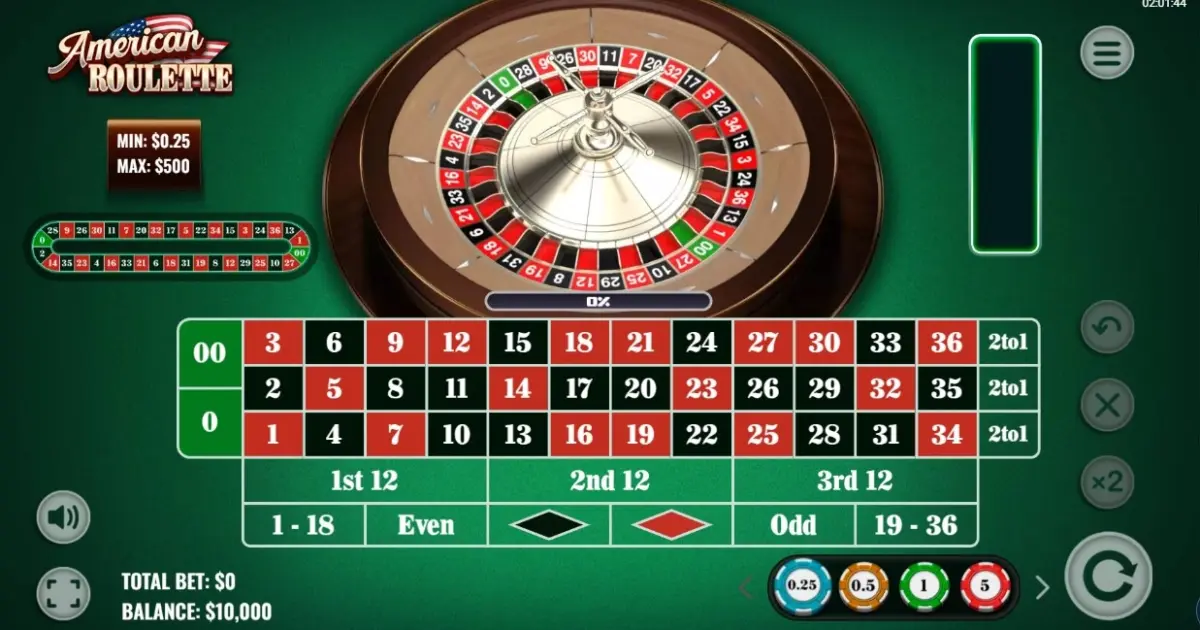
American Roulette (Platipus) is worth your time only if you specifically want the double-zero layout and accept the mathematical cost that comes with it. At 94.74% RTP, it sits below both the typical American wheel and well below every European alternative, making it one of the more expensive tables in the Platipus catalogue.
What kind of roulette is American Roulette (Platipus)?
This is a full American wheel: 38 pockets numbered 1 through 36, plus 0 and 00. The name points to a double-zero wheel, which normally means a 5.26% house edge on standard bets—confirm it on the game’s own rules screen before betting real money. The extra pocket compared to European roulette increases the house edge from 2.70% to 5.26%, and that difference compounds over every spin. The American layout includes the five-number basket bet (0, 00, 1, 2, 3), which carries an even worse 7.89% edge and should be avoided entirely.
Platipus operates a small roulette catalogue—just two titles—and the contrast is stark. European Roulette (Platipus) returns 97.3% and cuts the house edge by more than half. If you have no strong preference for the American layout, that single-zero table is the better mathematical choice every time.
Return to player and house edge
The confirmed RTP is 94.74%, which translates to a house edge of 5.26% across all standard bets. This matches the structural edge of a 38-pocket wheel: every bet except the basket pays as though there are only 36 pockets, and that two-pocket gap is where the house advantage lives. A straight-up number pays 35:1 against true odds of 37:1 on this wheel, and that shortfall applies to every wager on the layout.
At 94.74%, this table sits 2.23 percentage points below the corpus average of 96.97% and 1.28 points below Platipus’s own provider average of 96.02%. For context, European Roulette (Red Tiger) and European Roulette Pro both deliver 97.3% RTP on single-zero wheels, saving you 2.56 percentage points per spin. Over a 200-spin session wagering one unit per spin, the difference between 94.74% and 97.3% is more than five units of expected loss—a tangible cost that adds up quickly.
Why American wheels cost more
The second zero pocket increases the denominator without increasing any payout. On a European wheel, a single number has a 1 in 37 chance and pays 35:1; on an American wheel, that same bet has a 1 in 38 chance but still pays 35:1. The house edge on a double-zero wheel is nearly double that of a single-zero wheel, and no amount of bet selection or progression can erase it. The maths is completely known and completely unforgiving.
Reading the Platipus paytable before you bet
The FACTS block does not include table limits, available call bets, racetrack options, or any details about the interface beyond the RTP figure. These details matter, especially if you plan to use neighbour bets or need a specific minimum stake for your session budget. Always check the game’s own rules panel before committing real money. The paytable should confirm the 35:1 straight-up payout and list any side bets or special features, if present.
If Platipus has included any non-standard bets or adjustments to the payout structure, they will be documented in that rules screen. Multiplier-style variants sometimes reduce the base straight-up payout to fund the enhanced prizes, which changes the effective RTP on those bets. This table is labelled as straight American roulette, so expect the classic payouts, but verify before you play.
Bet coverage, variance and session length
Choosing between inside and outside bets does not change your expected loss per spin—it only redistributes the variance. A straight-up number on this wheel pays 35:1 and wins once every 38 spins on average; an even-money red or black bet pays 1:1 and wins 18 times out of 38. Both carry the same 5.26% house edge, but the straight bet produces wild swings and the even-money bet grinds steadily. Your choice should depend on how much volatility you want and how long you want your bankroll to last.
| Bet type | Payout | True odds (38 pockets) | House edge |
|---|---|---|---|
| Straight-up | 35:1 | 37:1 | 5.26% |
| Split | 17:1 | 18:1 | 5.26% |
| Street | 11:1 | 11.67:1 | 5.26% |
| Corner | 8:1 | 8.5:1 | 5.26% |
| Line (six numbers) | 5:1 | 5.33:1 | 5.26% |
| Dozen / Column | 2:1 | 2.17:1 | 5.26% |
| Even money (red/black, odd/even, high/low) | 1:1 | 1.11:1 | 5.26% |
| Basket (0, 00, 1, 2, 3) | 6:1 | 6.6:1 | 7.89% |
The basket bet is the only wager on the layout with a different edge, and it is worse. Avoid it. Every other standard bet costs you the same 5.26% over time. If your goal is to stretch a fixed bankroll, bet outside; if you want a chance at a large win and can accept losing quickly, bet inside. Neither strategy changes the expected value.
Patterns, hot numbers and the gambler’s fallacy
No betting system—Martingale, Fibonacci, D’Alembert, or waiting for five reds—changes expected value. Spins are independent; the wheel has no memory. A number that has not hit in 100 spins is no more likely to land on spin 101 than any other number. Each spin is a fresh 1 in 38 draw, and the house edge applies every single time.
Progression systems like the Martingale redistribute variance by increasing bet size after a loss, but they also accelerate table-limit risk and bankroll depletion. Doubling after every loss sounds like a recovery strategy until you hit a losing streak that exceeds your budget or the table maximum. At that point, the system collapses and you cannot recover the previous losses. The maths does not support these methods, and treating them as low-risk is a mistake.
Similarly, tracking previous results to identify hot or cold numbers has no predictive value on an RNG wheel. The random number generator produces independent outcomes with no regard for history. A number is never “due,” and a sector is never “running hot.” These are psychological patterns, not mathematical realities, and betting on them does not improve your odds.
Trying the demo
A free demo is available, which lets you test the interface, pace, and bet layout without spending money. Use it to confirm the table limits, practice placing multi-pocket bets, and get a feel for the speed of play. Demo mode does not predict real-money results—the RNG produces independent outcomes regardless of whether you are playing for free or for cash—but it is a useful way to verify that the interface works for you before committing a deposit.
Set a budget in advance and treat roulette as entertainment, not income. No spin outcome is predictable, no system is profitable, and the house edge applies to every wager. Only play with money you can afford to lose, and stop when you reach your limit. This is an 18+ activity, and responsible play means knowing when to walk away.
Verdict on American Roulette (Platipus)
American Roulette (Platipus) is a competent implementation of the double-zero format, but the 94.74% RTP makes it one of the more expensive wheels in the catalogue. If you specifically want the American layout for its aesthetic or regional familiarity, this table delivers the classic 38-pocket structure with all standard bets available. If you care primarily about getting the best mathematical value from your session, the single-zero alternative in the same provider’s catalogue returns 97.3% and cuts the house edge by more than half.
The American wheel is not inherently broken—it simply costs more per spin, and that cost is baked into the structure. You are paying 5.26% on every standard bet, and the two-zero layout offers no compensating features, no multipliers, and no rule variations that would soften the edge. It is honest, expensive roulette. Choose it only if the format itself is part of the experience you want, and go in knowing exactly what it costs.
Frequently Asked Questions
Is there a free demo for American Roulette (Platipus)?
Yes, a free demo is available. You can test the interface, practice bet placement, and verify table limits without spending money. Demo play uses the same RNG as real-money mode, but outcomes are independent and do not predict future results. Use the demo to confirm the game works for you before depositing.
What is the RTP of American Roulette (Platipus)?
The RTP is 94.74%, which corresponds to a 5.26% house edge on all standard bets. This is typical for a double-zero American wheel, but sits 2.23 percentage points below the site average and 2.56 points below European roulette tables at 97.3%. The extra zero pocket drives the higher edge.
Does the Martingale system work on this wheel?
No. The Martingale and all other progression systems redistribute variance without changing expected value. Each spin is independent, the house edge applies every time, and doubling after losses accelerates table-limit risk. Over time, you will lose 5.26% of total wagered on this wheel regardless of bet size or pattern. No system beats the maths.
How does American Roulette (Platipus) compare to the European version from the same provider?
European Roulette (Platipus) returns 97.3% with a single-zero wheel and a 2.70% house edge—less than half the cost of this American table at 94.74%. Over 200 spins at one unit per spin, the European wheel saves more than five units of expected loss. Unless you specifically want the double-zero layout, the European version is the better value.
Are hot numbers or cold numbers real on this table?
No. The RNG produces independent outcomes with no memory of previous spins. A number that has not hit in 100 spins has the same 1 in 38 chance on spin 101 as every other number. Hot and cold streaks are retrospective patterns with no predictive power. Betting on them does not improve your odds or reduce the 5.26% house edge.




