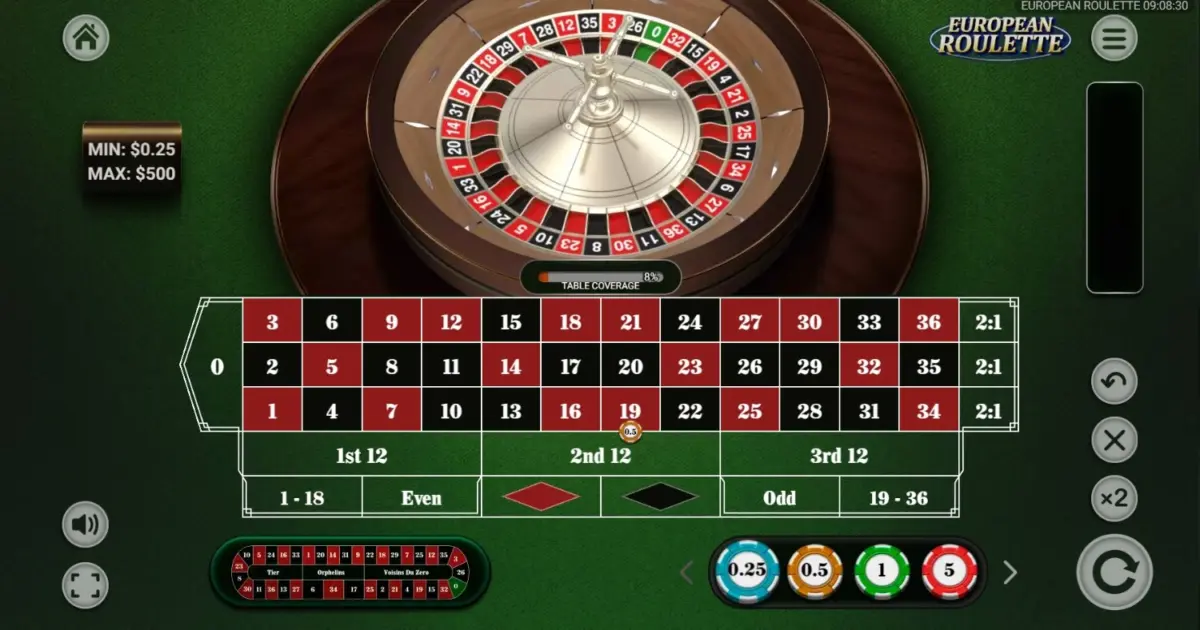
European Roulette (Platipus) is a straightforward single-zero table with a stated RTP of 97.3%, and it is available as a free demo, so you can look at the layout and rules screen before any money moves. That 97.3% is the number the maths predicts for a 37-pocket wheel, which is a good sign: nothing unusual has been bolted on. What FACTS does not tell you is whether this table offers La Partage, a racetrack, call bets, or what the limits are, and those details change how you would actually play it.
European Roulette (Platipus) in one minute
Provider: Platipus. Stated RTP: 97.3%. Free demo: yes. Category: roulette. That is the confirmed set.
The title points to a single-zero wheel, which normally means 37 pockets and a 2.70% house edge on every standard bet. Treat that as a strong hint rather than a confirmed fact — open the game’s own rules screen and count the pockets before betting real money. Platipus lists only two roulette titles, the other being an American variant, so this is the better-value of the pair on paper.
Missing from the facts available here: table minimum and maximum, whether the zero triggers any stake refund, and whether a racetrack for neighbour bets is included. The limits matter most. A table’s maximum decides how many stake increases you could physically make if you were tempted by a progression, and the minimum decides how long a fixed budget lasts. You will need the game’s own interface for both.
The maths of a single spin
On a single-zero wheel there are 37 pockets. A straight-up bet on one number wins once in 37 spins on average, so the true odds are 36:1. The payout is 35:1. That one-pocket gap is the entire house edge, and it works out to 2.70%.
The same 2.70% applies to every standard bet on the layout. Red, black, odd, even, a dozen, a column, a split, a corner — all of them carry an identical expected cost per unit staked. What changes between them is variance, not value. A straight-up bet loses 36 times out of 37 and pays 35 units when it lands; an even-money bet resolves close to half the time. Same edge, completely different ride.
Spins are independent. An RNG wheel has no memory of the last result, so a run of eight reds tells you nothing about the ninth spin. No number, colour or sector is ever “due”. Systems built on that idea — Martingale, Fibonacci, D’Alembert, waiting for five reds — do not change expected value at all. They redistribute variance and push you toward the table maximum faster, which is where progressions break.
Where the 97.3% comes from
97.3% is simply 100% minus 2.70%. It is the exact theoretical return of a 37-pocket wheel paying standard odds with no zero refund, so the figure confirms the format rather than describing a bonus.
| Bet | Pays | True odds (37 pockets) | House edge |
|---|---|---|---|
| Straight up (1 number) | 35:1 | 36:1 | 2.70% |
| Split (2 numbers) | 17:1 | 17.5:1 | 2.70% |
| Corner (4 numbers) | 8:1 | 8.25:1 | 2.70% |
| Dozen / column | 2:1 | 2.08:1 | 2.70% |
| Red / black / odd / even | 1:1 | 1.054:1 | 2.70% |
Read the RTP as a long-run average across enormous numbers of spins, not a session forecast. Over a hundred spins you can finish well above or well below it. The theoretical cost is roughly 2.7 units per 100 units staked, and staked is the key word — the figure applies to total turnover, so a session with many small repeated bets moves more money past the edge than the size of your deposit suggests.
Even-money bets and the zero problem
Zero is what makes red and black worse than a coin flip. On a 37-pocket wheel, red wins 18 times, black wins 18 times, and zero collects both. That is why an even-money bet paying 1:1 still carries a 2.70% edge.
Some tables soften this with French rules. Under La Partage, a zero returns half your even-money stake immediately. Under En Prison, the bet is held for one more spin and released whole if it wins. Either rule cuts the even-money house edge to roughly 1.35%, which is the best standard bet in the game — better than any bet on a plain single-zero table and less than a third of the cost of an American wheel’s 5.26%.
Whether this Platipus table applies either rule is not stated in the information available here, and the 97.3% RTP is consistent with a table that does not. If La Partage were active on even-money bets, the effective return on those bets specifically would be higher than 97.3%. Check the rules screen for the words La Partage, En Prison, or any mention of half-back on zero. If it is absent, the edge is a flat 2.70% everywhere and no bet on the layout is cheaper than another.
How European Roulette (Platipus) compares to other online roulette
The average RTP across the roulette tables in this catalogue is 96.97%, so 97.3% sits about a third of a percentage point above the middle. That gap comes almost entirely from wheel type rather than generosity: single-zero tables cluster at 97.3%, and double-zero tables pull the average down.
The clearest comparison is inside Platipus’s own pair. American Roulette (Platipus) runs at 94.74%, because a second zero makes 38 pockets and lifts the house edge to 5.26% on every standard bet, with the five-number basket bet worse still at 7.89%. Same provider, nearly double the cost per spin. If you want a like-for-like alternative, European Roulette (Red Tiger) posts the identical 97.3%, and so does European Roulette Pro, which is worth a look if you want to compare interfaces and bet-limit ranges at the same theoretical return.
Because these European tables share one RTP figure, the deciding factors are the things RTP does not capture: table limits, whether a racetrack is offered, whether French rules apply, and how the layout feels to use. Those are worth comparing directly in the demos.
Playing responsibly
Roulette is 18+ entertainment, not income. Set a budget before you open the table, treat it as the cost of the session, and stop when it is gone rather than raising stakes to recover it. Decide a time limit too, since a fast RNG wheel can run through far more spins per hour than a live table.
Two specific things to be honest with yourself about. First, no progression is low risk. Doubling after a loss feels controlled because most sequences end in a small win, but the rare long run costs more than every win before it combined, and the table maximum ends the sequence whether you are ready or not. Second, the free demo shows you the interface and the bet types, and nothing more. It does not predict real-money outcomes, and short demo results tell you nothing about what the same table will do next.
If tracking losses or chasing them starts feeling automatic, use the deposit limits, session reminders and self-exclusion tools your operator provides.
Verdict
As a single-zero table, this one is priced correctly. 97.3% is the honest number for 37 pockets with standard payouts, it beats the 96.97% catalogue average, and it comfortably beats the same studio’s American wheel. If you play roulette online, a table at this figure is the baseline you should not go below.
The open questions are structural rather than mathematical. Nothing in the available information confirms the pocket count, the presence of La Partage or En Prison, the table limits, or whether a racetrack is offered — and the first two of those decide whether your even-money bets cost 2.70% or about 1.35%. That is a meaningful difference, so read the rules screen in the free demo before you commit real money. Then pick a bet type for the variance you want, since every standard bet costs the same either way.
Frequently Asked Questions
Can I play European Roulette (Platipus) free with no download?
Yes. A free demo is available, and it runs in the browser without a download or registration at most sites that carry it. The demo uses play-money chips, so it is useful for learning the layout, bet types and interface. It does not predict real-money results in any way.
What is the European Roulette (Platipus) RTP?
The stated RTP is 97.3%, which is about a third of a percentage point above the 96.97% average across roulette tables in this catalogue. That figure is a long-run theoretical average over huge numbers of spins, not a session forecast, and it applies to total turnover rather than your deposit.
What is the house edge and how many pockets does this wheel have?
A 97.3% RTP corresponds to a 2.70% house edge, which is the exact figure for a 37-pocket single-zero wheel paying 35:1 on straight-up numbers. The title points the same way, but confirm the pocket count on the game's own rules screen rather than taking the name as proof.
Does the Martingale system work on this table?
No. Martingale, Fibonacci, D'Alembert and pattern-spotting all leave expected value unchanged at 2.70% per unit staked. Spins are independent, so no number or colour is ever due. Progressions only reshape variance, and the table maximum ends a doubling sequence whether the run has finished or not.
How does it compare to American Roulette (Platipus)?
European Roulette (Platipus) returns 97.3% against 94.74% for the American table, because the extra zero makes 38 pockets and raises the house edge to 5.26% on standard bets, or 7.89% on the five-number basket. Same provider, nearly double the theoretical cost per spin.




