Fortune Bingo is a TaDa Gaming bingo room with a published return of 97.0%, which sits 2.59 percentage points above the 94.41% average across the bingo games catalogued on this site. If you want a room where the operator has actually put a number on the prize pool rather than leaving you to guess, that is the strongest argument for trying it. It is not the strongest argument for expecting to win — nothing is — but it is a real, checkable piece of information that most bingo rooms never give you.
Fortune Bingo is a free demo title here, so you can watch a full game play out, see how the calls land and how quickly a line and a full house resolve, before any money is involved.
What kind of bingo is fortune bingo?
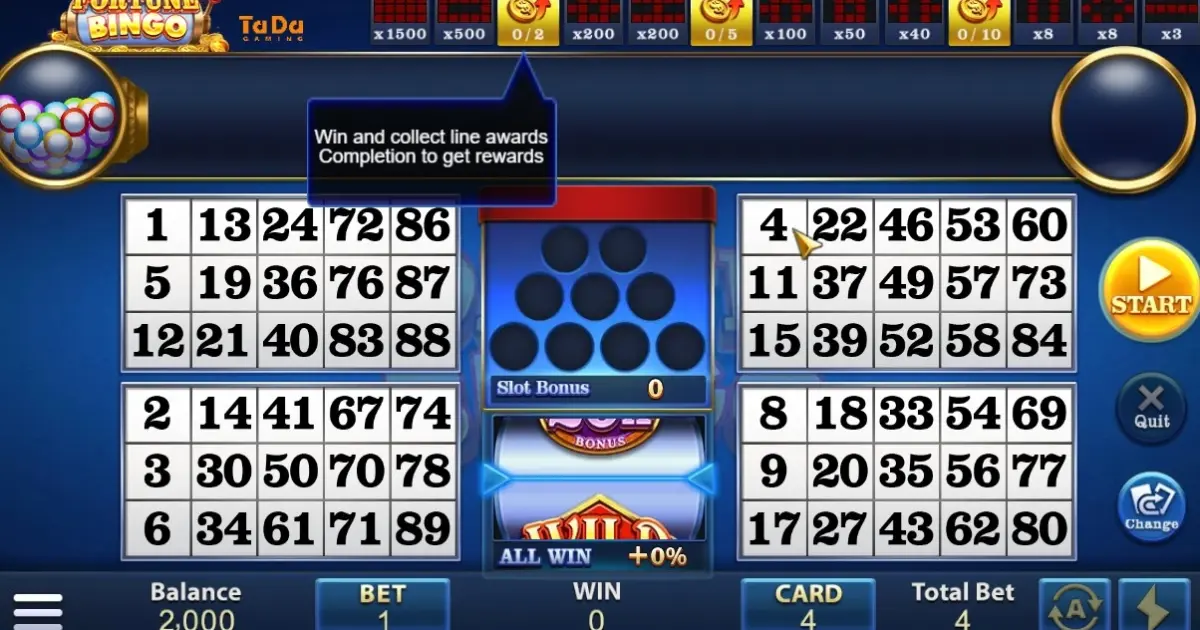
The FACTS available for this game describe it as a bingo room from TaDa Gaming with a Fortune theme. They do not state whether it is played on a 90-ball ticket with one-line, two-line and full-house prizes, on a 75-ball pattern card, or on a compressed speed format. That matters, because the three play very differently, and I am not going to guess which one this is.
What can be said without guessing is what the format label determines once you do find it. A 90-ball room pays three times inside a single game: the first ticket to complete any one line, the first to complete two lines, and the first to fill the whole ticket. A 75-ball room drops the line tiers and pays on shapes — a specific pattern of marked squares on a 5×5 grid — and typically lets you pick which cards you hold rather than dealing them to you. A 30-ball or speed room collapses everything into a single full-house win on a much smaller card, which means shorter rounds and less time between results.
Fortune Bingo is listed under the Fortune theme, and it is the only game in that theme in this catalogue — so the visual framing is its own rather than part of a large family. Beyond that, the presentation is not described in the data available here, and the room’s own rules page is the place to confirm the ticket size, the number of balls and the prize tiers.
The maths of a shared draw
Bingo is not a slot, and the difference is worth being precise about. In a slot, your spin is resolved by a random number generator that only involves you. In bingo, a single sequence of numbers is drawn for the whole room, and every ticket in play is marked against that same sequence. You are not playing against the house in the way a spin plays against the house — you are holding a set of tickets in a pool of tickets, and the draw decides which of them happens to match.
Two consequences follow, and both are practical.
The first is that standard auto-daub online bingo has essentially no skill component. You do not choose which numbers to mark, and you cannot mark them faster than the software does. The only decision you actually make is which tickets you hold before the first ball is called. After that, the outcome is settled by the draw and by the numbers printed on your card. Anyone selling you a “system” for bingo is selling you a story about a game that does not have that kind of leverage in it.
The second is about buying more cards. Holding more tickets in the same game does increase your chance of being the player who completes the line or the full house — you are covering more of the possible outcomes, so more of the ways the draw can fall end with you winning. What it does not do is change the expected value per unit staked. Ten tickets expose ten times as much money to the same house edge as one ticket. More cards means a better chance of winning this round, not a better return on each pound you put in. Those are different things and the genre blurs them constantly.
Where the 97.0% comes from
In bingo, the return figure is set by how the operator structures the prize pool relative to ticket sales. It is not a per-spin return the way a slot’s RTP is, weighted by reel symbols. It is closer to a statement about the share of stakes that is paid back out as prizes over time, with the remainder being the operator’s margin. When you read 97.0% for Fortune Bingo, read it as “97 pence in every pound staked is returned as prizes across the pool”, not as “you will get 97 pence back”.
That distinction has a specific consequence in a shared-draw game. In any single game, the prizes are fixed and the number of tickets sold determines how much was staked to win them. If a room sells more tickets than expected, the same prizes are spread across more stakes and the effective return in that particular game falls below the headline. If it sells fewer, the return in that game rises above it. The 97.0% is a structural figure describing how the pool is built, and it is the right number to compare rooms with — but it is not a promise about any one game you sit in.
For context, 97.0% is a strong published number here. It sits 2.59 points above the 94.41% corpus average, and it exactly matches TaDa Gaming’s average across its 14 catalogued games, which suggests this is the studio’s standard structure rather than an outlier. The operator has published a figure, which is more than many bingo rooms do.
Reading the room’s rules before you buy in
Because so much of what matters in a bingo room lives in the room’s own rules rather than in a marketing page, here is what to actually look for before you commit money.
- Ticket price and prize tiers. The rules page should tell you what a ticket costs and what each tier pays — one line, two lines, full house, or the pattern set if it is a 75-ball room. That structure, not the headline RTP, determines how top-heavy the payouts are.
- Whether the return is published in the room itself. A 97.0% figure on a review page is useful for comparison. A figure printed on the room’s own paytable is the one that governs your game.
- How many tickets are in play. Some rooms show the number of tickets sold for the current game. That is the single best indicator of how diluted the prizes are likely to be in that round.
- Pre-buy and auto-buy settings. Many rooms let you reserve tickets for multiple upcoming games automatically. It is convenient and it is also the fastest way to spend more than you intended, because the decision is made once and executed repeatedly.
- Any bundled side game. Themed bingo products sometimes attach a slot-style bonus round. If there is one, it runs on entirely separate mechanics and its own return, and it should not be assumed to be present here — the description available for Fortune Bingo does not mention one.
How Fortune Bingo compares to other rooms
The cleanest comparison inside TaDa Gaming’s own bingo range is Magic Lamp Bingo, which carries the same 97.0% published return. If the maths is identical, the choice between them comes down to theme and format — Magic Lamp leans on a lamp-and-wishes framing rather than a fortune one, and if the two rooms use different ticket sizes or prize tier structures, that is the thing to check, because it changes the shape of the payouts even when the headline return matches.
If you want to see what a bingo room looks like when the operator has not published a return at all, Jackpot Bingo is the useful counter-example: no RTP figure is listed for it, which is common in the genre and means you would be working from the room’s own paytable alone. Bonus Bingo is in the same position. Comparing a room with a published 97.0% against rooms with no published figure is a fair way to decide how much you care about that disclosure.
| Attribute | Fortune Bingo |
|---|---|
| Provider | TaDa Gaming |
| Published return | 97.0% |
| Corpus average return | 94.41% |
| Difference vs corpus | +2.59 percentage points |
| Theme | Fortune |
| Free demo | Available |
| Format (90-ball / 75-ball / speed) | Not stated in available data |
Free demo and staying in control
A free demo is available for Fortune Bingo, which is genuinely useful in this format for reasons that do not apply to slots. In a demo you can watch a full game from first call to full house and see how long it takes, how many tickets are typically in play, and how the prize tiers resolve. That is real information about pacing and structure. What it cannot tell you is anything about your real-money results — demo play does not predict outcomes, and in a shared draw the outcome depends on which tickets you hold and which numbers come out, neither of which the demo influences.
TaDa Gaming has 14 games catalogued on this site, all averaging 97.0%, so if you like how this studio structures a prize pool, there is a consistent range to explore.
Bingo is entertainment you pay for, not income. Set a budget for the session before you open the room and treat it as spent, because in a shared-draw game the money leaves your balance on ticket purchase and the result is decided after. Do not chase a line you nearly got. Fortune Bingo is strictly 18+, and if the session stops being fun, the correct move is to close the room rather than buy one more card.
Final verdict
Fortune Bingo’s case rests on one thing: a published 97.0% return that is 2.59 points above the bingo average on this site and consistent with everything else TaDa Gaming puts out. In a genre where many rooms publish nothing at all, that is a meaningful disclosure, and it makes the room easy to compare against alternatives rather than a leap of faith.
The gaps are real, though. The available data does not say whether this is 90-ball, 75-ball or a speed format, and it does not describe the ticket price or the prize tier structure. Those are the details that decide whether a room suits you — a 90-ball room with three prizes per game plays very differently from a single-winner speed round, even at the same headline return.
So: try the demo, watch a full game, and check the room’s own rules for the format and paytable. If the structure suits how you want to play, the published return is a solid reason to give it a session. If you cannot find the format details before you buy in, that is a reason to wait rather than a reason to assume.
Frequently Asked Questions
Is there a free demo of Fortune Bingo?
Yes, a free demo is available. It is worth using for a full game rather than a few calls, because what you learn from it is structural — how long a round runs, how the prize tiers resolve, how many tickets are typically in play. Demo play does not predict real-money results, so treat it as a way to read the room rather than a way to test your luck.
What does the 97.0% return actually mean in bingo?
It means 97 pence in every pound staked is returned as prizes across the pool, set by how the operator structures the prize pool against ticket sales. It is not a per-spin return like a slot's RTP. In any single game, prizes are fixed and the number of tickets sold determines the effective return in that round.
Does choosing my own cards or daubing faster improve my odds?
No. In standard auto-daub online bingo, every ticket in the room is marked against the same sequence of calls, and the software marks them. Your only decision is which tickets you hold before the first ball. Card choice and daubing speed do not change your chance of completing a line or full house.
Who provides Fortune Bingo?
TaDa Gaming, a studio with 14 games catalogued on this site, all averaging a 97.0% published return. Fortune Bingo matches that studio average exactly, which suggests it uses the standard TaDa prize-pool structure rather than being an outlier. The provider's range is worth browsing if you like how that structure is built.
Does buying more cards give me better value per pound?
No. More cards increase your chance of being the player who wins this round, because you cover more of the possible outcomes the draw can produce. They do not change the expected value per unit staked — ten tickets expose ten times as much money to the same house edge as one. More cards means a better shot at winning, not a better return.