The short answer: Far West Bingo is worth a look if you want a themed bingo room with a published return figure, which is more transparency than many bingo products offer. MGA lists it at 90.61%, which is below the 94.41% average across the wider game corpus on this site and slightly under MGA’s own 90.97% average across its 34 titles. A free demo is available, so you can see the room’s pace and layout before any money moves.
What kind of bingo is far west bingo?
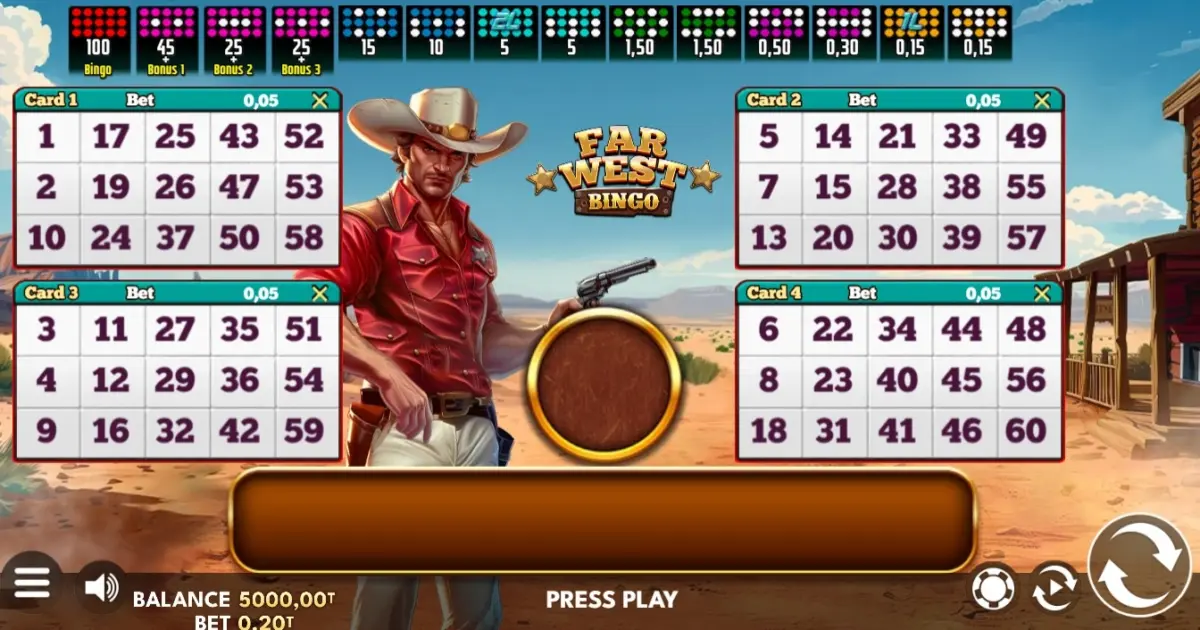
Far West Bingo is a bingo title from MGA, listed in the bingo subcategory, with a western theme carried by the name. Beyond that, MGA has not published the ball count, ticket price, card limits or prize tiers for this room in the data available here, and inventing them would not help you.
What that means in practice: you do not yet know whether you are looking at a 90-ball game with three prize tiers (one line, two lines, full house), a 75-ball pattern game on a 5×5 grid where you may be able to pick your own cards, or a compressed speed format that resolves on a single full house. Those three structures play very differently. A 90-ball game gives you more chances to see something land in a round because the line prizes pay out well before the full house does. A 75-ball pattern game concentrates the money differently depending on which shapes the room asks for. A 30-ball speed game is over in well under a minute and gets through far more rounds per hour, which matters a lot for how quickly a budget moves.
The room’s own rules page will state which of these it is. Load the demo first and count the calls, or read the paytable — either takes under a minute and tells you more about the experience than any theme description can.
| Provider | MGA |
|---|---|
| RTP | 90.61% |
| Free demo | Yes |
| Site-wide average RTP | 94.41% |
The maths of a shared draw
Bingo is not a slot, and the difference matters for how you read any figure attached to it. When you spin a slot, the RNG resolves your spin and nobody else’s. In online bingo, numbers are drawn at random and every ticket in the room is marked against that same sequence. You are not playing against the house in isolation; you are all watching one draw and the winner is whoever happens to hold the numbers that complete first.
That has a direct consequence for skill. In standard auto-daub online bingo, there is effectively none. The software marks your card for you, so there is no missed number and no reaction time to sharpen. Everything is decided by which numbers sit on your tickets, and those are fixed before the first call. Where a format lets you choose cards, you are choosing between sets of numbers that are all equally likely to appear — a preference, not an edge.
The other consequence concerns buying more cards. Holding more tickets in a round genuinely does increase your chance of being the player who wins it, because you cover more of the possible outcomes. It does not improve what you get back per pound staked. Every extra ticket carries the same house margin as the first one, so more cards means more money exposed to the same edge, spread across more chances. Both things are true at once, and the second one is the one that gets left out of most explanations.
Where the 90.61% comes from
MGA publishes a return of 90.61% for this room. In bingo, that figure means something slightly different from a slot’s RTP. A slot’s return is engineered through symbol weighting on the reels. A bingo return is set by how the operator structures the prize pool relative to ticket sales — the share of stakes paid back out as prizes rather than retained. Read 90.61% as “roughly nine pounds in every ten staked across the room comes back as prizes over a very long run”, not as a per-round return you will experience.
Against the wider picture, that number is on the low side. It sits 3.8 points below the 94.41% corpus average and just under the 90.97% average across MGA’s 34 games. That gap is not unusual for bingo as a category — bingo returns routinely run lower than slot returns — but it is worth knowing before you decide where your session budget goes. Sub-91% means the expected cost of playing here is higher per pound staked than at a typical 94-96% slot, and no amount of ticket-buying or timing changes that. The distribution matters too: bingo tends to concentrate returns into fewer, larger wins for whoever completes first, so most rounds return nothing to any individual player. The 90.61% is a room-wide average, not a personal one.
Reading the room’s rules before you buy in
Because the ticket price, card limits and prize breakdown for Far West Bingo are not published in the information available here, the rules page is where you settle them. A few things to check, in order of how much they affect your money:
- Ticket price and maximum cards — these two together set the real cost of a round, and the maximum is often much higher than people assume.
- Prize tier split — how much of the pool goes to line prizes versus the full house, and whether any progressive or jackpot element sits on top.
- Call speed and round length — the single biggest driver of how fast a budget depletes, and easy to check in the demo.
- Whether the room needs a minimum number of players to start, and what happens to your stake if it does not fill.
- Any side game or bonus feature. Themed bingo products sometimes bundle slot-style extras that run on entirely separate mechanics with their own return, so do not assume the 90.61% covers them.
None of this takes long, and it is the difference between knowing what you are buying and guessing.
How Far West Bingo compares to other rooms
MGA has 34 games in its catalogue, and Far West Bingo sits at rank 29 on this site with a popularity percentile of 82.7, so it gets more traffic than most of the bingo rooms listed here. If you want to compare formats from the same studio, Detective Bingo is the obvious sibling to try in demo alongside this one, since a side-by-side run is the fastest way to feel the difference in call speed and card layout.
Zeus Bingo is worth loading if you want to see whether MGA varies its prize structure between themes or reuses the same engine with new artwork. And Buffalo Bingo rounds out the comparison if the western setting is what drew you here in the first place.
One caveat: MGA has not published return figures for any of those three rooms in the data available here. Far West Bingo does publish one, which makes it the easier room to assess. When you cannot see the payout percentage, you are relying entirely on the paytable and the room’s own rules to judge value.
Free demo and staying in control
A free demo of Far West Bingo is available, and it is the right first step. Use it to answer the questions the published data leaves open: how many balls, how many prize tiers, how fast the calls come, how many cards the interface lets you hold. Play Far West Bingo free for a handful of rounds and you will know whether the pace suits you.
What the demo cannot tell you is anything about outcomes. Demo results do not predict real-money results — the draws are independent, and a good run in free play carries no information forward.
Bingo is 18+. Decide what a session is worth to you before you open the room, and treat that figure as the price of the entertainment rather than a stake you expect to recover. At 90.61%, the long-run maths says the room keeps a share of what passes through it. No number is ever due, no room runs hot or cold, and a losing streak does not build toward anything. If a session stops being enjoyable, close it.
Final verdict
Far West Bingo is a reasonable pick for anyone who wants a themed bingo room and values seeing a return figure at all. The 90.61% is honest and checkable, which puts it ahead of the three MGA siblings that publish nothing. It is also genuinely low — nearly four points under the corpus average and a touch under MGA’s own house average — so it belongs in a session budget you have already accepted you are spending.
What holds the review back is everything MGA has not published: ball count, ticket price, card limits and prize tiers are all unknown from here. That is normal for bingo, where the prize pool depends on ticket sales, but it means the demo and the rules page do real work. Load the free version, count the calls, read the paytable, then decide. If the pace suits you and the ticket price fits the budget you set, it is a fair room to spend an hour in. If you are comparing on return alone, most slots on this site give you more back per pound.
Frequently Asked Questions
Can I play Far West Bingo for free?
Yes, a free demo of Far West Bingo is available with no download required, so you can load it in a browser and try a few rounds at no cost. Use it to check the ball count, call speed and card limits, since MGA has not published those details. Demo results never predict real-money outcomes.
What is the Far West Bingo RTP and what does it mean in bingo?
MGA publishes 90.61%. In bingo that figure describes the share of total stakes the room returns as prizes, set by the prize-pool structure rather than by weighted reels. It is a long-run, room-wide average, not a per-round return. It sits 3.8 points below the 94.41% corpus average on this site.
Does choosing my cards improve my odds in Far West Bingo?
No. Numbers are drawn at random and every ticket in the room is marked against the same sequence, so the outcome depends only on which numbers your tickets already hold. With auto-daub there is nothing to react to either. If the format lets you pick cards, every set of numbers is equally likely to be called.
Who makes Far West Bingo?
MGA, which has 34 games listed on this site with an average published return of 90.97%. Far West Bingo's 90.61% is marginally below that house average. It ranks 29th here and sits in the 82.7th popularity percentile, making it one of the better-trafficked MGA bingo rooms.
Does buying more cards give better value per pound?
No. More cards cover more of the possible outcomes, so your chance of being the player who wins that round genuinely rises. Your expected return per pound staked does not change, because every extra ticket carries the same house margin. More cards means more money exposed to the same 90.61% return, not a better rate.