Super Baccarat is worth your time if you want a straightforward Punto Banco table to practise bet selection without side distractions, and you can try it as a free demo with no download required. The value here is not in complex decisions – there are none after you bet – but in understanding how the three standard bets compare on cost per hand. If that maths-first approach suits you, this Cards-themed game from Triple Profits Games (TPG) gives you a clean place to learn it.
Super Baccarat at a glance
This is a Cards-themed baccarat title from Triple Profits Games (TPG), listed in the Baccarat subcategory and sitting at rank 30 in the current corpus with a popularity percentile of 37.0. The provider has one game in this dataset, and there are four Cards-themed games overall, which puts super baccarat in a small, focused group rather than a large series. A free demo is available, so you can load the table and see the layout, bet spots and paytable without creating an account or wagering real money.
What has not been published for this specific table is the exact return-to-player percentage, the Tie payout (whether it pays 8:1 or 9:1), whether the table charges the standard 5% commission on winning Banker bets or uses a commission-free structure, the table limits, and any side bets such as Player Pair or Banker Pair. That absence matters more in baccarat than in many other games because the Tie payout alone moves the house edge on that bet by several percentage points, and a commission-free label changes how a winning Banker 6 is paid. Rather than guess, the useful approach is to treat any unpublished figure as unchecked and confirm it directly on the game’s own rules or help screen before you play for real money.
The name itself does not confirm a special ruleset – it points to a standard Punto Banco presentation unless the in-game rules state otherwise. If you want a point of comparison while you evaluate presentation, Baccarat 3D Dealer shows how a different visual approach presents the same three bets, which helps you separate presentation from maths.
Banker, Player or Tie: the three bets explained
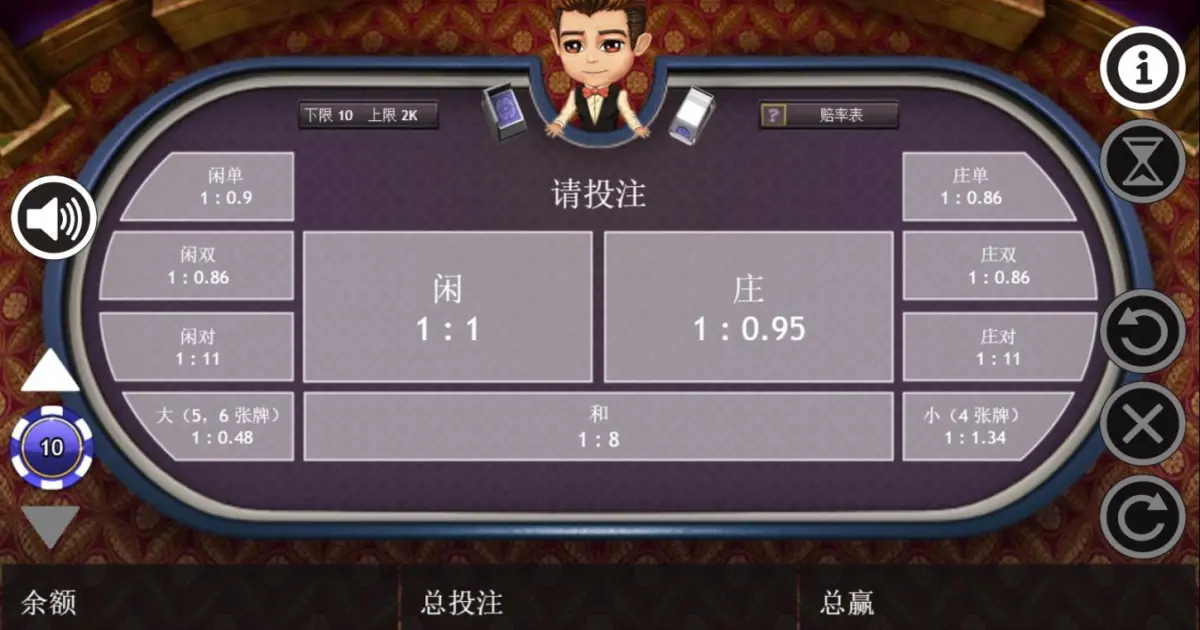
Baccarat gives you exactly three bets. You back Banker, you back Player, or you back Tie, and then every card is drawn for you by a fixed tableau. There are no hitting or standing decisions, no splits and no doubles after the initial wager. Banker and Player both pay even money when they win, with the standard rule that a winning Banker bet pays a 5% commission, so you receive 0.95 to 1. Tie pays substantially more than even money when the two hands finish level, typically quoted as 8:1 and sometimes as 9:1, but that figure varies by table and is not confirmed for this one.
Because the draw is automatic, the only decision that changes your expected cost is which of the three spots you choose and how much you stake. That makes the paytable the most important thing to check. If you like to compare how different studios lay out the same choice, Multiplayer Baccarat is a useful contrast – it puts the same Banker/Player/Tie selection on a shared table, which underlines that the bet types themselves do not change across most Punto Banco games.
The table below uses the well-known approximate house edges for a standard 8-deck Punto Banco shoe with 5% commission on Banker. These are general baccarat figures, not confirmed numbers for this specific table, because the provider has not published a paytable here. Use them to understand the relative cost of each bet, then verify the actual payouts in-game.
| Bet | Standard payout | Approximate house edge (general 8-deck, 5% commission) |
|---|---|---|
| Banker | 1 to 1 minus 5% commission (0.95 to 1) | about 1.06% |
| Player | 1 to 1 | about 1.24% |
| Tie | 8 to 1 (some tables 9 to 1) | about 14.36% at 8:1, lower at 9:1 |
Tie is the outlier. Even at the more generous 9:1, its edge remains several times higher than Banker or Player, which is why it is the highest-variance, worst-value standard bet in the game by a wide margin.
What RTP means at the baccarat table
This provider has not published a specific RTP for Super Baccarat, so there is no single percentage to quote for this table. That is common for baccarat listings where the paytable is shown only inside the game. Rather than substitute the corpus average of 98.55% or an estimate from another title, it is more accurate to explain what RTP would mean here if it were published and why the missing Tie payout makes a single figure hard to assume.
In baccarat, RTP is simply 100% minus the house edge for the bet you actually make, not a blended number across all three spots. If a table confirmed a Banker edge of about 1.06%, the RTP on that bet would be about 98.94%; if it confirmed a Player edge of about 1.24%, the RTP on that bet would be about 98.76%. Tie’s RTP moves with its payout: at 8:1 the return is roughly 85.64%, at 9:1 it is higher, but still far below the other two. Because you only occupy one spot per hand, your personal RTP is determined by the spot you choose repeatedly.
Without a published paytable, the responsible way to read any future RTP figure you see on the help screen is to check which bet it applies to and what Tie pays. A headline number without that context can mislead, since a table could show a strong Banker RTP while the Tie on the same felt carries a much lower return. If you open the demo, the rules page should list the exact payouts; that is the only source that can turn these general ranges into a confirmed figure for this table.
Why Banker is usually the better bet, even with commission
On a standard Punto Banco shoe with 5% commission, Banker is mathematically the best of the three standard bets despite the fee. The reason is not intuition or streaks, it is the drawing rules. The Banker hand acts after the Player hand and its tableau is slightly more favourable, so it wins a little more often than Player. The 5% commission on winning Banker bets is the mechanism that claws back that advantage for the house, leaving Banker with an edge of about 1.06% compared with about 1.24% on Player.
That difference is small per hand but it is consistent. Over a large number of hands flat-betting the same amount, the expected cost per unit wagered is lower on Banker than on Player, and dramatically lower than on Tie. No progression, such as doubling after losses, changes that expectation; it only changes the distribution of wins and losses around the same average. The house edge is fixed by the payouts and the draw, not by bet sizing.
There is one common exception to watch for. Some tables are labelled commission-free and instead pay a winning Banker 6 at 1:2 rather than even money. The name Super Baccarat does not confirm that structure, so do not assume it. If the rules screen for this table shows a reduced payout on Banker 6, the edge calculation shifts and the simple 1.06% versus 1.24% comparison no longer applies. Again, the in-game help is the definitive check; the general figures here describe the standard commission game only.
Third-card rules and why there is no real strategy
Once you place your bet, baccarat plays itself. Two cards are dealt to Player and two to Banker, and a fixed tableau decides whether either hand draws a third card. Player draws on 0-5 and stands on 6-7, with 8-9 being naturals that end the hand barring a tie. Banker’s decision depends on its own total and, when Player has drawn, on the value of Player’s third card. You do not choose to hit or stand, and the dealer – or the RNG – has no discretion either.
That automation is why there is no strategy in the blackjack sense. You cannot improve a hand by making a better decision, because there is no decision to make. Scoreboards that display previous results, such as bead plates or derived roads, are records of what has happened, not predictors of what will happen next. On a digital RNG table that shuffles a fresh virtual shoe each round, each hand is independent, so pattern-reading has no effect on the odds of the next coup.
What you can control is bet selection and stake size. Choosing Banker over Player lowers the expected cost per hand on a standard commission table, and avoiding Tie avoids the highest edge on the felt. Beyond that, managing session length and bet size is bankroll management, not an edge. If you want to see how the same fixed-draw structure feels on a different interface, HitMe! Baccarat presents the same automatic draws with its own layout, which is a good reminder that changing the presentation does not change the tableau that drives the results.
Playing the Super Baccarat demo
The free demo available for this title is the most practical way to confirm everything that the external listing does not show. Load the demo, open the rules or paytable, and check three items before you consider real-money play: the exact Tie payout, whether winning Banker bets pay 0.95 to 1 or whether a commission-free rule on Banker 6 applies, and whether any side bets are present and what they pay. The demo uses the same rules display as the real-money version, even though demo credits have no cash value and demo results do not predict real-money outcomes.
Use the demo to get comfortable with the pace and the interface rather than to test systems. Because the RNG shuffles a fresh shoe each round, tracking previous Banker or Player wins cannot inform the next hand, and no staking pattern alters the fixed edges described earlier. Treat the session as familiarisation: place small demo bets on each spot, watch how naturals and third-card draws resolve, and note how the balance would move with the commission applied.
Keep play in the entertainment frame. You must be 18+ to gamble, set a budget in advance that you can afford to spend as the price of entertainment, and stop when it is gone. Baccarat is not a way to make income, and a demo session does not change the house edge when you switch to real money. If you ever feel play is no longer just entertainment, use the operator’s limit tools or time-out and seek support from a responsible-gambling organisation in your jurisdiction.
Verdict: who should play Super Baccarat
Super Baccarat suits players who want a no-frills Punto Banco table to practise disciplined bet selection in demo mode before deciding whether to play for real money. If you value a clean Cards theme, a single-provider focus, and the ability to check the paytable at your own pace, the demo gives you exactly that without extra side bets cluttering the decision. It will appeal less if you are looking for published paytables up front or for confirmed details on limits and side bets before loading the game.
The maths takeaway travels with you whichever table you choose. On a standard commission shoe, Banker carries the lowest edge, Player is close behind, and Tie is by far the most expensive way to play, with an edge that remains high even when the payout is 9:1. Because this specific table has not published its Tie price or its commission structure, the most honest verdict is provisional: verify those two lines on the in-game help screen, then let that confirmed information, not the name or the theme, guide which spot you back.
Frequently Asked Questions
Can I play Super Baccarat for free without downloading anything?
Yes. The listing shows a free demo is available for Super Baccarat, so you can load the Cards-themed table in your browser and try it with demo credits. Use the demo to check the rules screen and paytable before considering real-money play.
What is the RTP of Super Baccarat and what does it mean for my bets?
Triple Profits Games (TPG) has not published a specific RTP for this table, so no confirmed percentage can be quoted here. In baccarat, RTP is 100% minus the house edge for the bet you actually place, so Banker, Player and Tie each have their own figure tied to their payouts.
Which is the best-value bet on Super Baccarat — Banker, Player or Tie?
On a standard 8-deck Punto Banco shoe with 5% commission, Banker is the best value at about 1.06% house edge, followed by Player at about 1.24%, with Tie far worse at roughly 14.36% at 8:1. Confirm the Tie payout and commission rule in-game, as they change the exact edges.
Does tracking patterns or using a betting system work on this digital baccarat game?
No. Digital RNG baccarat shuffles a fresh virtual shoe each round, so each hand is independent and scoreboards do not predict the next result. Staking systems like Martingale cannot change the fixed house edge; they only alter short-term variance around the same expected loss.
Who makes Super Baccarat and how does it compare to Baccarat 3D Dealer?
Super Baccarat is by Triple Profits Games (TPG), which has one game in this dataset and uses a Cards theme. Compared with Baccarat 3D Dealer, which is listed at 99.0% RTP and uses a 3D presentation, Super Baccarat has no published RTP here, so you should verify its paytable directly rather than assuming similar returns.