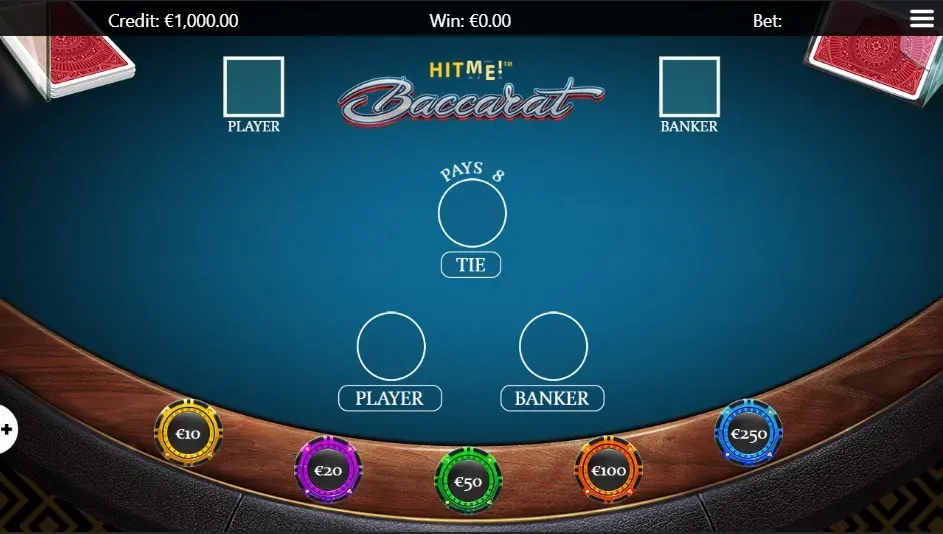
HitMe! Baccarat is worth your time if you want a plain Punto Banco table with a free demo and you are willing to check one number before staking anything: which bet the stated 99.5% RTP refers to. That figure is unusually high for baccarat and it sits above the 98.55% average across the baccarat tables on this site, which is a genuine reason to look closer — and also a reason to be suspicious of taking it at face value.
Mechanically there is nothing to learn here. You pick Banker, Player or Tie, cards come out under fixed rules, and you either win or you do not. The whole review is therefore about the maths and the bet selection, because that is the only place a baccarat player has any influence at all.
HitMe! Baccarat and the Eyecon table range
Eyecon is the provider behind this table, and the useful context is that Eyecon is not a baccarat specialist. The provider’s catalogue on this site lists a single baccarat title — this one — with an average RTP across its games of 99.5%, which is simply the same figure as this table because there is nothing else to average it with. Compare that with the site-wide corpus average of 98.55% and you can see the shape of the comparison: Eyecon’s one baccarat entry sits 0.95 percentage points above the typical table here.
That is a meaningful gap in baccarat terms, where fractions of a percent separate a good table from an ordinary one. But a single-game sample tells you very little about a studio’s habits, and it tells you nothing about how the table actually pays. What it does tell you is that Eyecon has published a high headline number and that the burden of proof sits with the rules screen, not with the marketing.
If you want to see how a more conventional baccarat presentation handles the same three bets, Baccarat 3D Dealer is listed at 99.0% RTP and gives you a clean point of comparison. If you would rather play against other people than against a solo RNG table, Multiplayer Baccarat changes the presentation without touching the underlying odds of Punto Banco.
| Provider | Eyecon |
|---|---|
| RTP | 99.5% |
| Theme | Cards |
| Free demo | Yes |
| Site-wide average RTP | 98.55% |
The 99.5% figure, and the assumption behind it
Here is the problem with a baccarat RTP number: baccarat does not have one RTP. It has three, one per bet type, and they are wildly different from each other. A single headline figure has to be describing one of them, or an average weighted by how the studio assumes you will bet.
In a standard eight-deck Punto Banco shoe with a 5% commission on winning Banker bets, the well-known house edges are roughly 1.06% on Banker, roughly 1.24% on Player, and somewhere near 14.36% on Tie. Converted to RTP that is about 98.94% on Banker, 98.76% on Player, and roughly 85.6% on Tie. None of those is 99.5%.
So where does 99.5% come from? Two plausible explanations, and FACTS does not tell us which applies. The first is that the table is commission-free, or that it applies a reduced commission, which shifts the Banker edge. The second is that the 99.5% is an average across the three bets weighted by some assumed bet mix — and if a slice of that mix is Tie money, the figure would be dragged down hard rather than up. A third possibility is that Eyecon is quoting the RTP of the best available bet under rules we cannot see.
What you should take from this is not that the number is false, but that it is unverifiable from the outside. Eyecon has not published the exact Tie payout for this table here, and that single detail moves the Tie edge by several percentage points — an 8:1 Tie pays differently from a 9:1 Tie, and the difference is not small. Check the paytable on the game’s own rules screen before you bet real money on any assumption about it.
How the third-card rules actually work
This is the part of baccarat that people describe as complicated and that is, in fact, entirely mechanical. You make no decisions after your bet is placed. There is no hit-or-stand choice, no doubling, no splitting, and therefore no strategy in the blackjack sense. Only bet selection matters.
The sequence is fixed. Two cards go to Player and two to Banker. A third card is drawn or withheld according to a tableau of rules that depends on the Player hand total and, where relevant, on the value of the Player’s third card. A natural 8 or 9 on either side ends the hand immediately. Player draws on 0 through 5 and stands on 6 and 7. Banker’s draw rule is the longer table, and it is the reason Banker wins more often than Player.
That last point is worth stating plainly, because it is counterintuitive. The Banker hand is not favoured because the dealer plays it, or because of any house trick. It is favoured because the Banker’s third-card rule is written so that Banker draws to a winning position more often than Player does. Banker wins roughly 45.9% of resolved hands against Player’s roughly 44.6%, with the remainder being ties. The 5% commission on winning Banker bets claws back part of that advantage but not all of it, which is why Banker remains the best standard bet in the game despite the commission.
On a digital table like this one, the shoe is a virtual one, freshly shuffled for each round. There is no physical shoe to read, no burn card to track, and no depletion pattern to exploit. The tableau is the same; the randomness is not a sequence you can follow.
Side bets: the maths behind the temptation
FACTS does not list any side bets for HitMe! Baccarat, and the name gives no hint of one. That is worth saying rather than guessing at, because side bets are where baccarat tables quietly get much more expensive.
The standard baccarat side bets — Player Pair, Banker Pair, Perfect Pair, and the various Dragon Bonus or bonus-hand wagers — all carry house edges well above the main game, typically in the range of several percent to double digits. They are designed to be attractive: they pay a lot when they hit, they hit rarely, and the gap between the two is the house’s margin. A pair bet looks like a small add-on and behaves like a different game with a much worse price.
If this table does turn out to offer side bets on its rules screen, the correct way to read them is as a separate purchase with its own edge, not as a way to improve a Banker bet. Nothing about adding a side bet changes the expected value of the main wager you already placed. The two are independent, and the side bet is the worse of the two.
Variance at the baccarat table
Variance is the reason the Tie bet is a bad idea even though it pays 8:1 or 9:1, and it is the part of baccarat that players most often misread.
Banker and Player are close to even-money propositions with high hit rates and shallow swings. Tie hits at roughly one hand in ten and pays a large multiple, which means long stretches of nothing followed by an occasional spike. That shape is emotionally appealing and mathematically expensive: the Tie house edge of roughly 14.36% is more than ten times the Banker edge, and it is the worst-value standard bet in the game by a wide margin.
None of this means Tie never wins, and none of it means a run of Banker hands is “due” to break or that a scoreboard is telling you anything. On an RNG table drawing from a fresh virtual shoe each round, previous outcomes have no bearing on the next hand. Bead plates and scoreboards are a record of what happened, not a forecast of what will. Staking patterns — Martingale, flat progression, betting with or against a streak — do not change the expected value of a bet with a fixed house edge. They change the size of your swings and how quickly you reach a bad outcome, not whether the bet is profitable.
Playing responsibly
Baccarat is entertainment you pay for, not income, and the 99.5% figure on this page — whatever it turns out to describe — is a long-run average over an enormous number of hands, not a promise about your session. Set a budget before you open the table, decide in advance what you are willing to lose, and treat that number as spent. If you are chasing a loss or playing past the point you planned to stop, step away. This site is for adults aged 18 and over.
Verdict on HitMe! Baccarat
The honest verdict is that this table is worth a free demo and deserves a hard look at its rules screen before any real-money play. The stated 99.5% RTP is genuinely high against the 98.55% site average and the 99.0% listed for Baccarat 3D Dealer, but a baccarat RTP figure is only as useful as the assumption behind it, and Eyecon has not published the assumption here.
What you can rely on is the game itself. Banker is the best standard bet at roughly 1.06% house edge even after commission. Player is close behind at roughly 1.24%. Tie is the worst standard bet in baccarat at roughly 14.36% and is not worth the payout. No system, no scoreboard and no staking pattern changes any of that.
So the recommendation is narrow and specific: play the demo, open the paytable, find out which bet the 99.5% refers to and what the Tie pays. If the answer is that it describes Banker under a commission-free or reduced-commission rule, this is a better-than-average table. If it describes a weighted average that leans on Tie money, the headline number is doing marketing work rather than describing the bet you will actually place. Either way, the demo costs nothing and the rules screen settles it.
Frequently Asked Questions
Can I play HitMe! Baccarat for free?
Yes. HitMe! Baccarat is listed with a free demo available, so you can play the table without staking real money. The demo uses the same rules and the same virtual shoe as the real-money version, which makes it the right place to check the paytable — specifically which bet the stated 99.5% RTP refers to.
What does the 99.5% RTP on HitMe! Baccarat actually mean?
It is a long-run average return, not a per-session expectation, and the important caveat is that baccarat has three different RTPs, one per bet type. Standard eight-deck Punto Banco runs about 98.94% on Banker, 98.76% on Player and roughly 85.6% on Tie. Eyecon has not published which of those the 99.5% describes.
Which bet is the best value in HitMe! Baccarat?
Banker, at roughly 1.06% house edge in a standard eight-deck shoe with 5% commission. Player is close behind at roughly 1.24%. Banker wins more often because the third-card drawing rules are written in its favour, and the commission only partly claws that advantage back. Never bet Tie at roughly 14.36%.
Do baccarat systems or scoreboard patterns work?
No. On a digital table the shoe is a virtual one, freshly shuffled for each round, so there is no depletion pattern to track. Scoreboards record what already happened and have no bearing on the next hand. Staking patterns like Martingale change the size of your swings, not the expected value of a bet with a fixed house edge.
How does HitMe! Baccarat compare to other Eyecon and Cards tables?
Eyecon lists just one baccarat title on this site, so there is no provider range to compare against. Against other Cards-theme tables, Baccarat 3D Dealer is listed at 99.0% RTP — 0.5 points below this table's headline figure — and Multiplayer Baccarat changes the presentation to a shared table without altering the underlying Punto Banco odds.