Baccarat 3D Dealer from Casino Web Scripts is a straightforward RNG take on Punto Banco that delivers a published 99% RTP — comfortably above the corpus average of 98.55%. If you want a clean, digital baccarat table with no live-dealer lag and no side-bet noise, this one is worth a few minutes of free demo time. If you are looking for a live stream or a commission-free twist, this is not that game.
Baccarat 3D Dealer and the Casino Web Scripts table range
Casino Web Scripts is a smaller provider with a limited baccarat catalogue — two titles at the time of writing, both sharing a 99% average RTP. Baccarat 3D Dealer sits alongside Baccarat (Casino Web Scripts), which offers essentially the same maths in a different visual wrapper. If you prefer a 3D-rendered presentation over a flat interface, this is the one to pick; if you care only about the numbers, the two are interchangeable.
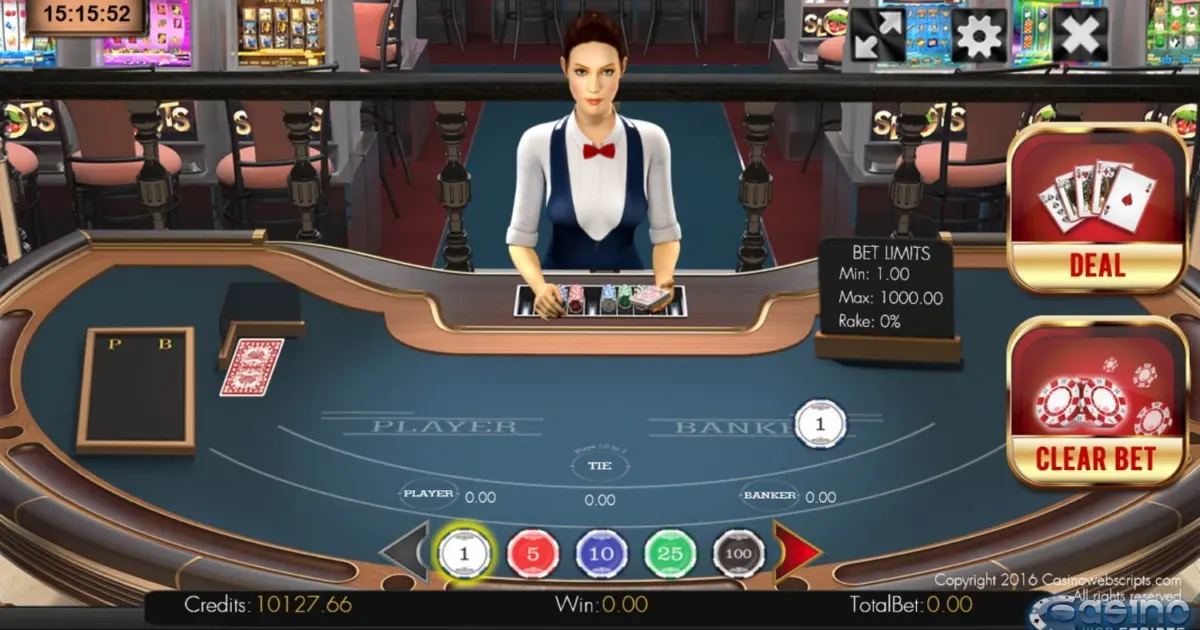
The “3D Dealer” label points to a digitally rendered dealer at a virtual table rather than a real person on a video feed. That means faster rounds, no waiting for other players, and no bandwidth demands of a live stream. It also means you are playing against a freshly shuffled virtual shoe every round — there is no physical shoe to “read,” and the bead-plate and road-map scoreboards, if present, are cosmetic only.
| Provider | Casino Web Scripts |
|---|---|
| RTP | 99.0% |
| Theme | Cards |
| Free demo | Yes |
| Site-wide average RTP | 98.55% |
The 99% figure, and the assumption behind it
A 99% RTP on baccarat is a rounded figure that almost certainly applies to the Banker bet specifically, with the standard 5% commission on winning Banker hands factored in. The well-known house edges in standard 8-deck Punto Banco are roughly 1.06% on Banker, 1.24% on Player, and around 14–15% on Tie. A published 99% RTP aligns with the Banker number (100% minus ~1.06% ≈ 98.94%, rounded to 99%).
What this means practically: for every $100 wagered on Banker over a very large sample, the expected return is about $99. The Player bet will return slightly less — roughly $98.76 per $100 over the long run — and the Tie bet, depending on the payout offered (8:1 or 9:1), returns far less. Casino Web Scripts has not published the exact Tie payout for this table, and the difference between 8:1 and 9:1 moves the house edge by several percentage points, so check the paytable before you bet on it.
The 99% figure also assumes you are not chasing streaks, doubling after losses, or using any progression system. No staking pattern changes the expected value of a fixed-edge bet. Flat-betting Banker every round is the closest thing to an optimal approach, and even that simply minimises the rate at which the house edge chips away at your bankroll.
How the third-card rules actually work
In Punto Banco — which is what this game is — neither the Player nor the Banker makes any decision about drawing cards. The tableau is fixed: if the Player’s total is 0–5, a third card is dealt; on 6 or 7, the Player stands. The Banker’s draw depends on the Banker’s own total and the value of the Player’s third card, if one was drawn. These rules are identical across virtually every Punto Banco table in the world, and they give the Banker hand a slight structural edge because the Banker draws last and can react to the Player’s third card.
This built-in advantage is the reason the Banker bet carries a commission — without it, the Banker bet would simply be the best bet on the table by an even wider margin. With the 5% commission, Banker still comes out ahead at roughly 1.06% house edge, compared to 1.24% on Player. You do not need to memorise the drawing rules to play; the software handles all of it. But understanding that these rules exist — and that they are the same on every Punto Banco table — is useful when someone tries to sell you a “system” based on reading the third-card pattern.
Side bets: the maths behind the temptation
FACTS does not list any side bets for Baccarat 3D Dealer, and Casino Web Scripts has not published a side-bet menu for this title. If the game does offer them — Player Pair, Banker Pair, Perfect Pair, Dragon Bonus and similar — the house edge on those bets is typically much worse than the main bets, often in the 5–15% range or higher. Side bets exist because they are profitable for the house, not because they are profitable for the player.
The main-game comparison is useful context. A standard Banker bet at 5% commission carries roughly a 1.06% edge; a Tie at 8:1 carries roughly 14.36%. Even the “best” common side bet (Banker Pair, at around 10% house edge) is nearly ten times worse than betting Banker. If you want to stretch a demo bankroll and see how the game plays, stick to Banker and Player bets. If side bets are available, treat them as entertainment cost, not a strategy.
Variance at the baccarat table
Baccarat is a low-variance game compared to most casino offerings, and that is the main reason the published RTP is meaningful — you do not need millions of hands to see results cluster near the expected value. Banker and Player bets both pay even money (minus commission on Banker), so individual wins and losses are small relative to your stake. The standard deviation per hand is roughly 0.93 units, which is similar to a coin flip with a slight tilt.
Tie bets are the exception: they pay 8:1 or 9:1, which means long stretches of losses punctuated by occasional large wins. That is high variance, and combined with the worst house edge on the table, it makes Tie a poor choice for anyone trying to make a demo bankroll last. If you are playing the free demo to understand the game’s rhythm, flat-betting Banker or Player will give you the smoothest ride and the most accurate feel for the published RTP.
Playing responsibly
Baccarat is a game of fixed maths — the house edge is always there, and no pattern, streak, or system changes that. Set a budget before you play, treat demo credits as a learning tool rather than a preview of real-money results, and stop when the budget is gone. This is entertainment you pay for, not a source of income. If gambling stops being fun, step away. 18+.
Verdict on Baccarat 3D Dealer
Baccarat 3D Dealer is a solid, no-frills RNG baccarat with a published 99% RTP that sits above the corpus average and aligns with the best standard Banker-bet maths in the game. The 3D presentation is a cosmetic step up from flat digital tables, and the lack of live-dealer overhead means faster rounds and no waiting. If you want something with a slightly higher published RTP, HitMe! Baccarat comes in at 99.5%, and Multiplayer Baccarat offers a different social angle if you prefer a shared table. For pure, clean Punto Banco with a verified edge, this Casino Web Scripts title does the job.
Frequently Asked Questions
Can I play Baccarat 3D Dealer for free without downloading anything?
Yes. The free demo is available directly in-browser with no download required. Casino Web Scripts' titles run on standard HTML5, so you can test the game on desktop or mobile before committing any real money.
What is the RTP of Baccarat 3D Dealer, and which bet does it apply to?
The published RTP is 99%, which almost certainly applies to the Banker bet with the standard 5% commission. The Player bet runs slightly lower (around 98.76%), and the Tie bet is significantly worse depending on the payout offered.
Which bet — Banker, Player, or Tie — is the best value?
Banker is the best standard bet in baccarat by a consistent margin, with a house edge of roughly 1.06% after commission. Player is close behind at about 1.24%, while Tie carries a house edge of approximately 14% or more, making it the worst-value standard bet by a wide margin.
Does tracking patterns on the scoreboard help me predict the next hand?
No. Baccarat 3D Dealer is an RNG game that draws from a freshly shuffled virtual shoe each round. Previous outcomes have no mathematical influence on the next hand, so scoreboards and road maps are purely cosmetic.
How does Baccarat 3D Dealer compare to HitMe! Baccarat?
HitMe! Baccarat carries a published RTP of 99.5%, half a percentage point higher than Baccarat 3D Dealer's 99%. Both are digital Punto Banco games, but the RTP difference — while small per hand — compounds over extended play, making HitMe! Baccarat the tighter mathematical choice.