This is a plain digital baccarat table from a provider with only two baccarat titles in its range, and the honest headline is that Habanero has not published an RTP figure, a paytable or table limits for it. A free demo is available, which is the sensible way to see the actual numbers before you commit anything. If you already know that Banker is the bet worth making, there is nothing here that will surprise you.
Baccarat (Habanero) in one minute
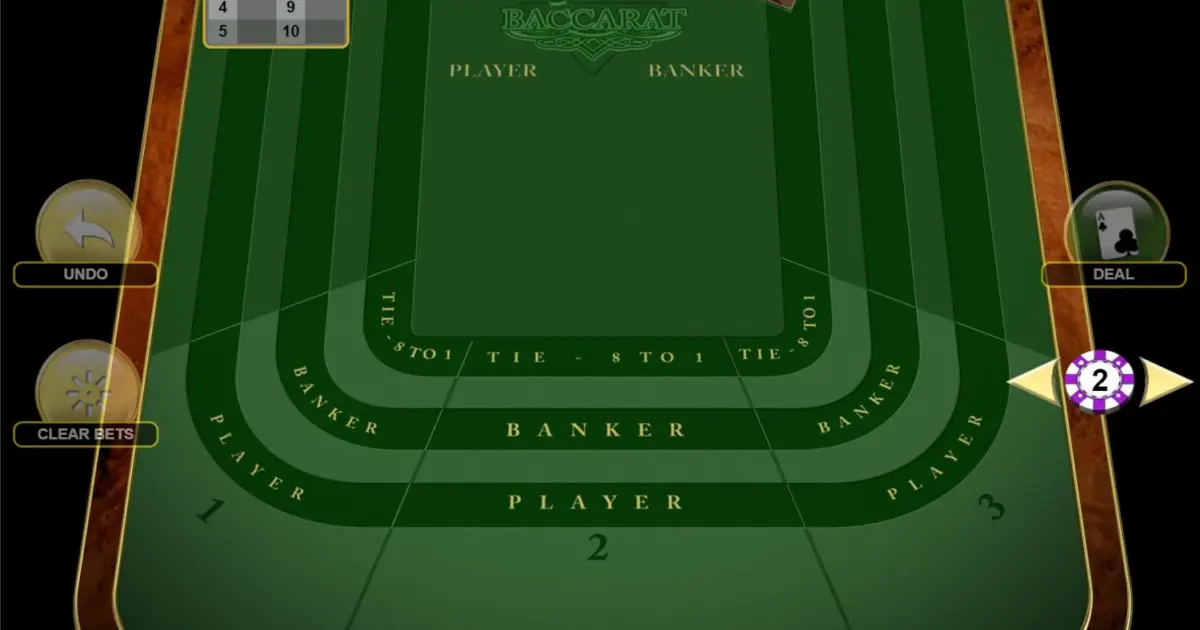
Baccarat (Habanero) is a digital, RNG-driven version of Punto Banco. You place one of three bets — Banker, Player or Tie — and then you stop making decisions. Both hands are dealt to a fixed tableau of drawing rules, so whether a third card comes out is not your call and never was. That is the whole game loop.
What Habanero has not published for this specific table is the part that matters: the exact RTP or house edge, the Tie payout, whether any commission applies to winning Banker bets, the minimum and maximum stakes, and whether pair side bets are offered. None of that appears in the available information. The game’s name gives you nothing either — it is simply “Baccarat”, with no format hint such as “Speed”, “Zero Commission” or “Multiplayer” attached.
The practical consequence is that you need to open the rules or paytable screen inside the game itself before you place a real-money bet. Two of the missing numbers, the Tie payout and the commission structure, move the house edge on those bets by whole percentage points. Everything below is written around that gap, using the fixed maths of baccarat itself where table-specific figures do not exist.
Return to player: not published
There is no RTP figure for this table. Habanero has not made one public, and inventing a plausible number would be worse than useless to you, because the range of legitimate answers in baccarat is wide and depends entirely on which bet you place.
Here is the useful way to think about it. Baccarat does not really have one RTP — it has three, one per bet, and they sit far apart. In a standard eight-deck Punto Banco shoe with the usual 5% commission on winning Banker bets, the house edge is roughly 1.06% on Banker, about 1.24% on Player, and somewhere around 14.36% on Tie depending on whether the Tie pays 8:1 or 9:1. Those are the well-known general figures for the standard game, not confirmed numbers for this table.
So the RTP you actually experience is a function of your bet selection, not of some single headline percentage. For context, the average across the baccarat tables catalogued on this site is 98.55%, which is broadly consistent with players sticking to the two main bets. If this table follows standard rules, Banker play lands you near the best return available anywhere in a casino. If it uses a non-standard Tie payout or an unusual commission, the numbers shift, and only the in-game rules screen can tell you which.
Banker vs Player vs Tie: picking a bet you understand
There are three bets and no decisions after that, so bet selection is the entire skill component of baccarat. Fortunately it is a short lesson.
| Bet | Typical payout | Approximate house edge (standard 8-deck game) |
|---|---|---|
| Banker | 1:1 less 5% commission | About 1.06% |
| Player | 1:1 | About 1.24% |
| Tie | 8:1 or 9:1 | Roughly 14.36%, varying with the payout |
Banker wins slightly more often than Player because the drawing tableau lets the Banker hand act second, with information about the Player’s third card. The 5% commission is the casino clawing part of that advantage back, and it does not claw all of it back — which is why Banker remains the better of the two even after you pay it. That is a fixed feature of the rules, not a promotion.
Tie is a different category of bet. At either common payout it costs more than ten times what Banker does per unit staked, and its rarity means long dry stretches. It is not a trap so much as a very expensive lottery ticket bolted onto a low-edge game.
If pair side bets appear when you open this table, treat them the same way — Player Pair, Banker Pair and similar wagers all carry far worse edges than the main three, and none of them are listed in the information available for this game.
Live, multiplayer or RNG — what the format changes and what it doesn’t
This is a digital, software-driven table, not a live-dealer stream. That distinction changes the experience and one important assumption.
An RNG baccarat table draws from a freshly shuffled virtual shoe every round. There is no physical deck being depleted, no cut card approaching, nothing to count down. Any scoreboard, bead plate or big-road display the game shows you is decoration: a record of what already happened, with no bearing on the next hand. Shuffle tracking and pattern reading do not function against a fresh shoe, because the previous round leaves no trace in the next one.
What the format does not change is the maths. Live dealer, multiplayer, speed variants and RNG tables all run the same Punto Banco tableau, so Banker’s structural edge over Player is identical across all of them. Presentation differs — a shared table with other players, a human dealer on video, faster round timing — but the odds attached to each bet come from the drawing rules, not the delivery method.
Practically, an RNG table like this one suits you if you want to set your own pace, play single-handed, and not wait on a table full of other people. If atmosphere is what you are after, a live table is the better fit, at identical odds.
Common baccarat mistakes
Two mistakes account for most of the money lost unnecessarily at a baccarat table.
- Chasing Tie. The payout looks generous next to two even-money bets, and that is precisely how the edge gets buried. At roughly fourteen percent against you, occasional Tie bets are the fastest way to turn a low-edge game into a high-edge one. Sprinkling small Tie stakes across a session does not diversify anything; it just raises your average cost per hand.
- Ignoring the commission. Some players avoid Banker because paying 5% on a win feels like a penalty. It is not — the commission exists because Banker wins more often, and the net result still favours Banker over Player. Skipping Banker to dodge the fee means voluntarily taking the worse of the two main bets.
A third habit worth naming: reading the scoreboard for streaks. Calling a shoe hot, cold or due describes nothing real on an RNG table, and no staking pattern — Martingale, flat progression, doubling after a loss — changes the expected value of a bet with a fixed house edge. Progressions redistribute when your losses arrive, not whether they do.
Trying the demo first
A free demo is available for this table, and given how much is unpublished, using it is the obvious first step. Open the rules screen and note four things: the Tie payout, whether a commission applies to Banker wins and at what rate, the stake range, and whether any side bets are on offer. Those four answers tell you almost everything the missing RTP figure would have told you. This Baccarat (Habanero) free demo costs nothing and needs no download, which makes it a cheap way to close the information gap.
What the demo cannot do is forecast results. Demo hands are not a preview of how a real-money session will go, in either direction — the sample is short and the outcomes are independent of anything that happens later with real stakes.
Baccarat is 18+ entertainment you pay for, not a way to earn. Decide what a session is worth to you before you start, treat that figure as the price of the entertainment, and stop when it is spent rather than when it feels like something is about to turn around.
Who should play Baccarat (Habanero)
This table suits a player who wants the simplest low-edge game in the casino, at their own pace, without a live stream or other players setting the tempo. Bet Banker, ignore the scoreboard, and you are playing close to the best odds available in any pit — assuming the rules screen confirms standard commission and payouts.
It is a weaker fit if you want confirmed numbers before you deposit. Habanero publishes little here, and its baccarat range runs to just two titles. If a published figure matters to you, Baccarat – Punto Banco lists a 98.77% RTP, and Baccarat Supreme a lower 95.65%, which is a useful reminder that baccarat tables are not interchangeable.
If the 5% commission is what puts you off Banker, look at Baccarat Zero Commission, Habanero’s other baccarat table — commission-free formats typically pay a winning Banker six at 1:2 instead of even money, which changes the edge calculation rather than removing it. Check its paytable too.
Frequently Asked Questions
Can I play Baccarat (Habanero) for free?
Yes, a free demo is available, and it is the sensible place to start with this table. Because Habanero has not published the RTP, Tie payout, commission rate or stake limits, the demo is where you can open the rules screen and read those numbers for yourself before risking real money.
What is the RTP of Baccarat (Habanero)?
Habanero has not published an RTP figure for this table. Baccarat effectively has three returns rather than one, tied to the bet you pick: in a standard eight-deck game the house edge runs about 1.06% on Banker, 1.24% on Player and roughly 14.36% on Tie. Confirm the paytable in-game.
Which bet gives the best value, Banker, Player or Tie?
Banker, in the standard game. The drawing rules give the Banker hand a structural advantage because it acts second, and the usual 5% commission only partly offsets that — leaving Banker at roughly 1.06% house edge against about 1.24% for Player. Tie, at roughly 14.36%, is far worse than both.
Does tracking previous results or using a betting system help here?
No. This is an RNG table, so each round draws from a freshly shuffled virtual shoe and previous hands leave no trace in the next one. Scoreboards and bead plates record history without predicting anything. Staking systems such as Martingale change when losses land, not the fixed house edge on each bet.
How does it compare to Baccarat Zero Commission?
Baccarat Zero Commission is Habanero's only other baccarat title, and its name points to a commission-free format. Those variants typically pay a winning Banker hand on a six at 1:2 instead of even money, which alters the edge rather than eliminating it. Neither table has a published RTP, so check both paytables.