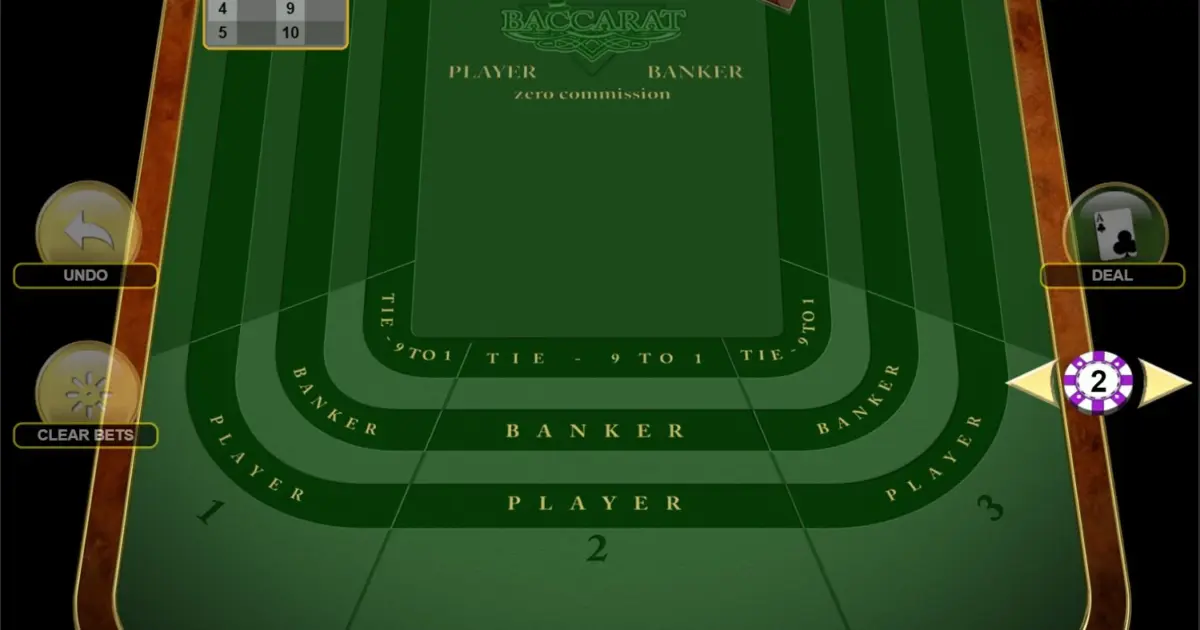
Baccarat Zero Commission from Habanero is worth a look if you want standard Punto Banco rules without the usual 5% cut on winning Banker bets. It strips away the commission structure and replaces it with a modified payout on one specific outcome, which keeps the house in profit while letting you skip the mental arithmetic of commission on every hand. The free demo is available on this site, so you can check the exact paytable before risking anything.
Baccarat Zero Commission and the Habanero table range
Habanero runs a small baccarat catalogue — this title plus Baccarat (Habanero), which follows the more conventional commission structure. The two tables sit side by side in the provider’s lobby, and the key difference is exactly what the names suggest: one charges the standard 5% on a winning Banker hand, the other does not but adjusts the payout on a specific outcome to compensate. If you prefer the familiar commission model, the standard Habanero baccarat is there; if you want to avoid per-hand commission calculations, this is the variant to pick. Both run on the same engine and share Habanero’s interface, so switching between them costs you nothing in terms of learning curve.
| Provider | Habanero |
|---|---|
| Free demo | Yes |
| Site-wide average RTP | 98.55% |
The RTP figure, and the assumption behind it
Habanero has not published a confirmed RTP for this specific table, and that omission matters more here than it would on a slot. In standard 8-deck Punto Banco the well-known house edges are roughly 1.06% on Banker, 1.24% on Player, and around 14.36% on Tie at 8:1 — but those numbers assume a 5% commission on Banker. When you remove that commission and instead pay a reduced amount on a Banker win at 6 (typically 1:2 instead of even money), the edge on Banker shifts upward and the overall RTP moves in a different direction. Without the published paytable confirming the exact Tie payout and the Banker-on-six rule, you cannot pin the RTP to a single number. Check the game’s own rules screen during demo play — it will show the payout table — and treat any RTP figure you see elsewhere as approximate until it matches what the screen actually says.
How the third-card rules actually work
Baccarat’s drawing rules are fixed by the tableau and leave the player with no decisions after placing a bet. The Player hand draws a third card on totals of 0–5 and stands on 6 or 7; 8 and 9 are naturals and no further cards come out. The Banker’s draw depends on both its own total and the Player’s third card, following a lookup table that gives the Banker a built-in statistical edge. That edge is why Banker is the best-value standard bet even after commission in regular baccarat — and it is also why commission-free variants like Baccarat Zero Commission must adjust the payout on at least one outcome to stay viable. In this game, the adjustment typically lands on a Banker win at a total of six, which pays 1:2 instead of even money. You do not need to memorise the tableau; the software applies it automatically. What you do need to understand is that removing commission does not remove the house edge — it just relocates it.
Side bets: the maths behind the temptation
The FACTS for this table do not list any confirmed side bets, so I cannot tell you which ones — if any — appear on the layout. That is actually useful information: many commission-free baccarat tables ship without side bets, which keeps the game closer to the pure three-bet structure. If side bets are present, treat them as separate wagers with their own house edges, which are almost always far worse than the main bets. Player Pair, Banker Pair, Perfect Pair, and Dragon Bonus are common in the baccarat ecosystem, and they typically carry edges in the 5–11% range — several times worse than either main bet. The absence of confirmed side-bet data means you should open the rules screen, look for any additional wagering options, and check their individual paytables before placing them. A baccarat table without side bets is not a limitation; it is a simplification that keeps your expected loss closer to the core game’s edge.
Variance at the baccarat table
Baccarat is a low-variance game compared to slots or even blackjack, and that holds true for Baccarat Zero Commission. The Banker and Player bets both have close to a 50% hit rate (Banker wins slightly more often, around 45.8% of resolved hands in standard play), so your bankroll tends to move in small increments rather than sharp swings. The Tie bet is the exception — it hits roughly 9.5% of the time but pays at a ratio that leaves the house with a large edge, making it the highest-variance, worst-value standard bet in the game. In this commission-free format, the modified payout on a Banker-six win adds a small extra wrinkle: a hand you would have won at even money under standard rules now pays half, which creates a slightly different variance profile on Banker bets. Over a long session the effect averages out, but in a short session it can feel like a drag. If you compare this to Baccarat Supreme, which carries a published RTP of 95.65%, or to Baccarat – Punto Banco at 98.77%, you can see that the RTP range across baccarat tables is real and worth paying attention to — though the exact figure for this table remains unconfirmed until you check the rules screen.
Playing responsibly
Baccarat is entertainment with a built-in cost, not a source of income. Set a budget before you start — an amount you are comfortable losing — and stop when it is gone. The free demo lets you explore the game at zero cost, but real-money play should never be a way to chase losses or fund other expenses. If gambling stops being fun, step away. You must be 18 or older to play.
Verdict on Baccarat Zero Commission
Baccarat Zero Commission does exactly what it promises: it removes the 5% commission on winning Banker bets and compensates with a reduced payout on a specific outcome, most likely a Banker win at six. The core maths of Punto Banco still apply — Banker remains the best-value standard bet, Player is close behind, and Tie is a trap by comparison. The main gap in this review is the unconfirmed RTP and the exact payout table, which Habanero has not published for this title. That is not unusual for a commission-free variant, but it means you should open the free demo, read the rules screen, and confirm the numbers before you bet real money. If you want a commission-free baccarat experience from a lightweight, mobile-friendly provider, this table delivers the format — just verify the paytable first.
Frequently Asked Questions
Can I play Baccarat Zero Commission for free?
Yes — the free demo is available on this site with no download required. It lets you check the paytable, test the interface, and get comfortable with the third-card rules before you consider real-money play.
What is the RTP of Baccarat Zero Commission?
Habanero has not published a confirmed RTP for this table. Standard commission-free baccarat usually sits in the 97–98% range depending on the Banker-on-six payout, but you should confirm the exact figure on the game's rules screen during demo play.
Which bet is the best value — Banker, Player, or Tie?
Banker is mathematically the best standard bet in baccarat even in this commission-free format, because the drawing rules give the Banker hand a built-in edge. Player is close behind, while Tie carries a house edge roughly ten to fourteen times larger and should be avoided.
Does removing the commission change the house edge?
It does not remove it — it relocates it. Commission-free baccarat typically pays a reduced amount on a Banker win at six (often 1:2 instead of even money), which keeps the house in profit while eliminating per-hand commission calculations.
How does Baccarat Zero Commission compare to Baccarat - Punto Banco?
Baccarat - Punto Banco from a different provider carries a published RTP of 98.77%, while this table's RTP is unconfirmed. Both follow standard Punto Banco rules, but the commission structure differs — verify the paytable on each before choosing which to play.