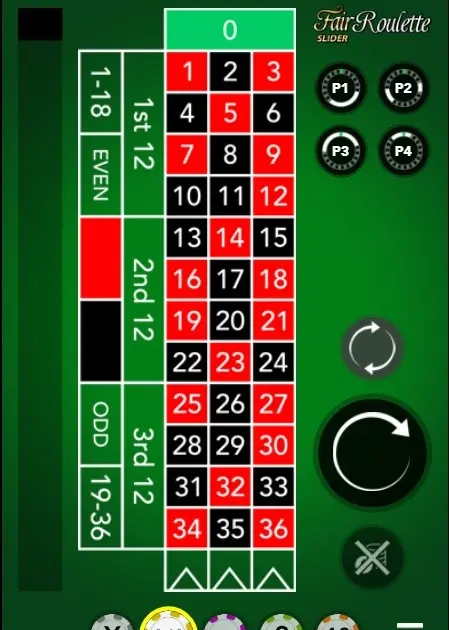
The fair roulette slider is worth a look if you want a table with a published return figure rather than a guess: Worldmatch lists it at 97.3% RTP, against a site-wide roulette average of 96.97%. The catch is that the material available for this review does not say how many pockets the wheel has, and on a roulette table that is the number that determines your cost per spin. There is a free demo, so you can answer that question yourself in about thirty seconds before any money is involved.
How Fair Roulette Slider plays
The core loop of any roulette table is the same and this one will not surprise you. You place chips on the layout, the wheel spins, a ball settles in one pocket, and every bet that covers that pocket pays at a fixed rate. Nothing you do between spins changes the odds of the next one.
What the available data does confirm is the practical stuff. Worldmatch is the developer, and it has 13 games listed here with an average RTP of 96.51%, so this table sits above its own studio’s typical figure. A free demo is available, which matters more for roulette than for most game types: the demo is where you read the rules screen, count the pockets, check the minimum and maximum on each bet position, and see whether there is a racetrack for call bets.
What the data does not tell us is anything about the wheel’s specific configuration. There is no information here on pocket count, no confirmation of La Partage or En Prison, no stated table limits, no listed side bets or multipliers, and no release date. Those absences are not a judgement on the game. They just mean the rules screen, not this page, is your source for them.
The pocket count is the whole story
Everything about the cost of playing roulette comes from one gap. On a single-zero European wheel there are 37 pockets, so the true odds against any one number are 36 to 1. The table pays 35 to 1. That one-pocket difference is the entire house edge, and it works out at 2.70% on every standard bet on the layout.
Add a second zero and you get 38 pockets. True odds against a single number become 37 to 1, the payout stays at 35 to 1, and the edge more than doubles to 5.26%. The five-number basket bet available only on the American layout is worse again at 7.89%. Same-looking table, same-looking chips, roughly double the long-run cost.
French rules change the picture in the player’s favour. Where La Partage or En Prison applies, a zero returns half your even-money stake instead of taking all of it, which drops the even-money house edge to about 1.35% — the lowest figure available on any standard roulette bet anywhere.
The name of this game does not tell you which of those three you are getting, and neither does the data supplied here. Open the demo and count.
Reading the 97.3% figure
97.3% RTP means that over a very large number of spins the table is modelled to return 97.30 units for every 100 staked, leaving a 2.70% house edge. That figure is arithmetically identical to the standard European single-zero wheel, which is a meaningful clue about the configuration, but a published RTP number is not the same as a confirmed pocket count and it does not by itself rule out other structures. Verify it against the rules screen.
Context helps. The site’s roulette corpus averages 96.97% RTP, so this table is 0.33 percentage points above that. Worldmatch’s own catalogue averages 96.51%, so this is one of the studio’s stronger listings on paper. In practical terms, 2.70% versus 5.26% is the difference that actually shows up in a bankroll over a long session; a third of a percentage point is real but modest.
Two things the number cannot do. It cannot predict any individual session, because short-run results are dominated by variance. And it cannot tell you what happens on non-standard bets if this table has any, since multiplier formats fund their big payouts by trimming the base straight-up return and must be read from their own paytable.
Choosing bets for the session you want
On a single-zero wheel every standard bet carries the same 2.70% edge. Choosing between them changes how bumpy the ride is, not what it costs you on average. Here is the shape of that trade-off on a European layout.
| Bet | Pockets covered | Payout | True odds |
|---|---|---|---|
| Straight up | 1 of 37 | 35:1 | 36:1 |
| Split | 2 of 37 | 17:1 | 17.5:1 |
| Street | 3 of 37 | 11:1 | 11.33:1 |
| Corner | 4 of 37 | 8:1 | 8.25:1 |
| Dozen / column | 12 of 37 | 2:1 | 2.08:1 |
| Red / black, odd / even | 18 of 37 | 1:1 | 1.06:1 |
If you want a long, slow session on a fixed budget, even-money bets land a bit under half the time and keep swings small. If you want the chance of a large payout and accept losing most spins, straight-up numbers do that. Both cost the same per unit staked. Worldmatch also lists Fair Roulette at the same 97.3% figure if you want to compare layouts side by side, and Ecuruleta at 94.73% shows how far the return can drop between tables that look similar.
Martingale and friends: the honest answer
No betting system improves your expected result. Not Martingale, not Fibonacci, not D’Alembert, not waiting for five reds before backing black. This is not a matter of opinion or of finding the right variation.
The reason is that spins are independent. The wheel has no memory and an RNG wheel has no physical bias to track, so the probability of red on the next spin is exactly what it always was regardless of what the last twenty spins did. No number, colour or sector is ever due, hot or cold. Recording previous results has no predictive value here.
What progressions actually do is move variance around. Martingale doubles after each loss, which converts many small wins into a smaller number of large losses. The expected value stays negative and unchanged; you have simply arranged for your losses to arrive in bigger lumps. Table maximums and bankroll limits cap the progression, so the run of bad luck that breaks it arrives sooner than the maths of infinite doubling suggests. Since the limits on this table are not documented in the data available here, the ceiling on any progression is unknown until you check.
Bankroll and table limits
Set your session budget before you open the game, and size your unit against it rather than against the minimum bet. A rough guide on even-money bets: expect stretches of six or eight losses in a row across a normal session, because at slightly under half a chance per spin those runs are ordinary rather than unusual.
Table limits are the other half of the calculation and this data set does not include them. Minimums and maximums matter because they set both the smallest sensible bankroll and the point at which any staking plan stops working. Inside and outside bets often carry different maximums too. Check both in the demo before you decide what a session costs.
Roulette is 18+ entertainment, not a way to make money. Decide in advance what you are willing to spend, treat that amount as the price of the entertainment, and stop when it is gone rather than raising stakes to recover it. Demo play uses no real money and its results tell you nothing about how a real-money session will run.
Verdict on Fair Roulette Slider
The published 97.3% return is the strongest thing about this table. It sits above both the Worldmatch average of 96.51% and the site roulette average of 96.97%, and it matches the arithmetic of a single-zero wheel, which is the configuration you want. That said, ranked 199th and in the 11.2th popularity percentile, this is not a heavily played table, and Worldmatch’s Instant 3D Roulette offers the same 97.3% figure if you prefer a different presentation.
The honest caveat is how much is undocumented here: pocket count, French rules, table limits, call bets. None of that is hidden from you, it just is not in this data set, and all of it is visible on the game’s own rules screen. Use the free demo to confirm the wheel type and the limits, then decide. If it is a genuine single-zero wheel with the 2.70% edge that 97.3% implies, it is a reasonable place to play.
Frequently Asked Questions
Can you play Fair Roulette Slider free with no download?
Yes. A free demo of Fair Roulette Slider is available and runs in the browser, so there is no download or deposit involved. Use it to check the things this review cannot confirm: the pocket count, the table minimum and maximum, and whether any special rules apply on zero. Demo results do not predict real-money outcomes.
What is the Fair Roulette Slider RTP?
Worldmatch lists Fair Roulette Slider at 97.3% RTP, meaning a modelled 2.70% house edge over the long run. That is 0.33 points above the site's roulette average of 96.97% and well above the Worldmatch catalogue average of 96.51%. RTP describes long-run averages only and says nothing about any single session.
Is Fair Roulette Slider a European or American wheel?
The data available for this review does not confirm the pocket count, so you should check the rules screen. It matters a lot: 37 pockets means a 2.70% house edge on standard bets, while 38 pockets means 5.26%. The published 97.3% return matches single-zero arithmetic, but confirm it in the demo before betting.
Does the Martingale system work on Fair Roulette Slider?
No. Spins are independent and the wheel has no memory, so no progression changes expected value. Martingale only reshapes variance, trading frequent small wins for occasional large losses, and table maximums cut it short. Since this table's limits are not documented here, check them in the demo if you were counting on any staking plan.
Who makes Fair Roulette Slider and what else do they offer?
Worldmatch developed it, and the studio has 13 games listed here at an average 97.3% RTP for its strongest tables and 96.51% overall. Its closest comparison is Fair Roulette, listed at the same 97.3% figure, while Ecuruleta sits much lower at 94.73%. Return figures vary widely within one studio's catalogue.




