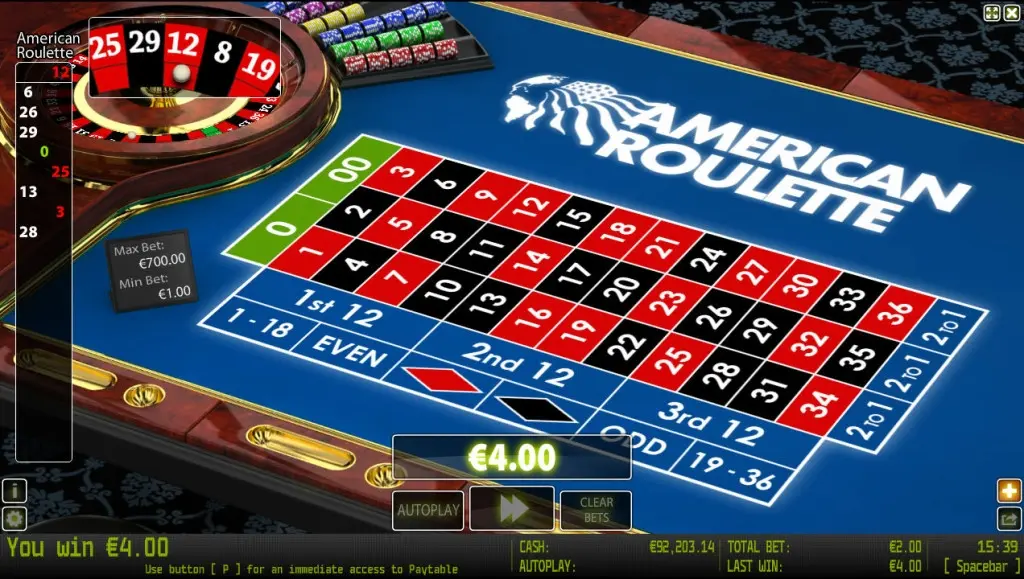
American Roulette Pro sits well below the average roulette table in both return and popularity. Its 94.73% RTP matches the expected output of a double-zero wheel, which means the maths behind every spin works against you at roughly twice the rate of a single-zero game. If you are choosing between tables, this is the kind of difference that compounds over hundreds of spins and deserves a clear-eyed read before you commit real money.
American Roulette Pro at a glance
Worldmatch built this table, and the provider runs thirteen titles in total with an average RTP of 96.51%. American Roulette Pro falls below even its own provider’s average, trailing the broader roulette corpus average of 96.97% by 2.24 percentage points. Its popularity percentile of 11.7 confirms that few players seek it out over alternatives. A free demo is available, so you can examine the layout and rules without depositing. The title’s rank of 198 reflects that thin interest. Nothing here is hidden or misleading — the game simply presents the harder version of the wheel and tells you so through its RTP figure.
Which wheel is this, and what it costs you
The name “American” is a strong hint that this table uses a 38-pocket wheel with both 0 and 00, which would carry a house edge of 5.26% on every standard bet. The published RTP of 94.73% is consistent with that — 100 minus 5.26 equals 94.74, and rounding accounts for the tenth of a percent gap. However, the name alone is not a rule. Check the in-game help screen for the actual pocket layout and confirm the double-zero is present before assuming the 5.26% figure applies to your session.
For context, a European single-zero wheel has 37 pockets and a 2.70% house edge. The extra pocket is the entire difference between those two figures. On a double-zero wheel, the five-number basket bet (0, 00, 1, 2, 3) is even worse at 7.89% and should be avoided entirely if your rules screen confirms it exists.
What a 94.73% RTP means per spin
RTP of 94.73% means that over a very large number of spins, the game retains 5.27 pence of every pound you wager. That is a long-run average across all bet types. A single session of fifty spins tells you nothing useful about your expected result, because variance swamps the edge at low sample sizes. What the figure does tell you is directional: every hundred pounds you place through this table’s long run returns roughly ninety-four pounds and seventy-three pence. If you compared this to a Fair Roulette at 97.3% RTP, you would be giving up 2.57 percentage points of return on every pound wagered. That gap is the cost of choosing a double-zero wheel, not a bonus feature or a multiplier format.
Inside versus outside bets
On a 38-pocket American wheel, the table below shows how payouts stack against true odds. No bet type escapes the house edge — inside and outside bets differ only in how variance is distributed, not in expected value.
| Bet type | Pays | True odds (38 pockets) | House edge |
|---|---|---|---|
| Straight-up (one number) | 35:1 | 37:1 | 5.26% |
| Split (two numbers) | 17:1 | 18:1 | 5.26% |
| Corner (four numbers) | 8:1 | 8.5:1 | 5.26% |
| Dozen / Column | 2:1 | 2.166:1 | 5.26% |
| Even money (red/black, odd/even) | 1:1 | 1.055:1 | 5.26% |
| Five-number basket (0, 00, 1, 2, 3) | 6:1 | 6.6:1 | 7.89% |
The straight-up payout of 35:1 against true odds of 37:1 is where the entire house edge lives on inside bets. Outside bets pay the same edge through a different mechanism: you win slightly less often than the payout implies. The five-number basket is strictly worse than every other option on this wheel because the payout was set as if the wheel had 37 pockets.
Compare this to Instant 3D Roulette at 97.3% RTP, which almost certainly runs a single-zero wheel and therefore halves your expected loss per spin.
Why no betting system changes the maths
Each spin on an RNG roulette table is independent. The wheel has no memory. A run of ten reds does not make black more likely on the eleventh spin, and no sequence of previous results gives you information about the next one. This is not opinion or convention — it follows from the design of the random number generator and the fixed paytable.
Martingale, Fibonacci, D’Alembert, and “wait for the streak to break” systems redistribute when you win and when you lose. They do not change the expected value of any bet, because the house edge is baked into the payout ratio. Progressions increase your average stake per round, which means they accelerate how quickly you approach table limits and deplete your session budget. The five-number basket at 7.89% is already the worst available; doubling your exposure to it through a progression simply loses money faster. The best decision you can make about systems is to not use one.
Playing the American Roulette Pro demo
The demo is free and requires no download. You can confirm the wheel layout, read the paytable, and check whether French rules (La Partage or En Prison) are listed — on a double-zero table they typically are not, but verify this in the game’s own rules screen rather than assuming. Demo play lets you observe variance and understand how quickly your virtual balance moves at this edge, but it does not predict your real-money results because the RNG does not “know” you were practising.
Play for entertainment, never as income. Set a loss limit before you begin, stick to it, and treat any session over 18 only. If roulette stops feeling like a game and starts feeling like a problem, help services are available and the right decision is to stop.
If you are exploring Worldmatch’s catalogue, Ecuruleta carries the same 94.73% RTP figure, suggesting a similar wheel configuration. That makes the provider’s Fair Roulette at 97.3% the clear upgrade for any player choosing within this catalogue.
Verdict
94.73% RTP places American Roulette Pro in the lowest tier of roulette available on this site. If the double-zero wheel is confirmed in-game, you are accepting a 5.26% house edge on every bet except the basket, where it rises to 7.89%. No feature, theme, or presentation change offsets that structural disadvantage. The game exists as a faithful American-layout simulation, and players who specifically want that format (or are researching table-limit behaviour under a high edge) will find it serviceable. For anyone comparing roulette options purely by return, a single-zero table is available from the same provider at 97.3%. The demo costs nothing, so use it to see the layout for yourself before you decide.
Frequently Asked Questions
Is American Roulette Pro free to play?
Yes, a free demo is available with no download required. You can play the full interface with virtual credits to examine the wheel layout, confirm the paytable, and observe how the double-zero format behaves across a session. Demo play uses the same RNG as real money but does not predict your real-money outcomes.
What is the RTP of American Roulette Pro?
The published RTP is 94.73%, which is 2.24 percentage points below the roulette corpus average of 96.97%. This figure aligns with the expected return of a standard 38-pocket American wheel where the house edge is 5.26%. It is the lowest RTP among the Worldmatch roulette titles listed on this site.
Is American Roulette Pro on a single-zero or double-zero wheel?
The name and the 94.73% RTP both strongly indicate a 38-pocket double-zero wheel (0 and 00), which carries a 5.26% house edge. However, the name is a hint, not a confirmed rule. Check the in-game help screen for the pocket count before staking real money, since a single-zero wheel would return 97.30% instead.
Can any betting system improve my results on American Roulette Pro?
No. Each spin is independent and the RNG has no memory. Martingale, Fibonacci, and D'Alembert progressions redistribute variance without changing expected value, which is fixed at -5.26% per unit wagered on standard bets. The five-number basket bet is even worse at -7.89%. No sequence of past results predicts future outcomes.
How does American Roulette Pro compare to Fair Roulette from the same provider?
Fair Roulette offers 97.3% RTP, which corresponds to a single-zero European wheel with a 2.70% house edge. American Roulette Pro at 94.73% nearly doubles that edge. Over ten thousand spins, the 2.57 percentage point difference means Fair Roulette retains roughly half what American Roulette Pro takes. Same provider, same interface style, materially different mathematics.




