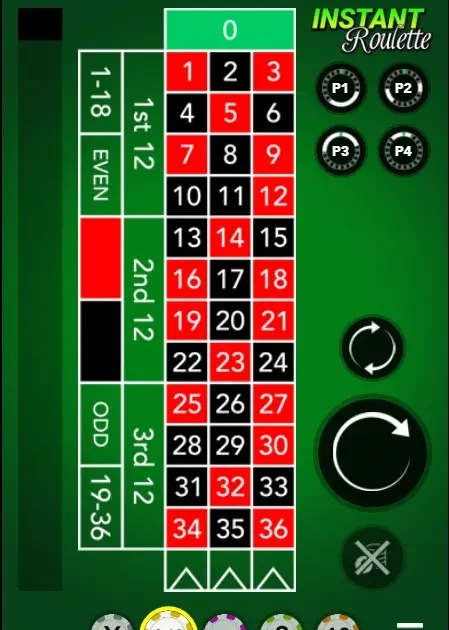
The listed return on instant roulette (worldmatch) is 97.3%, which sits above the 96.97% average across the tables in this catalogue and well above the 96.51% average of Worldmatch’s own 13 games. It is also available as a free demo, so you can read the layout and the limits without staking anything. The catch is that the wheel type is not confirmed in the data available for this page, and on a roulette table that is the detail everything else hangs from.
How Instant Roulette (Worldmatch) plays
Worldmatch builds this as a straightforward RNG table game rather than a live-dealer stream. You place chips on the layout, the spin resolves, and the result is generated by a random number generator with no physical wheel and no dealer involved. Each spin is independent of every spin before it.
The word “instant” in the title suggests a compressed spin cycle, which in RNG roulette usually means a shortened or skippable animation between bet and result. Treat that as an inference from the name, not a documented feature: the data here does not describe the animation length, an autoplay function, or a turbo toggle. Check the game’s own settings menu.
Several elements that shape a roulette session are simply absent from the information available. There is nothing here confirming whether a racetrack or call-bet overlay exists, whether neighbour bets or French call bets such as Voisins du Zero can be placed, whether favourite-bet slots can be saved, or whether any side bet or multiplier sits on top of the base game. Faster spins matter, because a compressed cycle raises the number of decisions per hour, and expected loss scales with the number of spins and the total staked, not with clock time. If you play a quick table at the same stake as a slow one, you are simply putting more money through the same edge in the same session.
The pocket count is the whole story
Roulette maths is fixed and public, so the only question that matters is which wheel you are on. A single-zero European wheel has 37 pockets and a house edge of 2.70% on every standard bet. A double-zero American wheel has 38 pockets, which pushes the edge to 5.26% on every standard bet and to 7.89% on the five-number basket bet. If French rules apply, La Partage or En Prison return half your stake on even-money bets when zero lands, cutting the even-money edge to roughly 1.35% and giving you the best standard bet in the game.
The mechanism is easy to see on a European wheel. A straight-up number pays 35:1 while the true odds against it are 36:1. That one-pocket gap between the payout and the real probability is the entire house edge, repeated across every bet on the layout in different shapes.
Nothing in the information available for this table names its pocket count, and the title itself gives no hint either way. That absence is worth acting on: the difference between 2.70% and 5.26% is roughly double the long-run cost per unit staked. Open the rules or paytable screen, count the zeros on the wheel graphic, and confirm whether a straight number pays 35:1 before you commit real money.
Reading the 97.3% figure
A listed RTP of 97.3% implies a house edge of 2.70%, which is exactly the figure for a single-zero wheel with no zero-refund rule. That is consistent with a 37-pocket European layout, and it is the strongest indirect signal available here about the wheel type. It is still an inference from an RTP figure rather than a confirmed rule, so verify it in the game.
What the number means in practice: over a very large volume of spins, the game is modelled to return 97.30 units for every 100 staked. Short sessions do not resolve to that. A few hundred spins can land far above or far below the modelled return in either direction, and no amount of play guarantees convergence within your own session.
Two comparisons help place it. Against the 96.51% Worldmatch average across its 13 titles, this table is 0.79 points better. Against the 96.97% catalogue average it is 0.33 points better. Both are meaningful over volume and invisible over an evening. Worth noting: Fair Roulette carries the same 97.3% figure, so if you want an identical modelled return with a different presentation, that is a direct swap.
Choosing bets for the session you want
On a standard wheel, every bet carries the same house edge. Switching between inside and outside bets changes the shape of your results, not their expected value. Use the table below to see how the payouts line up against true odds on a 37-pocket European wheel, which is the layout the 97.3% figure implies.
| Bet type | Numbers covered | Payout | True odds (37 pockets) | Win chance |
|---|---|---|---|---|
| Straight up | 1 | 35:1 | 36:1 | 2.70% |
| Split | 2 | 17:1 | 17.5:1 | 5.41% |
| Street | 3 | 11:1 | 11.33:1 | 8.11% |
| Corner | 4 | 8:1 | 8.25:1 | 10.81% |
| Line | 6 | 5:1 | 5.17:1 | 16.22% |
| Column or dozen | 12 | 2:1 | 2.08:1 | 32.43% |
| Red, black, odd, even, high, low | 18 | 1:1 | 1.06:1 | 48.65% |
Read the right-hand columns together. Even-money bets land just under half the time and pay small, so a bankroll lasts longer and the swings stay shallow. Straight-up bets land 2.70% of the time and pay 35:1, so most spins lose and the occasional hit is large. Pick according to how long you want the session to run and how much movement you can tolerate, not because one bet is somehow cheaper.
Martingale and friends: the honest answer
No betting system changes expected value. Not Martingale, not Fibonacci, not D’Alembert, not Labouchere, not waiting for five reds before backing black. This is not a matter of opinion or of finding the right variation. The RNG produces independent results, the wheel has no memory, and the odds on your next spin are identical whatever came before it.
What progressions actually do is redistribute variance. Martingale converts many small wins into one rare, very large loss by doubling after each loss. Seven consecutive even-money losses on a single-zero wheel happen often enough to matter, and by the eighth step a 1-unit base stake needs 128 units on that spin alone. Two things then end the sequence: the table maximum, or your bankroll. Both arrive faster than the arithmetic feels like it should.
Flat betting does not beat the edge either, but it keeps the cost predictable and it never asks you to stake an amount you did not plan for. If you arrived looking for a system that works, the useful answer is that there is not one, and the demo is a free place to watch a progression fail without paying for the lesson.
Bankroll and table limits
The minimum and maximum stakes for this table are not published in the information available here, and neither are the per-bet-type caps that most roulette games apply. This matters more than it sounds. On roulette, the maximum on even-money bets is what sets the hard ceiling on any progression, and inside bets often carry a much lower cap than outside bets. Open the limits display in the demo and note both numbers before you decide on a base stake.
Size your stake against spins rather than against money. Decide how many spins you want the session to last, divide your budget by that number, and hold the result flat. With no confirmed limits to work from, that approach at least keeps your own ceiling in your control.
This game is for players aged 18 or over. Set a budget before you start, treat it as the cost of entertainment rather than a source of income, and stop when it is spent rather than topping it up. Free demo play does not predict real-money outcomes and cannot be used to test whether a strategy will pay.
Verdict on Instant Roulette (Worldmatch)
The listed 97.3% return is the strongest thing on this page. It beats both the Worldmatch and catalogue averages, it matches the 2.70% edge of a single-zero wheel, and a free demo is available so you can confirm the details yourself at no cost.
What holds it back from an unqualified recommendation is how much is unstated. The pocket count, whether any zero-refund rule applies, the stake limits, and whether a racetrack or call bets exist are all unconfirmed in the data here. None of those is a red flag; they are just checks you should run on the rules screen first.
If you want the same modelled return with a different look, Instant 3D Roulette also lists 97.3%. If you want a contrast, Ecuruleta sits at 94.73% among Worldmatch roulettes, which is a materially worse figure over volume. At rank 193 and the 13.9th popularity percentile this is not a heavily played table, but popularity and returns are separate questions.
Frequently Asked Questions
Can I play Instant Roulette (Worldmatch) for free?
Yes. A free demo is available for this table, so you can place bets with virtual chips, read the layout, and check the rules and limits screens without staking real money. Demo results do not predict real-money outcomes, but the demo is the right place to confirm the pocket count and the payouts.
What is the Instant Roulette (Worldmatch) RTP?
The listed RTP is 97.3%. That sits above the 96.51% average across Worldmatch's 13 titles and above the 96.97% catalogue average. Over a very large number of spins the game is modelled to return 97.30 units per 100 staked, though short sessions can land well above or below that.
Which wheel does this table use and what is the house edge?
The data available here does not confirm the pocket count. A 97.3% RTP implies a 2.70% house edge, which matches a 37-pocket single-zero wheel, but that is an inference rather than a stated rule. Count the zeros on the wheel graphic and check whether a straight number pays 35:1 before betting.
Does the Martingale system work on this game?
No. Spins are independent RNG results, so no progression changes expected value. Martingale trades frequent small wins for a rare large loss: after seven even-money losses, a 1-unit base stake needs 128 units on the next spin. The table maximum or your bankroll ends the sequence first.
How does it compare to Fair Roulette by the same provider?
Both list 97.3%, so the modelled return is identical and the choice comes down to presentation and features rather than value. Ecuruleta, also from Worldmatch, lists 94.73%, which is materially worse over volume. Verify each table's wheel type and limits individually, since those are not published here.




