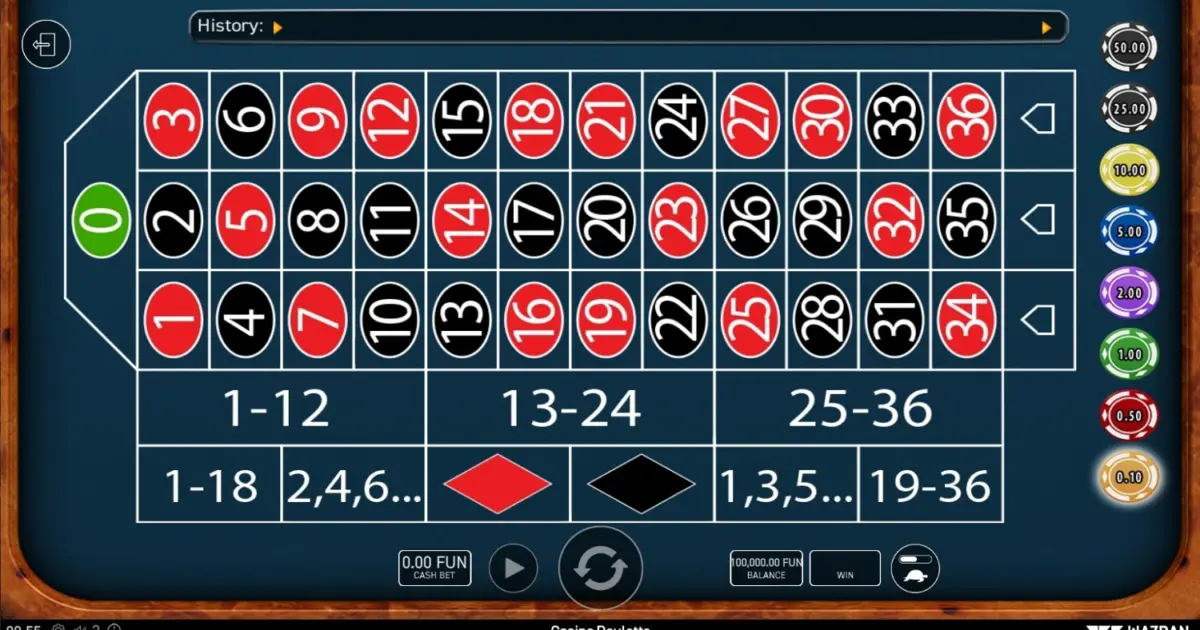
Casino Roulette (Wazdan) publishes an RTP of 97.3%, and a free demo is available, so you can open the table and read its rules screen before any money is involved. That RTP figure is the one number worth anchoring on, because in roulette the maths is fixed the moment the wheel type is settled. What FACTS does not tell you is the pocket count, and that is the first thing to check yourself.
What kind of roulette is Casino Roulette (Wazdan)?
The title is generic. It says “Casino Roulette” and names Wazdan as the studio, and nothing in that name commits to a single-zero or double-zero wheel, to French rules, or to a racetrack for call bets. So treat the wheel type as unconfirmed until you look at the game itself.
What you can do is reason from the published RTP. A 97.3% return is the exact complement of a 2.70% house edge, and 2.70% is what you get on every standard bet on a 37-pocket single-zero wheel. That correspondence is strong, but it is arithmetic, not documentation. A double-zero wheel carries a 5.26% edge on standard bets, which would show up as a 94.74% RTP, so the published figure is not consistent with an American layout.
Things the FACTS set does not cover, and which you should read off the game’s own screens: whether La Partage or En Prison applies to even-money bets when zero lands, the minimum and maximum stake per bet type, whether a racetrack is present for neighbour and section bets, and whether any side bet or multiplier feature sits on top of the base game. Each of those changes either your effective edge or how long a given bankroll lasts, and guessing at them is worse than simply checking.
Return to player and house edge
RTP and house edge are the same statement written two ways. A 97.3% RTP means the expected cost of play is 2.7% of everything you stake, over a very long run of spins. Wager 100 units across a session and the expected return is 97.3 units, not because any single spin resolves that way, but because that is the average the payout structure produces.
On a single-zero wheel that 2.70% edge is uniform. Straight-up, split, street, corner, line, column, dozen, red, black, odd, even, high, low: all of them cost the same 2.7% per unit staked. The mechanism is visible in the straight-up bet. There are 37 pockets, so the true odds against your number are 36:1, and the table pays 35:1. That single pocket of difference, spread across the whole layout, is the entire edge.
For context, the average RTP across the roulette tables covered here is 96.97%, so 97.3% sits 0.33 points above it. That gap sounds small and mostly is, but it is the difference between a single-zero and a double-zero wheel showing up in the averages, and it compounds with volume.
One caveat worth carrying: if this table does apply La Partage, even-money bets would return half your stake on zero and their edge would fall to roughly 1.35%, better than the headline RTP suggests. FACTS does not say whether it does, so do not assume it.
Reading the Wazdan paytable before you bet
Before your first real-money spin, open the rules or paytable screen and confirm four things. First, the pocket count. Count the wheel graphic or read the layout description: 37 pockets means one zero, 38 means a double zero, and that single fact fixes your edge. Second, the even-money rule on zero. If half your stake comes back, or the bet is imprisoned for one spin, you are looking at a meaningfully cheaper even-money game. Third, the payout list itself, bet type by bet type. Fourth, the table limits, both the per-bet minimum and the maximum.
Limits matter more than most players expect, because they cap the size of any recovery attempt and interact badly with progressive staking. If FACTS listed no limits for this table, that is exactly why the rules screen is the place to look rather than a review.
Wazdan has two roulette titles in this collection, and the other, Gold Roulette, also lists 97.3%, so the studio’s roulette RTP is consistent at least across those two. If you want an established single-zero reference point to compare screens against, European Roulette (Red Tiger) states its wheel type in its name and posts the same figure.
Bet coverage, variance and session length
Choosing a bet type does not change what the game costs you on a single-zero wheel. It changes how the losses and wins are distributed, which decides how long a fixed bankroll lasts and how large the swings feel. The table below shows the standard single-zero structure, which is the layout the published RTP points to.
| Bet | Pockets covered (of 37) | Payout | True odds | Win chance |
|---|---|---|---|---|
| Straight up | 1 | 35:1 | 36:1 | 2.70% |
| Split | 2 | 17:1 | 17.5:1 | 5.41% |
| Street | 3 | 11:1 | 11.33:1 | 8.11% |
| Corner | 4 | 8:1 | 8.25:1 | 10.81% |
| Line | 6 | 5:1 | 5.17:1 | 16.22% |
| Column or dozen | 12 | 2:1 | 2.08:1 | 32.43% |
| Red, black, odd, even, high, low | 18 | 1:1 | 1.06:1 | 48.65% |
Read the last column as session length. Even-money bets land just under half the time, so a bankroll drains slowly and predictably. Straight-up bets land 2.70% of the time, roughly once in 37 spins, which means long dry stretches punctuated by 36-unit returns. Neither is better value. One is a slow grind, the other is a lottery ticket with the same price tag.
Patterns, hot numbers and the gambler’s fallacy
Each spin on an RNG wheel is independent of every spin before it. The wheel keeps no record, and the software does not adjust to balance results. Whatever the history display shows, red on the next spin has the same 48.65% chance on a single-zero wheel as it did five spins ago, and every individual number has the same 2.70%.
That kills the whole family of pattern strategies. No number is due. No sector is hot or cold. Waiting for five reds before backing black does not improve anything, because the coming spin does not know the previous five happened. Tracking results can be entertaining, but it has no predictive value here.
Progressive systems fail for a different reason. Martingale, Fibonacci and D’Alembert all reshape variance, converting many small wins into occasional very large losses. They do not touch expected value, which stays at 2.7% of total turnover on a single-zero wheel. Worse, they run into the table maximum precisely when the doubling sequence is at its most expensive, which is the point at which the losses lock in. If you came here looking for a system that works, the honest answer is that none exists, and the maths above is why.
Trying the demo
A free demo is available for this table, so you can load it with no download and no deposit, and use it for exactly what it is good for: reading the rules screen, checking the pocket count, learning where the chips go on the layout, and seeing whether the interface suits you. Play through a few hundred spins and you will get a feel for the pace and how the bet types behave.
What the demo cannot do is forecast real-money outcomes. Short runs are dominated by variance, so a good demo session and a bad one carry equally little information about what comes next. The 97.3% figure only asserts itself over volumes far larger than any session you will play.
Play is for over-18s only. Set a budget before you open the table, treat it as the price of entertainment rather than a route to income, and stop when the budget is spent rather than staking more to chase it back. If play stops feeling like entertainment, take a break and use the deposit limits and self-exclusion tools your operator provides.
Verdict on Casino Roulette (Wazdan)
The published 97.3% RTP is the reason to consider this table. It sits 0.33 points above the 96.97% average across the roulette tables covered here, and it matches the standard single-zero structure exactly, which is the cheaper of the two common wheels by a wide margin. Wazdan is a small presence in this category with two roulette titles, both at the same figure.
The gap is documentation. The name does not confirm the pocket count, and FACTS does not record the table limits, whether a racetrack is available, or whether La Partage applies on zero. None of those are reasons to avoid the game; they are reasons to spend two minutes in the demo’s rules screen before staking anything. If you want a table that states its wheel type up front, European Roulette Pro posts the same 97.3% and leaves less to check. Either way, the edge you accept is the number in the rules, not the number in the title.
Frequently Asked Questions
Can I play Casino Roulette (Wazdan) free before depositing?
Yes, a free demo is available for this table, with no download or deposit required. Use it to read the rules screen, confirm the pocket count and learn the layout. Just remember that demo results say nothing about real-money outcomes, since a few hundred spins are dominated by variance rather than the 97.3% RTP.
What is the Casino Roulette (Wazdan) RTP?
The published RTP is 97.3%, meaning the expected cost of play is 2.7% of everything you stake over a long run of spins. That sits 0.33 percentage points above the 96.97% average across the roulette tables covered here, and it matches the same figure Wazdan lists for its other roulette title.
Is this a European or American wheel?
FACTS does not confirm the pocket count, and the generic title does not settle it either. The 97.3% RTP corresponds exactly to a 2.70% house edge, which is the single-zero standard, and it is not consistent with a double-zero wheel's 94.74%. Confirm it on the game's own rules screen before betting.
Does the Martingale system work on this table?
No. Spins are independent and the wheel has no memory, so no staking progression changes expected value, which stays at 2.7% of turnover on a single-zero wheel. Martingale converts many small wins into occasional very large losses, and it collides with the table maximum exactly when the doubling sequence is most expensive.
Which bet should I choose for a longer session?
Even-money bets on red, black, odd, even, high or low cover 18 of 37 pockets and land 48.65% of the time, so a fixed bankroll drains slowly. Straight-up bets win 2.70% of the time for 35:1. Both cost the same 2.7% edge, so the choice is about variance, not value.




