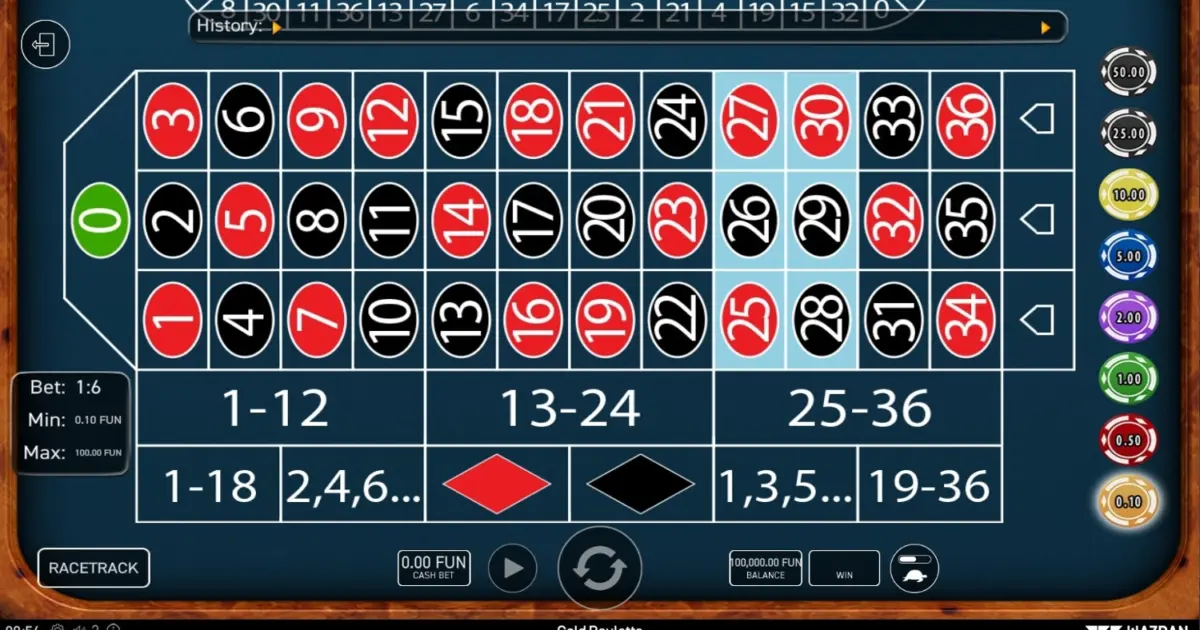
If you want a straightforward roulette table with a published return figure and no obligation to deposit first, gold roulette is worth a look: Wazdan lists it at an RTP of 97.3%, and a free demo is available. What the FACTS available for this table do not tell you is the pocket count, whether French rules apply, or what the table limits are — and those three things matter more to your money than anything else on the page.
So treat this review as two halves. The first is what is actually confirmed about the game. The second is the roulette maths that applies universally, which you can then check against the game’s own rules screen in the demo before you commit real stakes.
How Gold Roulette plays
This is a Wazdan release listed under the roulette subcategory, with free demo play available. Wazdan has two roulette titles in this collection, both listed at the same 97.3% return, so if you like the way one handles you will probably get on with the other.
Beyond that, the specifics are not documented here. The title does not tell you whether the wheel is single-zero or double-zero. There is no confirmed information on a racetrack for call bets, no confirmed betting-limit range, no confirmed side bets or multiplier feature, and no release date. That absence is not a criticism of the game — it is a reason to spend two minutes in the demo with the rules screen open before you decide anything.
What you should be looking for in that rules screen, in order of importance: the number of pockets, whether zero returns half your even-money stake, the minimum and maximum on both inside and outside bets, and the paytable for straight-up numbers. Those four answers tell you almost everything.
The pocket count is the whole story
Roulette is the one casino game where the maths is fully known and completely unforgiving, and it all comes down to how many pockets the wheel has.
A single-zero European wheel has 37 pockets. Every standard bet on it carries a house edge of 2.70%. A double-zero American wheel has 38 pockets, and every standard bet carries 5.26% — except the five-number basket bet, which is 7.89% and should simply never be played. Same-looking layout, same-looking payouts, roughly double the cost.
French rules improve things further. Under La Partage or En Prison, an even-money bet returns half your stake when zero lands, which cuts the even-money house edge to about 1.35%. That is the best standard bet available anywhere in roulette.
The mechanism behind all of this is one pocket. A straight-up number pays 35:1 when the true odds on a European wheel are 36:1. That single-pocket gap, repeated across every bet type on the layout, is the entire house edge. Nothing in the game’s presentation, theme or feature set alters it.
The pocket count for this table is not confirmed in the information available here, so check it yourself. It is the single most valuable thing you can learn in the demo.
Reading the 97.3% figure
Wazdan publishes an RTP of 97.3% for this table. Across the games catalogued here the average sits at 96.97%, so this is about a third of a percentage point above the typical listing — a small edge in your favour relative to the field, not a transformative one.
Read the figure as a long-run average, not a session forecast. A 97.3% return means that across an enormous number of spins the game is modelled to pay back 97.3% of everything staked. Over the fifty or two hundred spins you will actually play, your result will scatter widely around that number, and the scatter is far larger than the 2.7% gap itself.
It is also worth noting that 97.3% is precisely what you get from a single-zero wheel with a 2.70% house edge, which is consistent with a European-style layout. Consistent is not confirmed, though. Multiplier formats fund their multipliers by cutting the base straight-up payout, so their effective return on straight bets differs from classic roulette and has to be read from the paytable rather than inferred. If you want a clearly labelled comparison point, European Roulette Pro is listed at the same 97.3% and states its wheel type in the name.
Choosing bets for the session you want
Here is the part most guides get wrong. On a standard wheel, switching between bet types does not change your expected loss per unit staked. It changes how violently your balance moves. Choose based on the session you want, not on a belief that one bet is smarter than another.
The figures below are for a single-zero, 37-pocket wheel. Confirm the pocket count on this table before applying them.
| Bet | Pays | True odds (37 pockets) | Win chance |
|---|---|---|---|
| Straight up (1 number) | 35:1 | 36:1 | 2.70% |
| Split (2 numbers) | 17:1 | 17.5:1 | 5.41% |
| Corner (4 numbers) | 8:1 | 8.25:1 | 10.81% |
| Dozen / column | 2:1 | 2.08:1 | 32.43% |
| Red / black, odd / even | 1:1 | 1.06:1 | 48.65% |
Even-money bets win just under half the time and give you the longest session for a given bankroll. Straight-up numbers win about once every 37 spins and produce long dry stretches punctuated by a 36-unit return. Dozens and columns sit in between. Every row in that table carries the same 2.70% cost per unit staked.
Martingale and friends: the honest answer
No betting system changes expected value. Not Martingale, not Fibonacci, not D’Alembert, not Labouchere, not waiting for five reds before backing black. If you came here looking for one that works, the useful answer is that there isn’t one, and understanding why saves you money.
Spins are independent. The wheel has no memory, and on an RNG table each result is generated fresh with no reference to what came before. A number is never due, and no colour or sector is hot or cold. Tracking previous results has no predictive value whatsoever.
What progressions actually do is redistribute variance. Martingale converts a wide spread of small results into a large number of small wins and a rare, very large loss. The expected value across all of it is unchanged, and the doubling runs into the table maximum fast: eight consecutive losses on a one-unit start needs a 256-unit bet on the ninth spin. Since this table’s limits are not documented in the information available here, you cannot even estimate where that wall sits until you open the game.
Bankroll and table limits
Work backwards from the number of spins you want. On even-money bets, a bankroll of 100 units at 1 unit per spin gives you a realistic shot at a long session; the same 100 units at 5 units per spin can vanish in twenty spins on an ordinary losing run. Neither is wrong, but decide which you are doing before the first spin, not during it.
Table minimums and maximums are not confirmed for this game, and they matter in two ways: the minimum sets how small your unit can be, and the maximum caps any progression you might be tempted to run. Check both in the demo. Note too that the demo uses play credits and tells you nothing about how a real-money session will go — it shows you the interface, the paytable and the rules, which is exactly what it is good for.
Roulette is for players aged 18 or over. Set a budget before you start, treat it as the cost of entertainment rather than a route to income, and stop when it is spent instead of chasing it back. If the amount you are staking has started to matter to you, that is the signal to close the game.
Verdict on Gold Roulette
A 97.3% published return is a decent starting point, marginally better than the 96.97% average across the tables listed here, and Gold Roulette no download demo access means you can inspect it at zero cost. That combination makes it a reasonable candidate.
The reservation is documentation. Pocket count, French rules, limits and any feature set are all unconfirmed in the information available for this table, and those are the details that determine whether you are paying 2.70%, 5.26% or about 1.35% on even-money bets. Two minutes on the rules screen resolves all of it.
If you would rather start from a table that states its wheel type upfront, Wazdan’s own Casino Roulette (Wazdan) is listed at the same 97.3%, and European Roulette (Red Tiger) matches that figure with a single-zero layout named on the tin. All three cost the same in theory; the difference is how much you have to check before you trust it.
Frequently Asked Questions
Can you play Gold Roulette for free?
Yes, a free demo is available for this Wazdan table, so you can open it without depositing. Use that time to read the rules screen — pocket count, whether zero returns half on even-money bets, and the table limits are all worth confirming before you stake real money, since none of those are documented here.
What is the Gold Roulette RTP?
Wazdan lists Gold Roulette at 97.3%. That sits about 0.33 percentage points above the 96.97% average across the tables catalogued here. Treat it as a long-run modelled average across a very large number of spins rather than anything you should expect over a single session, where results scatter widely.
Is Gold Roulette a European or American wheel?
The wheel type is not confirmed in the information available for this table, so check the game's rules screen. It matters a great deal: a 37-pocket single-zero wheel carries a 2.70% house edge on standard bets, while a 38-pocket double-zero wheel carries 5.26%. The 97.3% figure is consistent with single-zero, but that is inference rather than confirmation.
Does the Martingale system work on Gold Roulette?
No. No progression changes expected value, because spins are independent and the wheel has no memory. Martingale trades many small wins for a rare large loss and runs into the table maximum quickly — eight straight losses from one unit needs 256 units on the ninth spin. This table's limits are not documented, so check them.
Which bet gives the longest session on this table?
Even-money bets on red/black or odd/even win just under half the time on a single-zero wheel, so they stretch a bankroll furthest per spin. They do not reduce the house edge — every standard bet on the layout costs the same per unit staked. Straight-up numbers win roughly once in 37 spins instead.




