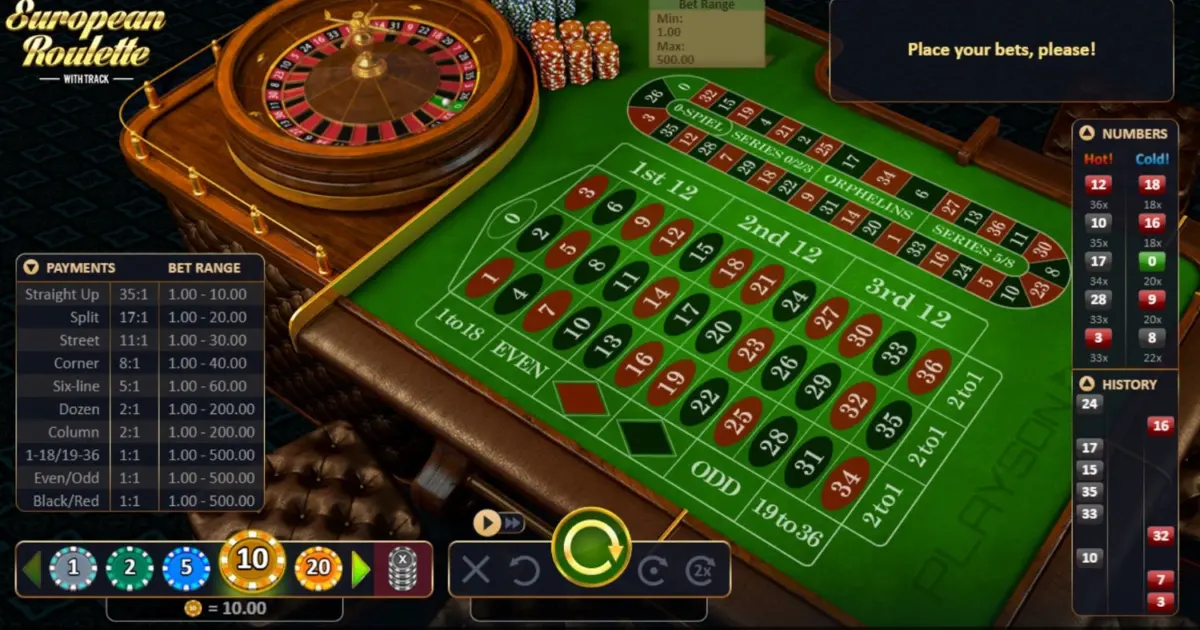
Roulette with Track Low is a Playson single-zero roulette that gives you a racetrack layout alongside the standard betting grid, with a low-limit focus for players who want to stretch a session. At 97.3% RTP it sits right at the European baseline, and the free demo lets you explore the interface without spending a cent. Whether it deserves a spot in your rotation depends on what you want from a roulette table — so let’s break that down.
How Roulette with Track Low plays
This is a European single-zero wheel dressed in Playson’s clean interface. You get the main betting area for inside and outside bets, plus a racetrack oval that lets you place announced bets on sectors of the wheel — neighbours, orphelins, tiers, and Voisins du Zéro — with a single click. The “Low” in the name points to lower minimum stakes, making it accessible if you prefer to bet conservatively or are working with a smaller bankroll. The core game mechanic is identical to any other single-zero table: 37 pockets, one zero, and every standard bet carries the same 2.70% house edge. The racetrack doesn’t change the maths; it just changes how you select your numbers — by their physical position on the wheel rather than their printed position on the layout.
| Provider | Playson |
|---|---|
| RTP | 97.3% |
| Free demo | Yes |
The pocket count is the whole story
Every roulette decision flows from one number: 37. A single-zero wheel has pockets numbered 0 through 36. On a straight-up bet the true odds are 36 to 1, but the payout is 35 to 1. That single-pocket gap across 37 pockets is exactly where the 2.70% house edge lives. It doesn’t matter whether you bet red or black, a single number, or a six-line — the expected loss is 2.70% of every euro wagered, averaged over an infinite number of spins. The racetrack layout on this Playson table lets you bet on neighbours and sectors, but those bets are just combinations of straight-ups. Tiers is 12 numbers covering roughly one-third of the wheel; Voisins is 17 numbers covering another chunk. The math behind each is a bundle of 35:1 payouts against 36:1 true odds. Same edge, different packaging. If this game’s name suggests a European wheel, that 2.70% is the expected figure — always confirm the rules screen to be certain.
Reading the 97.3% figure
The 97.3% RTP listed for Roulette with Track Low is the long-run return-to-player percentage, which is the complement of the 2.70% house edge. Over millions of simulated spins, for every €100 wagered the game returns approximately €97.30. That is not a promise for your session — short-term results swing wildly. A session with heavy straight-up betting might return 120% or 40% depending on luck. The RTP is a statement about the wheel’s mathematics, not your bankroll on a Tuesday night. For context, this figure is exactly in line with Roulette with Track and Roulette with Track High, both from Playson, which makes sense since they share the same single-zero wheel. It also matches European Roulette by Red Tiger, another 97.3% RTP European table. The RTP across the corpus of roulette games averages about 96.97%, so this game sits slightly above average — not because it is generous, but because it is a standard European wheel rather than a double-zero one.
Choosing bets for the session you want
The house edge does not change with your bet choice — it is 2.70% on red, on a column, on a corner, on everything. What changes is variance, and variance determines what your session looks and feels like. Outside bets (red/black, odd/even, high/low) hit frequently and pay 1:1. You will see long stretches of small wins and small losses, with your bankroll moving slowly. This is the lowest-variance way to play. Inside bets — straight-ups, splits, corners — hit rarely but pay big relative to the stake. A single straight-up on a European wheel hits roughly once every 37 spins. Mix them and you get a middle path. The racetrack on this Playson table makes sector bets convenient: a Neighbours bet covers five numbers, Tiers covers 12, Voisins covers 17. These are simply clusters of straight-up bets, so their variance sits between a single number and an even-money bet depending on the spread. None of this changes your expected return. It changes whether you want a quiet evening or a volatile ride.
Martingale and friends: the honest answer
The Martingale system tells you to double after every loss on an even-money bet, confident that a eventual win recovers all previous losses plus one unit. It feels logical. It is mathematically broken. On a fair table with no limits, the expected value of every spin is still negative. In practice, tables have maximum bets, your bankroll has a ceiling, and a losing streak of eight or nine — uncommon but perfectly possible on a 37-pocket wheel — pushes you into the limit or past your budget. The Fibonacci, D’Alembert, and Labouchère progressions are variations on the same theme: they redistribute when you win and lose, but they do not touch the 2.70% edge. On a single-zero wheel like this Playson table, every spin is independent. The wheel has no memory. No pattern of previous results — no run of reds, no cluster of high numbers — predicts the next outcome. If a progression makes the game more entertaining for you, that is a personal choice; just know it does not shift the maths one basis point.
Bankroll and table limits
The “Low” in this title suggests accessible minimum stakes, but the specific table limits are not published in the FACTS for this game. When you load the free demo or the real-money version, check the minimum and maximum bet fields — they are usually displayed near the chip selector. A sensible session bankroll is at least 40 to 50 times your base bet if you are playing outside bets, and considerably more if you plan to spread across inside bets or the racetrack. That gives you enough runway to ride the variance without busting early. If you are using any progression system, your required bankroll grows exponentially with streak length, which is another reason progressions are dangerous in practice. Set a loss limit before you start and a profit target you will actually walk away from. Play for entertainment, not as a way to make money — the maths guarantees the house wins over time. Only gamble what you can afford to lose, be 18 or over, and stop when it stops being fun.
Verdict on Roulette with Track Low
Roulette with Track Low is exactly what it claims to be: a single-zero Playson roulette with a racetrack layout and low minimum stakes, posting a 97.3% RTP. There is nothing flashy here, and that is not a criticism. The game delivers standard European roulette maths in a clean package with convenient sector betting. The racetrack is genuinely useful if you like announced bets, and the low-limit focus makes it practical for extended sessions on a modest bankroll. If you want multiplier features or side bets, look elsewhere — this is a stripped-back table that relies on the core game. Compared to its siblings in the Playson lineup, it offers the same RTP in a lower-stakes wrapper. For players who want honest, uncomplicated single-zero roulette with a convenient interface, this is a solid choice — but always verify the rules screen for yourself before wagering real money.
Frequently Asked Questions
Is Roulette with Track Low available as a free demo?
Yes, a free demo is available with no download required. You can spin the wheel, test the racetrack layout, and explore bet types without risking any real money. Demo play uses the same RNG and rules as the real-money version.
What is the RTP of Roulette with Track Low?
The listed RTP is 97.3%, which corresponds to a 2.70% house edge on a standard single-zero European wheel. This figure represents long-run expected return over millions of spins — your individual session results will vary significantly.
What house edge does this table have and what kind of wheel is it?
The name and the 97.3% RTP point to a single-zero European wheel with 37 pockets and a 2.70% house edge on every standard bet. Confirm the wheel type on the game's rules screen before placing real-money wagers.
Can any betting system or pattern give me an edge on this game?
No. Spins are independent and the wheel has no memory. Martingale, Fibonacci, D'Alembert, and every other progression system fail to change the expected value — they merely redistribute variance and increase the risk of hitting table limits or exhausting your bankroll.
How does Roulette with Track Low compare to Playson's Roulette with Track High?
Both games are Playson single-zero roulettes posting 97.3% RTP. The key difference implied by the naming is the stake range: "Low" targets lower minimum bets while "High" caters to larger wagers. The underlying wheel and house edge are the same.




