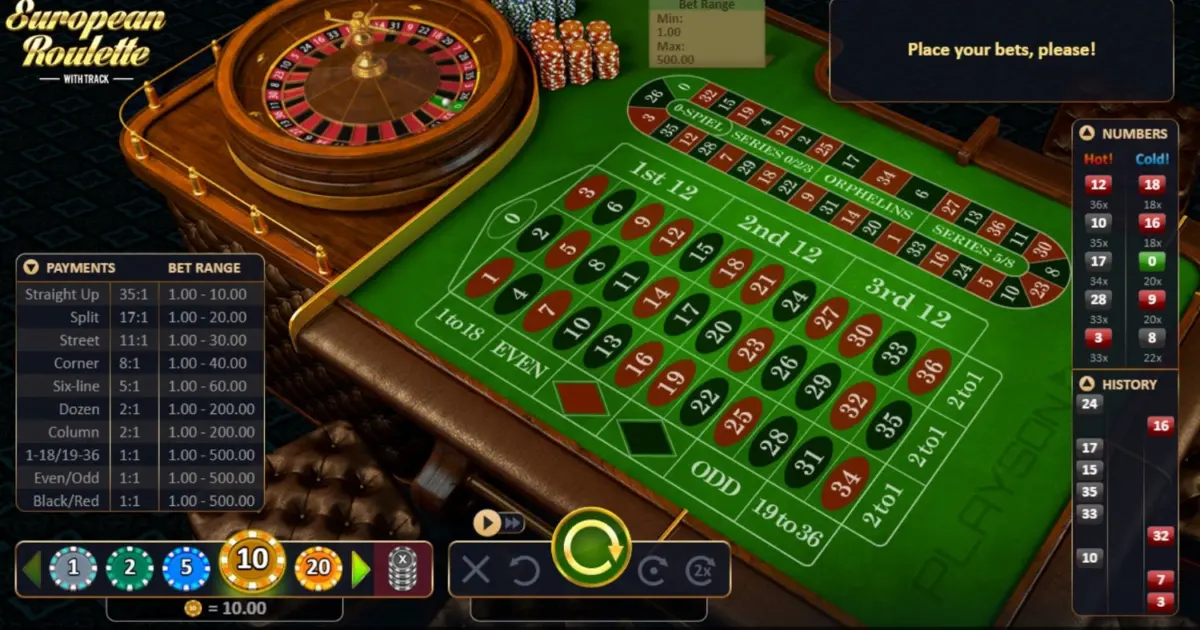
If you want a straightforward single-zero roulette table with a competitive return and the chance to try it without depositing, Roulette with Track High is worth your time. The name points to a European wheel, which normally means a 2.70% house edge on standard bets, and the listed RTP of 97.3% matches that expectation. Playson’s version adds a racetrack-style betting panel, but the core maths stays the same: every spin is independent and the wheel has no memory.
What kind of roulette is Roulette with Track High?
The “High” in the title distinguishes this table from two sibling Playson releases — Roulette with Track and Roulette with Track Low — but the underlying game is the same single-zero format. On a European wheel you have 37 pockets numbered 0 through 36, and every standard bet pays as though the zero did not exist. That single-pocket difference is precisely what generates the house edge.
Because FACTS does not state the pocket count explicitly, confirm it on the game’s own rules screen before betting real money. If the wheel is genuinely single-zero, the house edge is 2.70% on every standard bet. If a variant ever ran a double-zero layout, that figure would jump to 5.26%, so the distinction matters far more than the name suggests. The “Track” part of the title refers to the racetrack betting panel, which groups numbers into French-style sectors for call bets, though whether those bets are available here is not confirmed in the available data.
Return to player and house edge
The RTP figure for Roulette with Track High is 97.3%, which is 0.33 percentage points above the average of the wider roulette corpus at 96.97%. For a single-zero wheel this is the standard figure: 97.3% return to player means a 2.70% house edge, and that edge applies identically to every standard bet on the table — a straight-up number, a red/black wager, a dozen, or a corner bet.
This is the mathematical reality of roulette and it is worth stating plainly: no bet on this table is better or worse than another in expected value terms, because the payout for every bet is set to the true odds minus one pocket. Inside bets change the shape of your bankroll swings, not the average result. The only way to improve on 2.70% in the roulette family is a French-rules table with La Partage or En Prison, which returns half your even-money stake when zero lands and cuts that edge to about 1.35%. FACTS does not confirm whether this table offers those rules, so check the rules screen before assuming your even-money bets are protected.
Reading the Playson paytable before you bet
Playson publishes the paytable inside the game, and reading it is the single most useful thing you can do before your first spin. For a standard single-zero wheel the payouts are fixed: a straight-up number pays 35:1, a split pays 17:1, a street pays 11:1, a corner pays 8:1, a six-line pays 5:1, columns and dozens pay 2:1, and even-money bets pay 1:1. None of these change with the “High” or “Low” branding — they are the same across all three Playson roulette titles.
The reason to check the paytable yourself is that the “Track” panel may offer call bets — Voisins du Zéro, Tiers du Cylindre, Orphelins — and those have their own payout structures that are not always obvious from the layout. If call bets are present, their effective return still lands at the same 2.70% house edge on a single-zero wheel, because every bet is priced to the same mathematical gap. What changes is variance: a call bet covers many numbers at once, so it wins more often but pays less per hit.
Bet coverage, variance and session length
The shape of your session depends entirely on how many pockets you cover per spin, not on any system. A straight-up bet covers one pocket: high variance, long losing runs, and one 35:1 payout can return your whole session. An even-money bet covers 18 pockets: it wins almost half the time and keeps your bankroll moving, but the zero still lands roughly once in every 37 spins and takes that stake away. The table below shows how payout and true odds compare for the standard bets on this single-zero wheel.
| Bet type | Payout | True odds (European) | House edge |
|---|---|---|---|
| Straight-up | 35:1 | 36:1 | 2.70% |
| Split | 17:1 | 17.5:1 | 2.70% |
| Street | 11:1 | 11.33:1 | 2.70% |
| Corner | 8:1 | 8.25:1 | 2.70% |
| Six line | 5:1 | 5.17:1 | 2.70% |
| Column / dozen | 2:1 | 2.08:1 | 2.70% |
| Even money | 1:1 | 1.06:1 | 2.70% |
Session length is a direct function of how many pockets you cover and how big your stake is relative to your bankroll. Covering 18 pockets with even-money bets gives you frequent small wins and a long session, but the house edge grinds the same percentage regardless. Covering one pocket gives you dramatic swings and a shorter typical session, because losing streaks of 20–30 spins are common and expected. Neither approach is wrong — they are just different risk profiles.
Patterns, hot numbers and the gambler’s fallacy
No pattern exists on this wheel, and none can exist. Each spin is an independent event, and the wheel has no memory of the spin before it. A number that has not landed in 100 spins is exactly as likely to land on the next spin as any other number — one in 37. A red streak of five in a row does not make black “due”; it makes the next spin a fresh 18/37 chance of black, identical to every spin before it. Anyone telling you otherwise is selling a system, not maths.
The betting systems you will find online — Martingale, Fibonacci, D’Alembert, “wait for five reds” — all share the same flaw: they redistribute variance without changing expected value. Doubling your stake after a loss (Martingale) speeds up the path to a table limit and can wipe out a bankroll that survived dozens of wins. The house edge is 2.70% per spin on average, and no progression of bets changes that number. The honest use of this table is to set a budget, pick bets whose variance you can tolerate, and treat the outcome as entertainment.
Trying the demo
Roulette with Track High is available as a free demo, which means you can play the full table without depositing and without downloading anything. This is genuinely useful: you can test the racetrack panel, confirm the pocket count on the rules screen, and see how the call-bet payouts behave before you commit real money. The demo uses the same RNG as the real-money game, but it is not a predictor of real-money results — it is a practice tool, not a crystal ball.
Set a budget before you start and treat every stake as the price of entertainment, not an investment. Roulette is a game with a fixed mathematical edge, and no spin, streak or system changes that. If you find yourself chasing losses or extending a session to recover, that is the signal to stop. 18+ — play responsibly and within your means.
Verdict on Roulette with Track High
Roulette with Track High is a solid, standard single-zero table with a competitive 97.3% RTP and a useful racetrack panel for players who like French-style sectors. It does nothing exotic, which is exactly why it works: the maths is transparent, the payouts are conventional, and the free demo lets you verify everything before you wager. If you want the same wheel in a different flavour, Roulette with Track and Roulette with Track Low are the sibling releases with identical RTP, so your choice comes down to layout preference rather than return.
If this is your first Playson roulette, the demo is the right place to start. If you already know the format, the decision is whether you want the racetrack panel at all — for that, European Roulette (Red Tiger) offers a comparable 97.3% RTP in a more conventional layout. Either way, the house edge is the same 2.70%, and the only real question is which interface you enjoy more. The wheel itself will never owe you a win.
Frequently Asked Questions
Can I play Roulette with Track High for free?
Yes, a free demo is available and requires no download. You can spin the wheel, use the racetrack panel and check the paytable without depositing. The demo uses the same RNG as real money, but it does not predict future results.
What is the RTP of Roulette with Track High?
The listed return to player is 97.3%, which sits 0.33 percentage points above the roulette corpus average of 96.97%. That figure corresponds to a 2.70% house edge on standard bets, assuming the wheel is the single-zero European format its name suggests.
What is the house edge on this wheel?
With a 97.3% RTP, the house edge is 2.70% on every standard bet, provided the wheel has 37 pockets. The available data does not confirm La Partage or En Prison rules, so check the game's rules screen before assuming even-money bets are protected when zero lands.
Does any betting system work on Roulette with Track High?
No. Martingale, Fibonacci and every other progression change the shape of your bankroll swings but never the expected value. Spins are independent and the wheel has no memory, so the 2.70% house edge applies regardless of how you stake.
Who makes Roulette with Track High and how does it compare to other Playson tables?
Playson developed it, and it sits alongside Roulette with Track and Roulette with Track Low, both with the same 97.3% RTP. The difference is layout and bet coverage, not return — all three share the same wheel maths and house edge.




