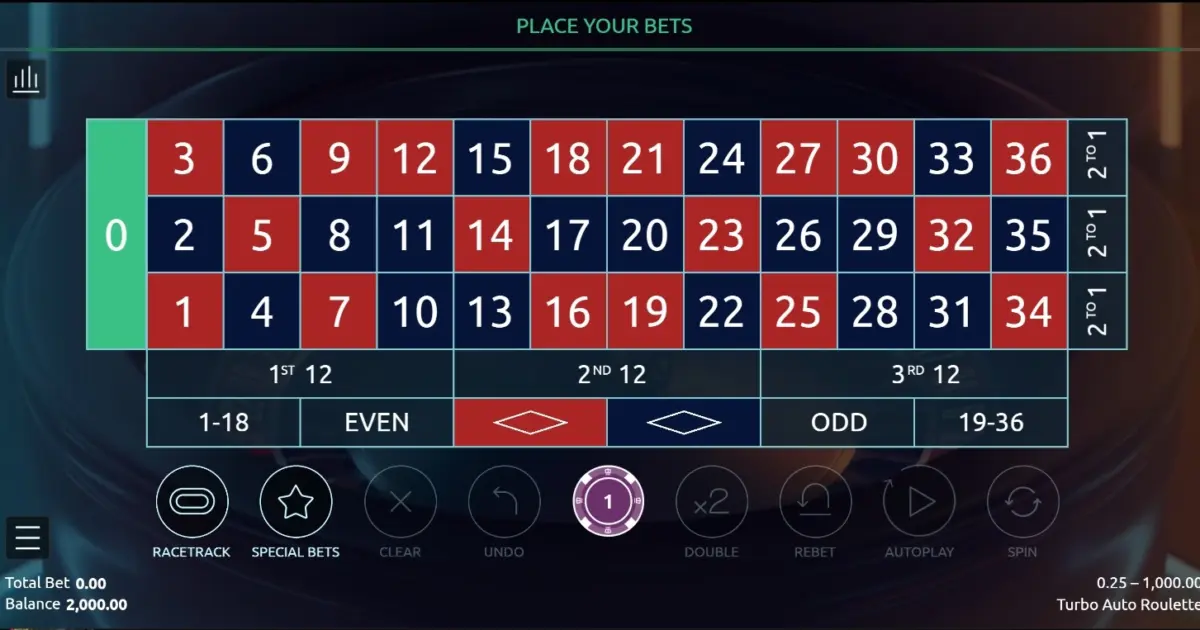
Turbo Auto Roulette is a fast-play auto-wheel title from Real Dealer Studios that strips away the presenter and speeds up the cycle, letting you get through far more spins in the same sitting. The maths underneath is the same European single-zero formula you already know, so there is nothing exotic to learn before you sit down. If you are comfortable with standard roulette bet types, this table will feel instantly familiar — just quicker.
How Turbo Auto Roulette plays
This is an automated table, which means there is no live dealer spinning the wheel. A random-number generator determines the winning pocket, and the software animates the result. The “turbo” label refers to the pace: the game trims dead time between rounds, so a result arrives every few seconds rather than every thirty or forty seconds as it would at a live table. You still place bets on the same layout — inside numbers, dozens, columns, red/black, odd/even — and the same payout rules apply. The interface typically offers repeat-bet buttons and a racetrack view for call bets, but the core decisions are identical to any European roulette. If you are new to auto roulette, the speed is the main adjustment: you must decide faster and resist the temptation to chase losses across a rapid sequence of rounds.
| Provider | Real Dealer Studios |
|---|---|
| RTP | 97.3% |
| Free demo | Yes |
The pocket count is the whole story
The title “Turbo Auto Roulette” points to a European single-zero wheel, which normally means 37 numbered pockets (1–36 plus a single green 0). That single zero is the source of every casino’s edge on this layout. If you confirm a 37-pocket wheel on the game’s rules screen, the standard straight-up odds are 35:1 against 36:1 true probability, and the gap is the entire house edge. A double-zero American wheel adds pocket 00, widening the gap to 38 pockets. The RTP of 97.3% listed in the FACTS block is consistent with a single-zero wheel and standard payouts, but always verify on the game’s own info panel before committing real money. Pocket count determines everything: it sets the house edge, which sets the long-run cost of every bet you place.
Reading the 97.3% figure
An RTP of 97.3% means that, over a very large number of spins, the game is designed to return 97.3 cents for every dollar wagered. That leaves a house edge of 2.70%, which is the standard figure for a European single-zero wheel with no special rule like La Partage or En Prison. For context, a double-zero American wheel sits at 94.74% RTP (5.26% edge), while French rules with La Partage bring even-money bets down to roughly 98.65% RTP (1.35% edge). Real Dealer Studios’ provider average across its catalogue is 97.25%, and the corpus average on this site is 96.97%, so this title sits slightly above both. That said, RTP is a long-run statistical average. In a single session of 200 spins at €1 a spin, you are wagering €200; the expected loss is €5.40, but actual results will swing widely around that number. Short sessions are dominated by variance, not by the edge.
Choosing bets for the session you want
The house edge is the same on every standard bet, so the choice between inside and outside bets is entirely about the shape of your variance. Straight-up bets on a single number pay 35:1 and hit roughly once every 37 spins on a European wheel. The swings are enormous: you can win 35 units in one spin or lose 1 unit thirty-seven times in a row. Outside bets — red/black, odd/even, high/low — pay 1:1 and hit close to half the time, producing much smaller swings and longer sessions for a given bankroll. Columns and dozens sit in the middle at 2:1. If your goal is to stretch a small bankroll for entertainment, outside bets are the practical choice. If you want the adrenaline of occasional big wins and accept the risk of quick depletion, straight-ups and splits deliver that. The expected loss per spin is identical either way; you are choosing how that loss is distributed across your session.
Martingale and friends: the honest answer
No betting system changes the expected value. The Martingale — doubling your stake after every loss — is the most popular example, and it is worth explaining exactly why it fails. On a European wheel, a run of ten consecutive losses on an even-money bet, while unlikely in any single ten-spin block, is not rare over hundreds of spins. When it happens, the required next bet exceeds most table limits, and even if it did not, you would be risking a huge sum to recover a small cumulative loss. The Fibonacci, D’Alembert, and Labouchère systems are variations on the same theme: they redistribute when you win and when you lose, but they cannot alter the 2.70% edge. Spins are independent events. The wheel has no memory of previous results. Tracking “hot” or “cold” numbers on an RNG table has zero predictive value. If you use a progression for entertainment, set a hard loss limit and stick to it — the system will not protect you, but a stop-loss will.
Bankroll and table limits
Because Turbo Auto Roulette runs at high speed, you will place more bets per hour than at a live table. At roughly one result every five seconds, that is around 720 spins per hour — compared with perhaps 30–40 at a live wheel. The house edge does not change, but the rate at which it grinds through your bankroll does. If you bring €100 and bet €1 per spin, the expected loss is €2.70 per 100 spins, but the rapid pace means you could cycle through that €100 in under fifteen minutes during an unlucky run. Set a session budget before you start, decide on a bet size that gives you at least 200–300 spins of runway, and treat any win as a bonus rather than a target. This is entertainment, not income. Play only with money you can afford to lose, and stop when the budget is gone. If gambling stops being fun, step away — resources like GamCare and BeGambleAware are available at any time. You must be 18 or older to play.
Verdict on Turbo Auto Roulette
Turbo Auto Roulette is a straightforward, no-frills European auto-wheel from Real Dealer Studios. The 97.3% RTP is standard for a single-zero table, the pace is significantly faster than live roulette, and the lack of a presenter keeps the interface clean. It does not introduce side bets, multipliers, or special rules that would change the maths, so what you see is what you get. If you want more presenter-led atmosphere, titles like Roulette with Rachael deliver a live-host experience at the same RTP. If you prefer another auto-wheel option, Real Auto Roulette is a comparable alternative from the same provider. For a different angle entirely, Fortune Finder with Holly blends a game-show theme with roulette mechanics. Turbo Auto Roulette is best suited to players who know the bet types, want speed, and are comfortable managing their own pace and budget.
Frequently Asked Questions
Can I play Turbo Auto Roulette for free with no download?
Yes, a free demo is available on this page with no download required. The demo uses the same RNG and payouts as the real-money version, so it is a useful way to learn the interface and bet types before committing funds.
What is the RTP of Turbo Auto Roulette?
The listed RTP is 97.3%, which is consistent with a standard European single-zero wheel and its 2.70% house edge. Always confirm the figure on the game's own rules screen, as RTP can vary by operator configuration.
Is Turbo Auto Roulette a European or American wheel?
The title and the 97.3% RTP both point to a single-zero European wheel with 37 pockets. Verify the pocket count on the game info panel before playing for real money, since the wheel type determines the house edge.
Does the Martingale system work on Turbo Auto Roulette?
No. No betting system changes the house edge. Spins are independent, the wheel has no memory, and progressions like Martingale simply redistribute variance while accelerating the risk of hitting table limits during losing streaks.
How does Turbo Auto Roulette compare to Real Auto Roulette?
Both are automated European wheels from Real Dealer Studios with a listed RTP of 97.3%. The differences are in presentation and pace rather than maths, so your choice comes down to interface preference and available table limits.




