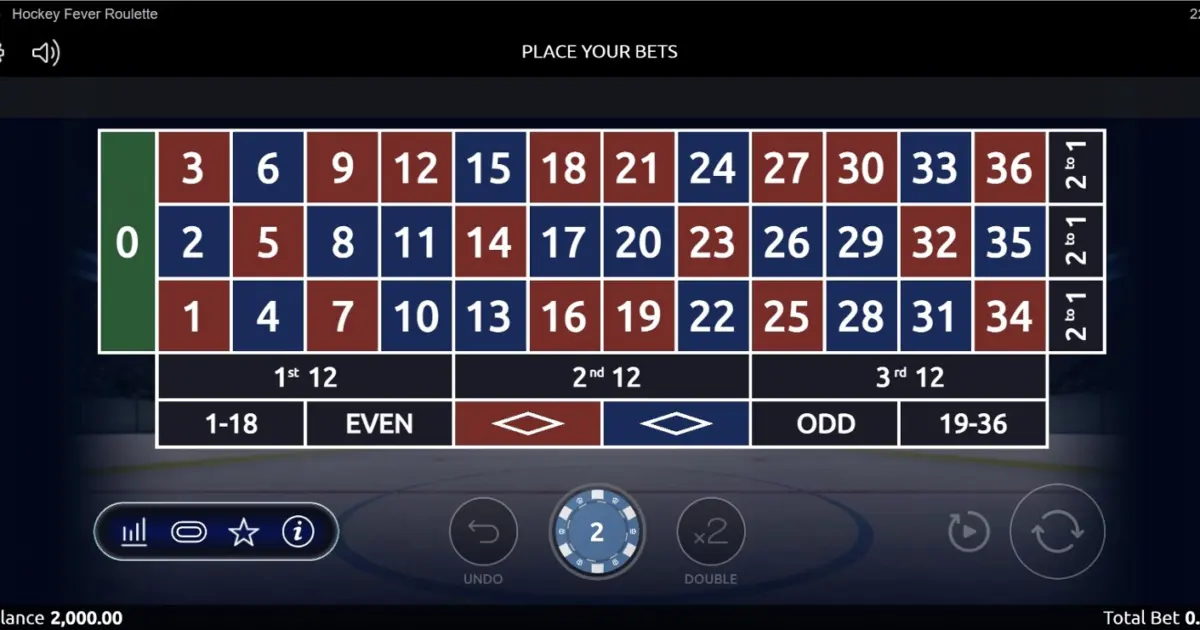
Hockey Fever Roulette is a Real Dealer Studios table with a published RTP of 97.3%, and a free demo you can open without depositing. That RTP figure is the single most useful number on this page, because it tells you roughly what wheel structure to expect while stopping short of confirming it. What FACTS does not tell you is the pocket count, whether French rules apply, or what the table limits are — and those are the things you should read off the game’s own rules screen before your first real-money spin.
Hockey Fever Roulette and the Real Dealer Studios roulette range
Real Dealer Studios has 30 games in this corpus, averaging 97.25% RTP, which is a shade above the 96.97% average across everything catalogued here. The studio is best known for filmed-dealer presentation: real footage, real people, RNG maths underneath. Hockey Fever Roulette sits at rank 89 with a popularity percentile of 60.5, so it is played more than the median table without being a headline title.
If you want the same 97.3% figure in a stripped-back format with no theming to look at, Real Auto Roulette is the studio’s plainest option and runs at the same RTP. If it is the presented-dealer experience you are after rather than the sports wrapper, Roulette with Rachael also lists 97.3%. And for something structurally different from the studio’s roulette line, Fortune Finder with Holly sits lower at 96.6%, which is a reminder that a studio’s average tells you nothing about any individual title. Comparing across a range like this is worth doing precisely because the presentation varies far more than the maths does.
The wheel, the pockets and the edge
Here is where honesty matters more than fluency. FACTS does not state how many pockets Hockey Fever Roulette has, and the title gives no wheel-family hint either — there is no “European”, “American” or “French” in the name to lean on. So the pocket count is unconfirmed, and you should treat it as an open question until the rules screen answers it.
Why it matters: on a single-zero wheel with 37 pockets, the house edge is 2.70% on every standard bet. On a double-zero wheel with 38 pockets, it is 5.26% on every standard bet, and 7.89% on the five-number basket bet. That is not a small difference. Over the same number of spins at the same stake, the double-zero wheel takes roughly twice as much from you on average.
If the table applies French rules — La Partage or En Prison — half your stake comes back on even-money bets when zero lands, which drops the even-money house edge to about 1.35%. That is the best standard bet available anywhere in roulette. FACTS does not say whether Hockey Fever Roulette offers it, so do not assume it does.
One more absence worth flagging: nothing in FACTS mentions a racetrack, call bets, side bets or multipliers. If the game has them, the rules screen will list them, and multiplier formats in particular change the paytable — they fund the multipliers by cutting the base straight-up payout, so the effective return on straight bets is not the classic 35:1.
97.3% in practice
A 97.3% RTP means the theoretical house edge is 2.7% — the long-run average return, not a per-session promise. Bet 100 units across a long stretch of spins and the modelled outcome returns 97.3 of them. Any individual hour can land anywhere.
The 2.7% figure lines up exactly with what a single-zero wheel produces on standard bets, which is a strong signal about the structure but not proof of it. RTP is calculated over the whole bet set, so it is worth reading alongside the paytable rather than instead of it.
What 2.7% actually costs: at 1 unit per spin and roughly 40 spins an hour, the modelled loss is about 1.08 units an hour. Raise the stake to 5 units and it becomes about 5.4 units an hour. The edge scales with turnover, not with time, so spin speed and stake size do all the work. Slower play at the same stake is cheaper play.
Building a bet you understand
Every standard bet on a single-zero wheel carries the same 2.70% edge. What changes between them is the shape of the ride — how often you win and how big the swings get. The table below shows the arithmetic on a 37-pocket wheel, which is the structure a 2.7% edge implies. Confirm the pocket count in-game before applying it.
| Bet | Pays | True odds (37 pockets) | Win chance |
|---|---|---|---|
| Straight up (1 number) | 35:1 | 36:1 | 2.70% |
| Split (2 numbers) | 17:1 | 17.5:1 | 5.41% |
| Street (3 numbers) | 11:1 | 11.33:1 | 8.11% |
| Corner (4 numbers) | 8:1 | 8.25:1 | 10.81% |
| Line (6 numbers) | 5:1 | 5.17:1 | 16.22% |
| Column or dozen | 2:1 | 2.08:1 | 32.43% |
| Red/black, odd/even, high/low | 1:1 | 1.06:1 | 48.65% |
Read the straight-up row closely. It pays 35:1 against true odds of 36:1, and that one-pocket gap is the entire house edge. Every other bet is built from the same gap, repackaged. Even-money bets win just under half the time and produce the gentlest variance; straight-up bets win 2.7% of the time and produce the wildest. Neither is a better bet mathematically. Pick the one whose swings you can sit through.
Systems, streaks and independent spins
No betting system changes expected value. Not Martingale, not Fibonacci, not D’Alembert, not waiting for five reds before backing black. This is not a matter of opinion or of finding the right variation — it is arithmetic. Each spin is independent, the wheel has no memory, and the edge applies to every unit you stake regardless of what you staked before it.
What progressions do is redistribute variance. Martingale converts many small wins into a rare large loss, which feels like winning right up until the sequence runs long. Doubling from 1 unit, a seven-loss run needs a 128-unit bet to continue, and 255 units are already committed. Table maximums and your own balance both cap the sequence, and the cap arrives at the worst possible moment.
On an RNG wheel, previous results carry no predictive information. A number is never due. Colours are never hot or cold. Sector tracking, scoreboards and “last 20 spins” displays are entertainment features, not data. If you came here looking for a system that works, the useful answer is that the lowest-edge bet available beats any staking pattern layered on top of a higher-edge one.
Free demo and staying in control
A free demo is available for this table, so you can open it, watch a few spins, and check the rules screen for the pocket count, the zero rules and the table limits before any money is involved. Use it for exactly that. Play Hockey Fever Roulette free for twenty minutes and you will know whether the pacing and presentation suit you — which is a genuinely useful thing to learn, and cheap to learn.
What the demo cannot tell you is anything about real-money outcomes. Demo results have no predictive value; a good run in practice mode says nothing about the next session, because the maths is identical and the maths is indifferent.
Roulette is 18+ entertainment, not income. Set a budget before you open the game, treat it as the cost of the session rather than as stake to win back, and stop when it is gone. If chasing losses starts feeling reasonable, that is the signal to close the tab.
Who should play Hockey Fever Roulette
This suits you if you want a themed, presented roulette table and the 97.3% RTP is enough to satisfy you on value. That figure is above the 96.97% corpus average and roughly in line with what Real Dealer Studios averages across its 30 games, so you are not paying a premium for the theming.
It suits you less if you need the rule set confirmed before you commit. The pocket count, zero handling and limits are all absent from the public data here, and if you specifically want La Partage on even-money bets — the 1.35% edge — you need to verify that in-game rather than hope for it.
The practical route: open the demo, read the rules screen, note the pocket count and whether zero returns half on even-money bets, then decide. If the theming is not what you want, the studio’s plainer tables run at the same RTP.
Frequently Asked Questions
Can I play Hockey Fever Roulette free with no download?
Yes. A free demo is available for this table, and it runs in the browser with no download or deposit needed. Use it to check the rules screen — pocket count, zero handling and table limits are not published in the public data, so the in-game rules are where you confirm them.
What is the Hockey Fever Roulette RTP?
The published RTP is 97.3%, which implies a 2.7% house edge. That sits above the 96.97% average across the tables catalogued here and matches the 97.25% average across Real Dealer Studios' 30 games. RTP is a long-run theoretical figure, not a guide to any single session.
Is this a European or American wheel?
The available data does not say, and the title gives no clue either. The 97.3% RTP is consistent with a 37-pocket single-zero wheel, where every standard bet carries a 2.70% edge, but that is an inference rather than a confirmed fact. Check the rules screen before staking real money.
Does the Martingale system work on this table?
No. No staking system changes expected value, because spins are independent and the house edge applies to every unit you bet. Martingale swaps frequent small wins for a rare large loss, and doubling from 1 unit means a seven-loss run needs a 128-unit bet with 255 already committed.
How does it compare to Roulette with Rachael?
Both are Real Dealer Studios tables listing 97.3% RTP, so the expected return is the same. The difference is presentation: Hockey Fever Roulette wraps the wheel in a sports theme, while Roulette with Rachael leans on the presented-dealer format. Pick on which you would rather watch for an hour.




