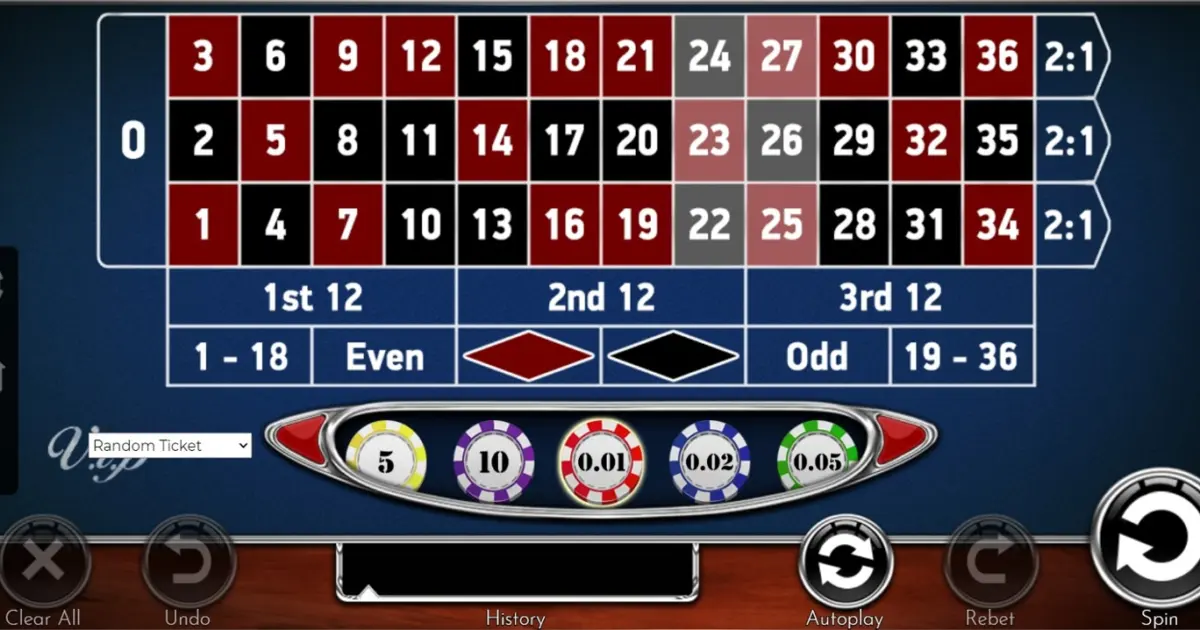
If you want a straightforward wheel with a published return figure and no real-money commitment to try it, european roulette vip is a reasonable place to start. Spinomenal lists the RTP at 97.3%, and a free demo is available, so you can learn the layout without staking anything. What FACTS does not tell you is the table’s minimum and maximum bets, whether a racetrack or call bets are offered, or whether any French rules apply — all of which you should read off the game’s own rules screen before you deposit.
How European Roulette VIP plays
This is a single-table RNG roulette game from Spinomenal, one of three roulette titles listed for the provider on this site. Play follows the standard sequence: you place chips on the felt, confirm the bet, the wheel spins, and the software resolves winners against the pocket the ball settles in. There is no dealer, no other players, and no clock pressure between spins beyond whatever the interface imposes.
The “VIP” label in the title is a marketing tag, not a defined ruleset. It usually signals higher table limits than a provider’s base table, but nothing in the available data confirms the actual minimum or maximum stake here. Treat that as an open question and check the limits panel first — on a high-limit table the difference between a €1 minimum and a €10 minimum changes how long a given bankroll lasts by an order of magnitude.
Similarly unconfirmed: whether the game offers a racetrack for calling neighbour bets and sector bets like voisins du zéro or tiers du cylindre, and whether it saves favourite bet layouts. Those are convenience features rather than value features, so their absence costs you nothing mathematically. It just means more clicking.
The pocket count is the whole story
Roulette’s house edge comes from one place: the mismatch between the payout and the true odds, created by the zero pockets. A single-zero wheel has 37 pockets. A straight-up number pays 35:1 when the true odds are 36:1, and that one-pocket gap produces a house edge of 2.70% on every standard bet on the layout. A double-zero wheel adds a 38th pocket, which pushes the edge to 5.26% on standard bets and 7.89% on the five-number basket bet.
The name of this game points to a single-zero wheel, which normally means the 2.70% figure. That is a strong hint, not a confirmed rule for this table. Nothing in the available data states the pocket count outright, so open the rules screen and count the wheel before you accept that number as this game’s edge.
The other thing worth checking is whether French rules apply. La Partage returns half your stake on even-money bets when zero lands; En Prison holds the bet for the next spin instead. Either one cuts the even-money house edge to roughly 1.35%, the best standard bet in roulette. No source here says whether this table has them, and the difference is large enough that it is worth two minutes of reading.
Reading the 97.3% figure
A 97.3% RTP is the mirror image of a 2.70% house edge, which is exactly what a single-zero wheel with no French rules returns. So the published figure and the game’s name agree with each other, which is mildly reassuring — though the RTP alone still does not confirm the pocket count or the zero rule.
In practical terms, 97.3% means that across a very large number of spins the game returns €97.30 for every €100 wagered. It is a long-run average across all bets, not a promise about your session, and it does not tell you when the returns arrive. Bet €5 a spin for 200 spins and you have wagered €1,000; the expected cost is €27, but the actual result can land far either side of that.
Against the site-wide average of 96.97%, this table sits 0.33 points higher. Spinomenal’s other listed roulette games carry the same 97.3%, and so does the widely played European Roulette (Red Tiger) — useful if you want to compare interfaces on identical maths. There is no European Roulette VIP rtp bonus or boosted mode indicated anywhere in the data.
Choosing bets for the session you want
On a single-zero wheel every standard bet carries the same edge. Choosing between them changes the shape of your session, not its expected cost. Inside bets pay more and hit less often; outside bets hit close to half the time and pay close to nothing extra. Both leak the same percentage.
| Bet | Numbers covered | Payout | True odds (37 pockets) | Hit chance |
|---|---|---|---|---|
| Straight up | 1 | 35:1 | 36:1 | 2.7% |
| Split | 2 | 17:1 | 17.5:1 | 5.4% |
| Street | 3 | 11:1 | 11.33:1 | 8.1% |
| Corner | 4 | 8:1 | 8.25:1 | 10.8% |
| Line | 6 | 5:1 | 5.17:1 | 16.2% |
| Dozen / column | 12 | 2:1 | 2.08:1 | 32.4% |
| Red / black, odd / even, high / low | 18 | 1:1 | 1.06:1 | 48.6% |
If you want a long, low-swing session, even-money bets keep you in the seat longest. If you want the chance of a large single result and accept long dry runs, straight-up numbers do that. Spreading chips across several inside bets does not reduce the edge; it just narrows the distribution of outcomes.
Martingale and friends: the honest answer
No betting system changes the expected value of a roulette bet. Not Martingale, not Fibonacci, not D’Alembert, not Labouchère, not waiting for five reds before backing black. Every spin is independent, the wheel has no memory, and the RNG does not know what happened previously. If the edge is 2.70% per spin, it is 2.70% on your first bet and 2.70% on your ninth doubled bet.
What progressions actually do is move risk around. Martingale converts a large number of small wins into a rare, very large loss. It works right up until the moment you hit the table maximum or run out of money, and because you are doubling, that moment arrives faster than intuition suggests: eight consecutive losses from a €1 base needs a €256 bet to continue and has already cost €255.
No number, colour or sector is ever “due”, “hot” or “cold” on an RNG wheel. Tracking previous results has no predictive value here. Systems are best understood as pacing tools — a way to decide stake sizes — not as an edge.
Bankroll and table limits
Because table limits are not documented in the data available, the first thing to do is find them. Your minimum stake sets your realistic session length: a bankroll of 100 minimum bets is a short session, 300 is a comfortable one. Your maximum matters if you use any progression, since the ceiling is where a doubling sequence stops working.
Decide your total budget before the first spin and treat it as spent. Roulette is entertainment, not income, and it is for players aged 18 or over. Set a loss limit and a time limit, take the break when you reach either, and never stake money you need for something else. If play stops feeling like a choice, use the operator’s deposit limits, reality checks and self-exclusion tools.
The free demo is the cheapest way to test a staking plan. Note that demo results tell you nothing about how a real-money session will go — the maths is identical, but the sample you see is far too small to mean anything either way.
Verdict on European Roulette VIP
The 97.3% RTP is fair for the format and slightly above the site-wide 96.97% average, and the maths behind a single-zero wheel is well understood and honest about what it costs. If you want a no-frills table with a published return figure, this qualifies.
The caveats are all documentation gaps rather than red flags: pocket count, table limits, La Partage or En Prison, and racetrack availability are all unstated here and all worth confirming in-game. If the interface does not suit you, European Roulette (Spinomenal) lists the same RTP, and European Roulette – Christmas Edition offers the same figure with a seasonal skin. Try the European Roulette VIP free demo first, read the rules screen, then decide.
Frequently Asked Questions
Can I play European Roulette VIP for free?
Yes. A free demo is available, so you can place bets with play-money chips and learn the layout without depositing. The demo runs the same maths as the real-money table, but a demo session is far too small a sample to predict how real-money play will go. Use it to test the interface and your staking plan.
What is the RTP of European Roulette VIP?
Spinomenal lists 97.3%, meaning the game returns €97.30 per €100 wagered over a very large number of spins. That is 0.33 points above the site-wide average of 96.97%. It is a long-run figure across all bet types, not a guide to any single session, and it says nothing about when returns arrive.
Is this a single-zero wheel, and what is the house edge?
The title points to a European wheel, which normally means 37 pockets and a 2.70% house edge on every standard bet. The 97.3% RTP is consistent with that. Nothing in the available data confirms the pocket count or whether La Partage applies, so check the game's rules screen before betting real money.
Does the Martingale system work on European Roulette VIP?
No. No betting system changes expected value. Spins are independent and the wheel has no memory, so a 2.70% edge stays 2.70% no matter how you size bets. Martingale trades many small wins for a rare large loss and runs into the table maximum quickly: eight losses from €1 needs a €256 stake.
How does it compare with European Roulette by Red Tiger?
Both list 97.3%, so the expected cost per spin is the same and the choice comes down to interface, table limits and features. Limits are not documented for this Spinomenal table, and neither is racetrack availability, so compare those two screens directly. Spinomenal's three roulette titles all share the same 97.3% figure.




