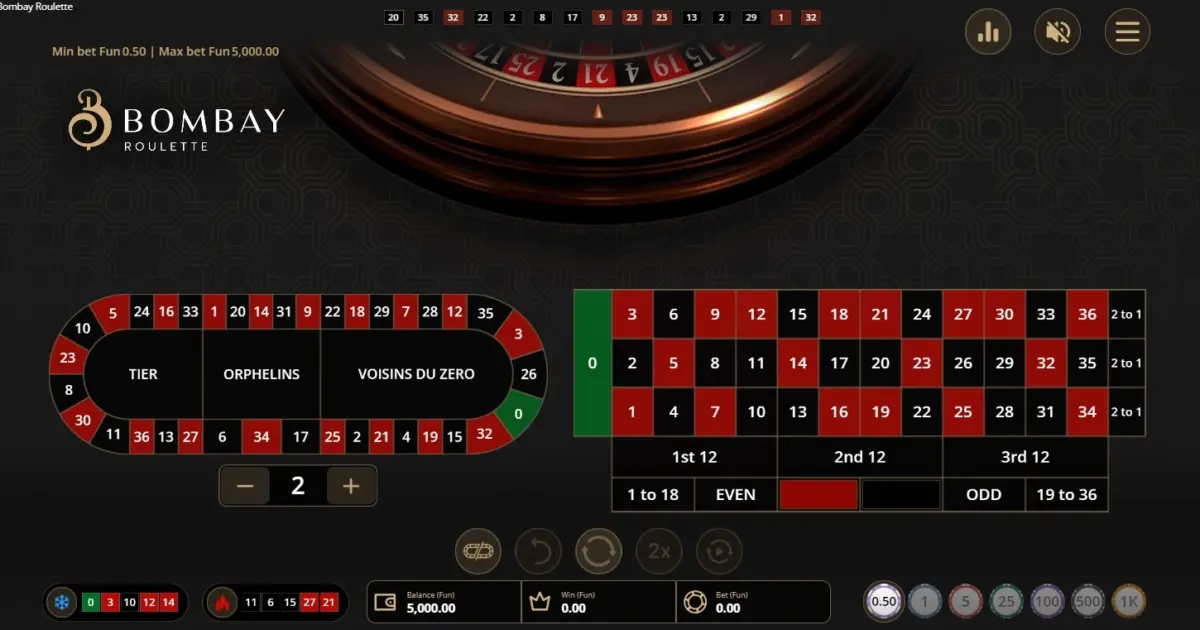
Bombay Roulette is a OneTouch roulette table available to try as a free demo, which lets you learn the layout without staking real money. Is it worth your time? If you want a no-download way to see how this specific OneTouch presentation handles bets, spins and payouts, the demo is useful, but you should verify its wheel type, RTP and rules on its own help screen before you decide to play for real. bombay roulette is reviewed here on maths alone because no house-edge figure or rule sheet was provided for this table.
Bombay Roulette in one minute
This is a roulette release from OneTouch, a provider with 3 games in the tracked corpus and an average RTP of 97.3% across those titles. That provider average is not a promise for this table — each roulette variant has its own paytable and wheel rules that determine its return. The page FACTS confirm a free demo is available and no download is needed to try it, which is the most decision-relevant point for a review site: you can inspect the interface, chip placement and result history without creating a casino account.
What is not in FACTS is equally important. There is no confirmed RTP, no confirmed pocket count, no table limits, no list of call bets or racetrack, and no statement about French rules such as La Partage or En Prison. There is also no release date, no side-bet list and no multiplier description. For roulette that matters because the wheel family alone changes the house edge from 2.70% to 5.26% and multiplier formats change the effective RTP on straight-up bets. The absence means you must open the game’s own rules or help file to confirm those items before playing for real money.
Popularity data places this title at rank 51 with a percentile of 77.6, so it sits above the median for visibility in the sample, but popularity does not alter maths. Use the demo to confirm whether the wheel you see is single-zero or double-zero, whether even-money bets are subject to any zero concession, and whether the paytable matches classic 35:1 for a straight-up. If any of those details are not clearly stated in-game, treat that as a reason to pause rather than to guess.
The maths of a single spin
Every standard roulette bet is a straightforward exercise in probability, and the house edge comes from one gap: the payout is slightly less than the true odds. On a single-zero European wheel there are 37 pockets, so the true odds against winning a straight-up number are 36 to 1, but the payout is 35 to 1. That difference, applied across all bet types, leaves a house edge of 2.70% on every standard bet. On a double-zero American wheel there are 38 pockets, true odds of 37 to 1, the same 35 to 1 payout, and a house edge of 5.26% on all standard bets except the five-number basket, which is 7.89%.
Inside versus outside bets do not change that expected value on a classic wheel; they change variance. A straight-up wins rarely and pays 35:1, a split pays 17:1, a street 11:1, a corner 8:1, a six-line 5:1, while even-money bets — red/black, odd/even, high/low — pay 1:1 and win most often. Dozens and columns pay 2:1. In each case the ratio of payout to true odds leaves the same 2.70% or 5.26% edge, depending on the wheel. French rules are the only standard exception: La Partage or En Prison return half the stake on even-money bets when zero lands, cutting that bet’s edge to about 1.35%, which is the best standard bet in the game.
Multiplier formats such as Lightning-style tables fund the multipliers by reducing the base straight-up payout, often to 30:1 or 29:1, with random multipliers applied instead. That shifts the effective RTP on straight bets away from classic figures and must be read from the specific paytable. No betting system changes any of this. Martingale, Fibonacci, D’Alembert, or waiting for five reds all redistribute variance and accelerate the risk of hitting table limits. Spins are independent; the wheel has no memory and is never due to compensate.
| Bet type | Payout | True odds (European 37 pockets) | True odds (American 38 pockets) |
|---|---|---|---|
| Straight-up (single number) | 35:1 | 36:1 | 37:1 |
| Split (2 numbers) | 17:1 | 17.5:1 | 18:1 |
| Street (3 numbers) | 11:1 | 11.33:1 | 11.67:1 |
| Corner (4 numbers) | 8:1 | 8.25:1 | 8.5:1 |
| Six-line (6 numbers) | 5:1 | 5.17:1 | 5.33:1 |
| Dozen / Column (12 numbers) | 2:1 | 2.08:1 | 2.17:1 |
| Even-money (18 numbers) | 1:1 | 1.06:1 | 1.11:1 |
The table shows why the house edge is constant across bet types on a classic wheel: every payout sits a fraction below true odds. Use it to compare what you see in the demo’s help screen. If Bombay Roulette’s help file shows 35:1 for a straight-up and no multiplier deduction, it points to classic payouts; any lower base payout with added multipliers signals a different maths model that needs its own RTP check.
Where the RTP comes from
No RTP figure was provided for this specific table in FACTS, so this section explains what is missing and why it matters rather than quoting a number. In roulette, RTP is simply 100% minus the house edge on the bet you make, and the house edge is fixed by the wheel and the payout. If you know the pocket count and the paytable, you know the edge exactly; if you do not, you cannot know the return.
Because the wheel type for Bombay Roulette is not confirmed in the data supplied, no house-edge figure can be stated as this table’s confirmed figure. The name alone is not enough to confirm it. A single-zero European setup would normally mean a 2.70% edge on standard bets and about 1.35% on even-money bets where La Partage or En Prison applies, while a double-zero American setup would normally mean 5.26%. Treat those as general maths to look for, not as facts about this table, and confirm which applies on the game’s own rules screen before betting real money.
Multiplier or bonus formats complicate this. If Bombay Roulette were to use reduced base payouts to fund multipliers, the straight-up RTP would no longer match the classic 97.3% European figure that appears for other OneTouch and Red Tiger European tables in the related data. In those formats the effective return depends on the frequency and size of the multipliers and must be read from the paytable. Until the paytable is documented here, the honest answer is that the RTP for this specific table is unverified in this review.
For comparison only, the corpus average RTP across tracked games is 96.97% and the provider average for OneTouch is 97.3%, but averages across different games do not set the return of this wheel. The only number that matters is the one printed in this game’s information panel. Open the demo, find the rules or help icon, and look for a line that states RTP or return to player and whether it varies by bet type. If that line is absent, contact the casino’s support or choose a table where it is published.
Even-money bets and the zero problem
Zero is the entire house edge in classic roulette. On a single-zero wheel, 18 red, 18 black and one green zero make up the 37 pockets; on a double-zero wheel, two greens make 38. Even-money bets cover 18 numbers and pay 1:1, so without any concession they would win 18 in 37 times on European and 18 in 38 on American. The payout of 1:1 is fair only if there were no zero, so the zero tilts the expectation to 2.70% and 5.26% respectively.
French rules address that directly, but only for even-money bets. With La Partage, when zero lands you lose only half your even-money stake and the other half is returned, which halves the edge to about 1.35% on those bets. En Prison achieves a similar result by imprisoning the stake for the next spin; if the next spin wins, the stake is returned with no profit, which also leaves an effective edge near 1.35%. Both rules apply only to red/black, odd/even and high/low, not to dozens, columns or inside bets. On a double-zero wheel there is no equivalent standard concession.
Whether La Partage or En Prison applies to Bombay Roulette is not stated in FACTS, so no claim can be made that this table offers it. That matters because the presence of a French rule is the single biggest difference you can find at the same wheel size: it makes even-money bets the lowest-edge standard wager in the game. When you open the demo, check the help text for the phrases La Partage, En Prison, half back on zero, or share on zero for even money. If none appear, assume classic even-money handling where a zero is a straight loss, which leaves the edge at the full 2.70% on a single-zero wheel or 5.26% on a double-zero wheel.
Some tables also offer a racetrack or call bets such as Voisins du Zéro, Tiers du Cylindre and Orphelins. Those are convenient ways to cover sectors of the wheel, but they do not change expected value; they are combinations of standard inside bets at the same payouts. Whether Bombay Roulette offers a racetrack or announced bets is not listed in the data, so verify in the demo layout. If it is absent, it does not affect fairness, only how quickly you can place sector coverage.
How Bombay Roulette compares to other online roulette
Placed against the wider sample, Bombay Roulette sits in a familiar area. The corpus average RTP across tracked games is 96.97%, which reflects a mix of slots and table games rather than a single wheel, so it is a background benchmark, not a target for this table. The provider average for OneTouch is 97.30% across 3 titles, matching the 97.3% listed for related OneTouch tables. That suggests OneTouch tends to publish classic single-zero maths where it is listed, but again it does not confirm this specific wheel.
For a like-for-like check, start with Classic Roulette (OneTouch) from the same provider, which in the related data is listed at 97.3% and therefore points to classic European payouts at that table; compare its help screen line-by-line with what you see in Bombay Roulette’s demo to spot any differences in zero handling or base straight-up payout. If you want a cross-provider comparison on the same wheel family, European Roulette (Red Tiger) is also listed at 97.3% and represents the standard single-zero expectation to measure variance and presentation against. For a plain-labelled reference with the same listed figure, Roulette gives you a baseline to judge whether Bombay Roulette’s interface adds anything beyond the maths.
What to compare in practice is practical: does the demo show 37 or 38 pockets, is the straight-up payout 35:1 or a reduced figure with multipliers, is there a visible La Partage or En Prison note for even money, and are table limits and racetrack options clearly labelled? Those four answers determine the edge more than theme or branding. If Bombay Roulette matches the classic 35:1 and 37-pocket layout without multipliers, its maths will sit with the standard European group; if it shows a reduced base payout or an American wheel, its return profile will sit lower and should be weighed accordingly before real-money play.
Playing responsibly
Roulette is entertainment with a built-in house edge, not a way to make money. No pattern, system or previous-results display changes the odds of the next spin, and demo play does not predict real-money outcomes. If you choose to play for real, set a budget in advance that you can afford to lose, set a time limit, and stick to both. Never chase losses and never borrow to play. You must be 18+ to gamble in most jurisdictions. If you feel play is no longer fun, use deposit limits, time-outs or self-exclusion tools provided by the casino and consider speaking to a support organisation in your country. Play for enjoyment, not income.
Verdict
Bombay Roulette’s value as reviewed here rests on two certainties: it is a OneTouch roulette table and a free demo is available. That makes it easy to inspect without risk, which is useful when the remaining specifics — wheel type, RTP, zero concessions, limits and paytable details — are not documented in the supplied data. The demo is the right place to answer those questions, and the answers you find there determine whether the table matches the low-edge European standard or a higher-edge alternative.
Use the maths above as a checklist: confirm pocket count, confirm the straight-up payout, look for La Partage or En Prison on even money, and note the published RTP if present. If the demo shows a clean 37-pocket, 35:1 layout with clear rules, it fits the classic mould that many players look for; if it shows 38 pockets or a reduced base payout for multipliers, adjust expectations accordingly. On facts alone, the demo earns a cautious try, with real-money play reserved for when the in-game information leaves no doubt.
Frequently Asked Questions
Can I try Bombay Roulette for free?
Yes. FACTS lists a free demo as available with no download needed, so you can load the table and inspect chip placement, wheel layout and help screens without staking real money. Demo credits have no cash value and demo results do not predict real-money outcomes.
What is the RTP of Bombay Roulette?
No RTP was provided for this specific table in the data supplied, so no figure can be quoted here. RTP in roulette comes from the pocket count and paytable, so check the game's own rules or help file for a published return-to-player percentage and whether it varies by bet type.
Is Bombay Roulette European or American?
The data does not confirm the pocket count or wheel family for this table, so it cannot be stated as European with 37 pockets or American with 38. Open the demo and count the green pockets or read the rules screen; that determines whether the standard house edge is 2.70% or 5.26%.
Do betting systems work on Bombay Roulette?
No. Spins are independent and the wheel has no memory, so Martingale, Fibonacci and other progressions do not change expected value. On a classic single-zero wheel the edge is 2.70% on every standard bet and about 1.35% on even-money bets with La Partage, regardless of stake pattern.
Who makes Bombay Roulette and how does it compare to other tables?
Bombay Roulette is by OneTouch, a provider with three tracked games averaging 97.3% RTP, though that average does not set this table's return. For comparison, Classic Roulette (OneTouch) and European Roulette (Red Tiger) are each listed at 97.3%, indicating classic European maths at those tables.




